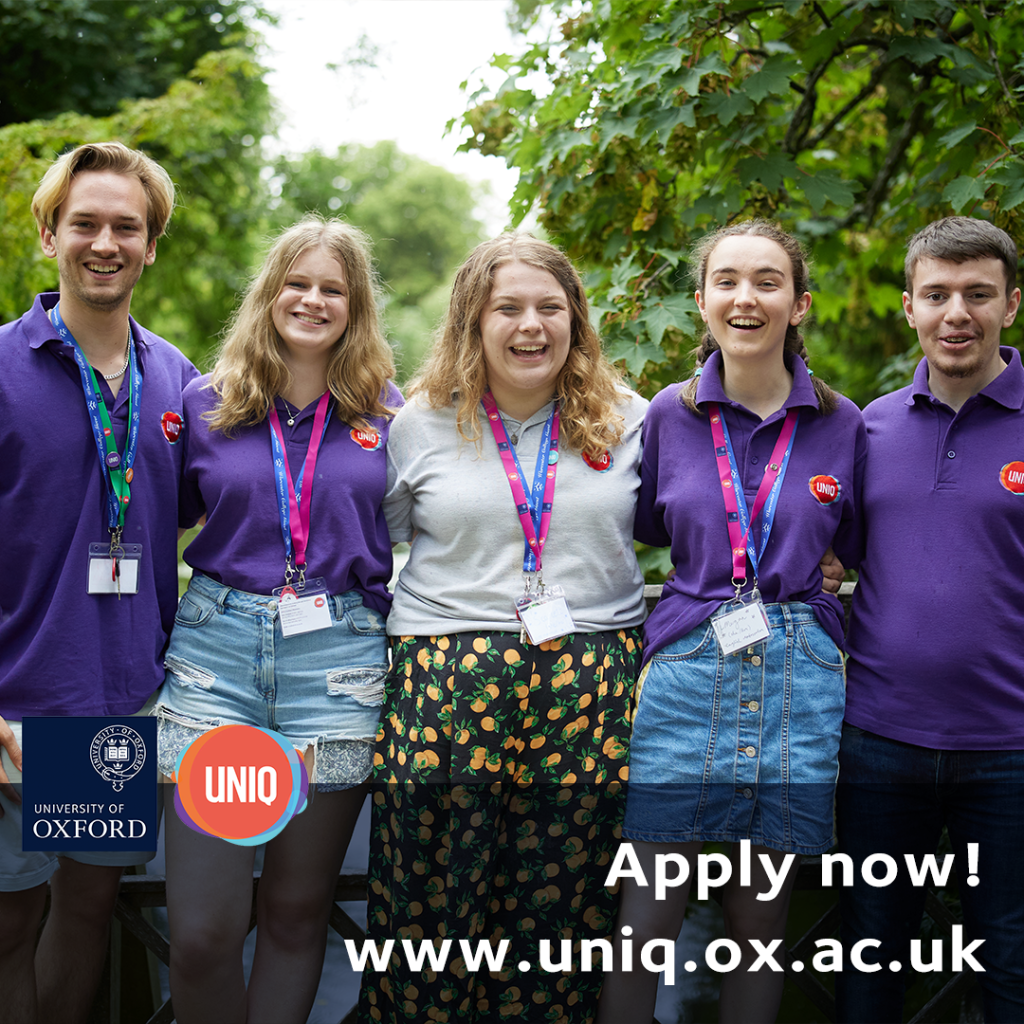
Will UNIQ help you shape your future? Apply now and find out!
What is UNIQ?
UNIQ is Oxford’s free access programme for UK state school students. Featuring a sustained contact programme and in-person summer residential, you’ll be taught by Oxford academics and explore subjects aligned with your academic interests. The programme encourages you to make friends with other UNIQ participants: you’ll meet them at regional events and live alongside them during the Oxford residential, where current undergraduates will also be supporting you and on hand to answer your questions about student life at Oxford. We’ll also support you to make a strong university application to a course at Oxford or elsewhere.
What Modern Languages courses are available?
For Modern Languages, there will be courses available for Spanish, French, and German taking place over the summer of 2026. Each varied course allows students to explore several exciting elements of degree-level language studies, such as language, literature, theatre, film, and linguistics, and provides the opportunity to experience a taster of two other European languages at beginners’ level.
How can I apply?
Applying is quick and simple – just register and fill out the form on the UNIQ website. It shouldn’t take you more than 15 minutes. Before you apply you should check that you meet our eligibility requirements and browse carefully the 30+ courses on offer to decide on your first and second choice.
Applications close on 13 January 2026. You can find out more about the programme and selection criteria on the UNIQ website (www.uniq.ox.ac.uk) and by following us on Instagram (@OxfordUNIQ). If you have any queries about the applications process, check out our FAQs or contact us at uniq@admin.ox.ac.uk.
*****
We’ll be back in January 2026 with more blog posts. In the meantime, we wish you a restful and peaceful festive period and a Happy New Year!
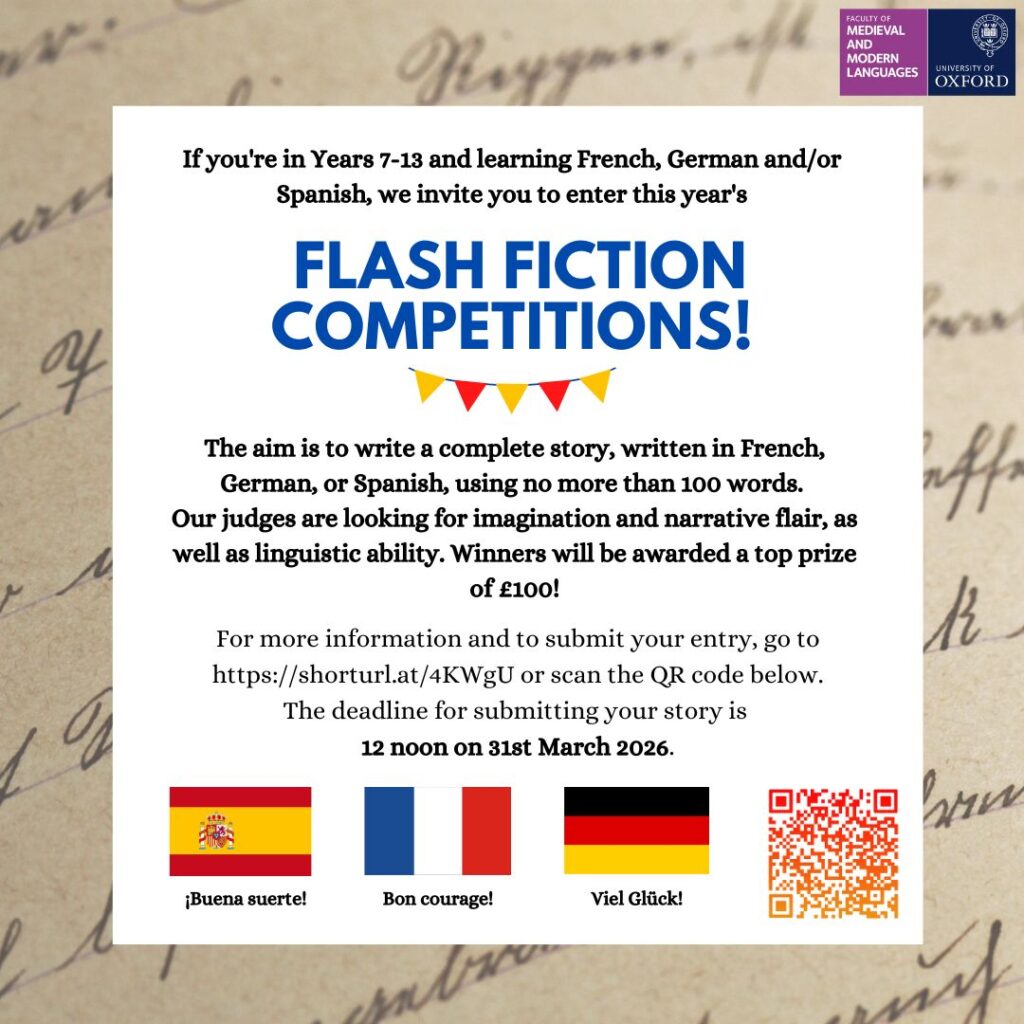
The Faculty of Medieval and Modern Languages is delighted to announce that this year’s Flash Fiction Competitions in French, Spanish and German are now open!
Our annual Flash Fiction Competitions invite secondary school pupils to submit a complete story of no more than 100 words, in French, Spanish, or German, for the chance to win up to £100.
Our 2026 Competition marks the first year in which German will be included and we’re excited to be expanding the Competition after many successful years!
Entries are judged by a panel of academics who are primarily looking for creativity, imagination and narrative flair, as well as linguistic accuracy. Pupils’ language skills will be considered in the context of their age and year group: in other words, we will not expect younger pupils to compete against older pupils linguistically. Each language competition is divided into three age categories:
Years 7-9 (ages 11-14)
Years 10-11 (ages 14-16)
Years 12-13 (ages 16-18)
The judges will award a top prize of £100, as well as prizes of £50 to a maximum of two runners up, in each category. Certificates will also be awarded to pupils who have been highly commended by our judges. Results as well as the winning, runner up, and highly commended stories will be published her on our blog if entrants give us permission to do so.
More information and links to the submission forms can be found on our website. Pupils may only submit one story per language but are welcome to submit a story in two or three languages if they would like to. For some inspiration, they can have a look at last year’s winning entries in French and Spanish.
Please note that pupils must enter the competition themselves: teachers cannot enter on their behalf for reasons of GDPR compliance.
On the blog this week, second year French and History student, Eleanor, talks about her internship in Mauritius!
This summer, I completed an internship on the beautiful island Mauritius – a wonderful melting pot of different languages and cultures. During Trinity term (the final term of the Oxford year), I, like many other students, was scrolling through Oxford’s careers website to find a meaningful way to spend my summer. At Oxford, we’re really lucky to have access to hundreds of summer internship opportunities, and a supportive careers service who want to help build your professional skills. I came across an advertisement for a children’s NGO, M-Kids Association, who were looking for Humanitarian Interns to come and help with the management of the charity. The advertisement specified that French-speakers were desirable, which also motivated me to apply. As a French student, I am always on the lookout for any chance to use and improve my language skills – especially in a non-European environment. Also having years of experience working with children and volunteering under my belt, I decided to apply.
After receiving my offer, I contacted the Oxford careers service to discuss funding options. Flights, accommodation, travel to the airport…Mauritius was not going to be cheap. However, I am very fortunate to be a receiver of Oxford’s Crankstart scholarship – a bursary which awards up to £3,200 to low-income students for unpaid or poorly paid internships. Oxford’s generous funding made this internship possible, which I am deeply grateful for.
I was initially really worried about travelling so far. I’d never been out of Europe alone, so a long-haul flight with a layover felt daunting. To calm my nerves, I spoke to members of staff at the airport, and asked them for help with checking in my bags correctly, finding the departure lounges and finding my seats on the planes. They were all more than happy to help me, which made me feel a lot more comfortable.
The charity is located near Port Louis, the capital of the country. Upon my arrival, I was instantly struck by the use of different languages. Officially, three languages are spoken in Mauritius: Créole (the most widespread), French and English. Out of French and English, my colleagues and the children I worked with tended to be most comfortable in French.
I was given my work tasks the day after arriving. I would be working with another Oxford intern to research the Mauritian curriculum and attainment levels to design a new programme of remedial classes for children in the local area. The other intern and I decided to focus on teaching maths and English, and we created engaging games to keep the children interested. We focussed on reinforcing the foundations of these subjects, such as common vocabulary in English and basic multiplication in maths.
The first twelve weeks of our programme would be a trial period to assess whether our games were working well. This included ‘maths hopscotch’ and drawing pictures to match up with English words. I taught mainly in French, but also encouraged some of the older children to speak English. This meant that my lessons were often a Franglais mix!
Any language learner would find working in Mauritius absolutely fascinating. My colleagues at the charity taught me basic phrases in Créole, such as ‘Ki manyèr ?’, which means ‘how are you?’. Tracking the developments in Mauritian Créole from French (for example, the phrase ‘Ki manyèr’ has developed from the French phrase ‘de quelle manière ?’) made me fully appreciate just how complex language can be. Language is always changing, and the way that languages are used today has been formed through historical events, such as colonisation
One of the key projects of the association is their ‘Share a Meal’ programme, in which they give free, hot and healthy meals to local children from low-income households. I really enjoyed taking part in this programme, as I felt fully integrated into Mauritian culture. The adults and children all prayed and ate together, and we carried out the Sunnah practice of sitting down to eat. I felt really lucky to be part of such a welcoming community and enjoyed learning from the children about their religious practices.
All religions exist in harmony in Mauritius. I visited Hindu temples, cathedrals and mosques whilst there. The colleagues at the charity were primarily Muslim, but they were still excited to show us other important places of worship. I really admired the respect between religions and how this makes up such a bright and interesting culture.
The experiences I’ve described make up only a fraction of my time in Mauritius – participating in an MMA lesson in Créole, meeting the British High-Commissioner to Mauritius and travelling widely were also highlights. My time here was one I will never forget, and my understanding of and love for other languages and cultures has grown significantly.
The 2025-26 edition of the Anthea Bell for Young Translators has commenced!
The Queen’s College Translation Exchange launched the Anthea Bell Prize for Young Translators in 2020. The competition is inspired by the life and work of the great translator Anthea Bell. It aims to promote language learning across the UK and to inspire creativity in the classroom. By providing teachers with the tools they need to bring translation to life, they hope to motivate more pupils to study modern foreign languages throughout their time at school and beyond.
The Anthea Bell Prize is free to enter and open to pupils aged 11-18 at all schools across the UK. The Prize currently offers French (into Welsh and English), German, Italian, Mandarin, Russian and Spanish.
The Translation Exchange wanted to make sure that this wasn’t a one-off event, but something that could be integrated into the year’s teaching. Before entering the competition, we invite you to prepare your students using their free teaching resources. Registered teachers receive teaching packs throughout the year, in the build up to the competition.
Register here to receive updates about the Prize, as well as access to free creative translation teaching resources.
The 2025-2026 Prize launched on 19 September 2025, in time for European Day of Languages (26 September) and International Translation Day (30 September). The 2025-2026 competition will run from 2 February to 27 March 2026. You can find the names of the 2024-2025 competition winners, runners-up and commendees here.
Information about the Anthea Bell Prize for Schools in Wales is also available in Welsh.
The Anthea Bell Prize left me wanting to delve further into the world of translation and the possibilities that come with it.
– Year 12 student participant, 2024 competition
Find more information and resources via the Translation Exchange website here.
A blog for school students and teachers and anyone else with an interest in Modern Languages and Cultures, written by the staff and students of Oxford University. Updated every Wednesday!
Data Protection: Like most websites, this site collects some user data in order to function properly.
In order to use this site we need you to consent to this by clicking I agree. I AcceptTell Me More
Privacy & Cookies Policy
Privacy Overview
This website uses cookies to improve your experience while you navigate through the website. Out of these, the cookies that are categorized as necessary are stored on your browser as they are essential for the working of basic functionalities of the website. We also use third-party cookies that help us analyze and understand how you use this website. These cookies will be stored in your browser only with your consent. You also have the option to opt-out of these cookies. But opting out of some of these cookies may affect your browsing experience.
Necessary cookies are absolutely essential for the website to function properly. This category only includes cookies that ensures basic functionalities and security features of the website. These cookies do not store any personal information.
Any cookies that may not be particularly necessary for the website to function and is used specifically to collect user personal data via analytics, ads, other embedded contents are termed as non-necessary cookies. It is mandatory to procure user consent prior to running these cookies on your website.