Category Archives: French

FRENCH FLASH FICTION 2026: THE WINNERS

We are delighted to publish the winning entries for this year’s French Flash Fiction competition. We’ll be publishing the winning entries for Spanish and German, as well as the runners up and the highly commended entries for both languages in each age category over the coming months.

Thank you and huge congratulations to everyone who entered! The French judging panel were extremely impressed with all the entries we received this year (over 550 of them!), and commented the following about the competition:

We have been really impressed by the inventiveness, courage, and linguistic flair shown by this year’s Flash Fiction Competition entrants. The winners, runners up, and commended entries demonstrated imagination, advanced vocabulary, and precise grammar to craft engaging, moving, or suspenseful narratives, all within the limits of 100 words.

We encountered a crime-fighting guinea pig, a rebellious swarm of insects, time capsules, apocalypses, many Mona Lisas, croissants, Monet’s garden, sentient bacteria, Nemo’s adventures abroad, talking teddy bears, battlefields both metaphoric and real, acrobats, celebrity frogs, airport encounters, surprise birthday cakes, atmospheric descriptions of the moon, and divinely ordained bins.

Your entries were a pleasure to read, and we are delighted to commend each one of you for your hard work and creativity. Our warmest congratulations to everyone for taking part! 

Without further ado, here are the winning stories! We hope you enjoy reading them as much as the judges did.

Years 7-9 winner

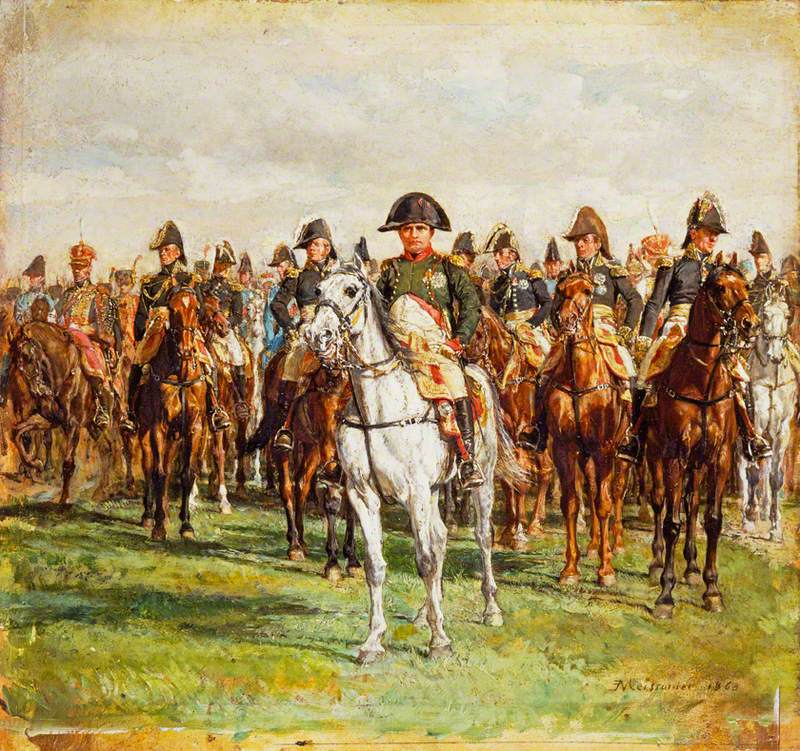
Derniers Jours à Sainte-Hélène

Meissonier, Jean Louis Ernest; Napoleon and his Staff; The Wallace Collection; http://www.artuk.org/artworks/napoleon-and-his-staff-209300

Un feu brûlait dans mon estomac, chaque souffle un halètement douloureux et rauque. Mon corps autrefois puissant n’est plus qu’une prison vivante. J’étais empereur! J’étais l’aigle qui a façonné des nations et ébranlé l’Europe. Quelle pitié maintenant dans cette prison isolée! Mes victoires, mon empire, ma légende – tout cela n’était plus qu’un coup d’épée dans l’eau. Les oiseaux volaient par paires, narguant ma solitude. Les navires britanniques m’encerclent comme des vautours, se moquant de ma gloire perdue. Je sens ma vie s’éteindre, comme mon triomphe s’efface. France… armée… tête de l’armée… Joséphine…

– Cindy Li, Year 9

Years 10-11 winner

Photo by John Murphey on Unsplash

Les deux Dauphins de France

Autrefois, il y avait deux Dauphins,
Les deux ont habité au Palais,
L’un à Versailles, L’autre à la Mediteranée,
Ils ont presidé leur domaine,
Mais bien qu’un commandât au champ de bataille,
Et était le prince de la terre,
L’autre s’est amusé dans l’eau
Et était le prince de la mer,
L’un a passé son temps en attendant un couronnement,
L’autre était hereux, il existe tout simplement
Finalement, leur destin est le même
L’un est mort dans l’intérêt de liberté
Et l’autre meurt à cause du réchauffement.

– Ranvir Sharma, Year 11

Years 12-13 winner

Photo by No Revisions on Unsplash

C’est presque le printemps. On voit le soleil danser dans les couloirs,

Quand Monsieur Aspirateur est sorti du placard, prêt pour la journée.

Il avale des miettes, des cheveux, même des coccinelles

Avec son souffle dans lequel les fragments d’histoires sont effacés.

Pendant la récré, les élèves se dépêchent de leur salle de classe

Tandis que les agents de nettoyage passent le sol couvert de poussière.

Dans son ventre, sous le filtre, c’est sombre et voilé

Où il cache des secrets d’hiver.

C’est presque le printemps. On se dégage pour fêter une nouvelle saison;

Monsieur Aspirateur ferme l’ancien chapitre.

– Julia Lee, Year 12

Félicitations à tous nos gagnants!

2026 Flash Fiction Competitions: The results

In December 2025, we launched our annual Flash Fiction competitions, which closed at the end of March. The competitions were open to students in Years 7 to 13, who were tasked with writing a short story of no more than 100 words in French, German and/or Spanish.

We had an incredible response, with entries coming in from all areas across the country! In total, we received over 1100 submissions across the three languages!

We would like to thank everyone who entered the competitions and commend you all for your hard work and creativity in writing a piece of fiction in a different language. This is a challenging exercise, and a significant achievement – congratulations all!

We are delighted to be able to announce the winners, runners up, and highly commended entries for each language below. We will be publishing the stories here on the blog over the summer so you can read them for yourselves.

French

In the Years 7-9 category, the winner is Cindy Li. The runners-up are Esme Pritchard and Shanzeh Masood.

The judges also identified the following entrants as highly commended: Ema Danileviciute; Mahek Amjad; Elisabetta Margherita Federici; Heritage Agbaje; Anah Imran; Iqra Zaheen; Veer Khanna; Eva Madan; Ayaan Banerjee; and Kimberley Woollard.

In the Years 10-11 category, the winner is Ranvir Sharma. The runners-up are Joseph Nebel and Honorée Wallis.

The judges also identified the following entrants as highly commended: Nandana Dhanabal; Henry Bodal Hansen; Myrtle  Mitchell; Yakshita Ramdhony; Victoria Wang; Chloe Shin; Djihane Ounissi; Aarush Lala; Aadi Jhawar; and Jack Bolton.

In the Years 12-13 category, the winner is Julia Lee. The runners-up are Salome Gvindadze and Francesca Bardou.

The judges also identified the following entrants as highly commended: Isla Thurlow; Jude Shalaby; Ines Amraoui; Isabelle Lake; Erin Grimsey; Alexander   Andrews; Caterina Ciniselli; Sherisa Johnson Rock; Henrietta Coningsby; and Sophie Agmen-Smith.

The French judging panel commented the following about all the entries:

We have been really impressed by the inventiveness, courage, and linguistic flair shown by this year’s Flash Fiction Competition entrants. The winners, runners up, and commended entries demonstrated imagination, advanced vocabulary, and precise grammar to craft engaging, moving, or suspenseful narratives, all within the limits of 100 words.

We encountered a crime-fighting guinea pig, a rebellious swarm of insects, time capsules, apocalypses, many Mona Lisas, croissants, Monet’s garden, sentient bacteria, Nemo’s adventures abroad, talking teddy bears, battlefields both metaphoric and real, acrobats, celebrity frogs, airport encounters, surprise birthday cakes, atmospheric descriptions of the moon, and divinely ordained bins.

Your entries were a pleasure to read, and we are delighted to commend each one of you for your hard work and creativity. Our warmest congratulations to everyone for taking part! 

German

In the Years 7-9 category, the winner is Rynad Mohudeen. The runners-up are Heritage Agbaje and Sophia Pfrang.

The judges also identified the following entrants as highly commended: Donald Kuhn; Eva Monica Buckingham; Eva Davies; Habibur Kazi; Kayden Jace Miraflor; Kenji Ronan; Lili May Kuhn; Muhammad Anwaar Ul Haq; Thomas Lawrance; and Vakish Indrajith.

In the Years 10-11 category, the winner is Mariia Slobodyanyuk. The runners-up are Amelia Sinclair and Anonymous.

The judges also identified the following entrants as highly commended: Ananya Patrick; Ananya Subramonian; Ariel Xu; Eleanor Ziegler-Tan; Elsa Rauschenbach; Eva Howells; Evelyn Roberts; Flora Boney; India Davie-Thornhill; and Luca Goolamali.

In the Years 12-13 category, the winner is Leah Holmes. The runners-up are Edith Taussig and Uma Ahluwalia.

The judges also identified the following entrants as highly commended: Alexander Howell; Alexandra Hampton; Ayaan Jilani; Charlotte Kenyon; Chloe Louet; Elisabeth Tillett; Ellis Underwood; Florence Datta; Isabella Young; and Tarannum Jayaswal.

The German judging panel commented the following about all the entries:

We were delighted to have received so many entries across a range of topics. Some stories led us into mystical realms and fairy-tale-like settings, while others offered new dimensions and dystopian glimpses at a future where robots and AI had taken over. At heart of all these often quite poetic stories was a deep emotional connection with the world, encompassing questions around the self and relationships with others, memories, hopes and dreams as well as the perspectives of animals. It was clear to see many entrants thinking carefully about the vocabulary and grammar structures they had been learning, and about how they could take risks with these to creative, poignant, or amusing effect. We found it heartening to see so many young Germanists engaging with fiction in such a palpably enthusiastic way, asking themselves how we narrate, how we connect with each other, and what we learn about German – and ourselves – in the process.

Spanish

In the Years 7-9 category, the winner is Alessia Jain. The runners-up are Rishaan Sharma and Lilac Eis.

The judges also identified the following entrants as highly commended: Lucio Angeli Stella; Anonymous; Anonymous; Ashvy Sasikumar; Ekamjot Kaur; Denis Rodriguez Sanmartin; Anonymous; Tara Hayhoe; and Ruby Ayetigbo.

In the Years 10-11 category, the winner is Alfie Bailey. The runners-up are Amelie Rahman and Maya Maimaris.

The judges also identified the following entrants as highly commended: Jemima Tapp; Clothilde Salord; Alexandros Pallett; Jasmin Leong; Malena Sievers Mayo; Maria Chowdhory; Sophie Blundell; Siena Gurjar; Anagha Abrol; and Aisha Balde.

In the Years 12-13 category, the winner is Lila Rock. The runners-up are Celia Guasch Bloomer and Nicole Kilby.

The judges also identified the following entrants as highly commended: Katerina Garcia; Olivia Slater; Paul Olusegun; Richard Hall; Sienna O’Keefe; Alexa Lewis-Banks; Ava Spillane; Anonymous; Bella Trafford-Barton; and Charles Romeu-Villalobos.

The Spanish judging panel commented the following about all the entries:

As in previous years, there were lots of very interestingly organized and thought-provoking entries. This year, we noticed quite a different at the level of theme – some were very funny, others, more sobering reflections on modern life. It was very difficult to decide the overall winners and runners up and there were a number of other stories that we would have liked to have commended too. The level of the Spanish seemed a little stronger than in previous years, which is testament to your hard work. ¡Seguid estudiando y escribiendo!

Huge congratulations everyone – you should be very proud of your achievement!

A year abroad in Lyon!

This week’s blog post is written by James, a French and Russian student who reflects on his time in Lyon as part of his year abroad experience...

I spent the first nine months of my year abroad living in Lyon, France, studying on Oxford’s exchange programme at the École normale supérieure de Lyon (ENS Lyon). Initially, I was somewhat sceptical about studying during my year abroad, imagining that I would envy my friends who had opted to teach, intern, or volunteer; however, this turned out not to be the case at all. I should really say that I ‘studied’ in France (in huge inverted commas), as, compared to the hectic Oxford schedule, I spent remarkably little time actually studying. This occupied a few hours a day for maybe three or four days of my week, conveniently clustered around the midweek so that I had extra-long weekends, which proved excellent for travelling across France.

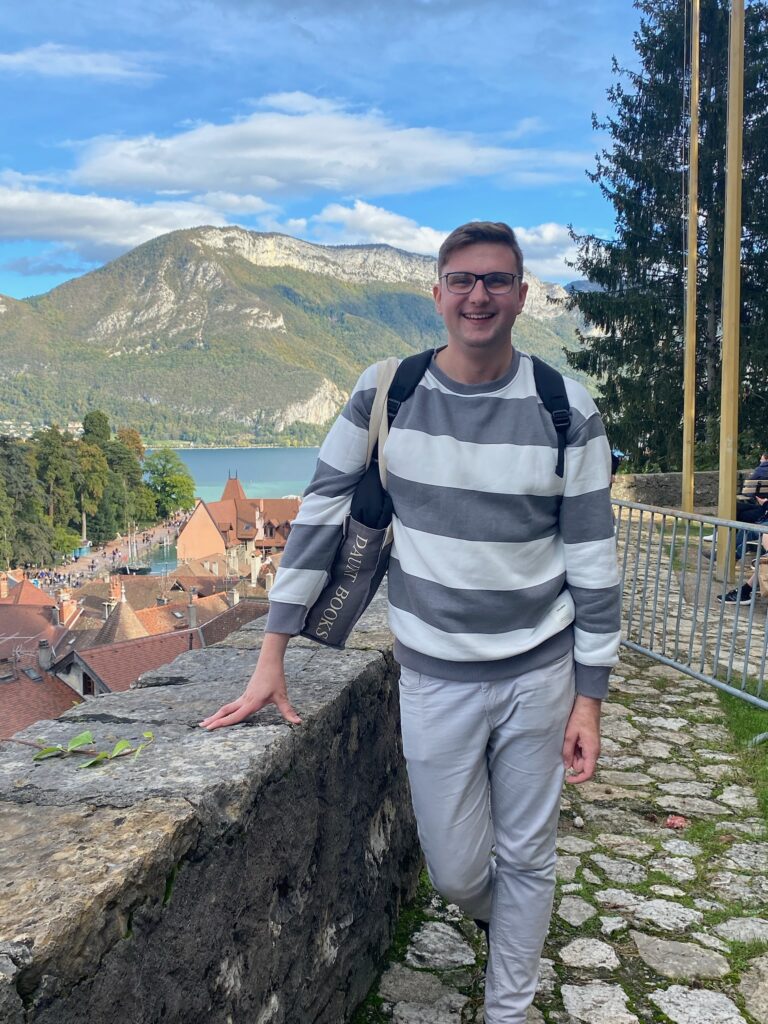
James in Annecy

During such weekends, I managed to visit many other places in France, from iconic Paris to Pérouges, a tiny medieval citadel not too far from Lyon. If my maths (and memory) is correct, I visited at least 15–20 other places in France, personal highlights of which included Nîmes, Annecy, Nice, and especially Strasbourg for the Christmas markets the week before Christmas. Lyon also benefits from good transport links to other European countries, so I also managed to visit Germany, Switzerland, Italy, Monaco, and Spain too – all relatively cheaply, and with friends I’d made at the university.

Whilst all this travelling was absolutely the highlight of my time in France, I did also really enjoy the university side of things. I enrolled doing a major in Russian, with a minor in contemporary French literature, and my classes were both fascinating, and a great opportunity to immerse myself in the French language and challenge my abilities, giving presentations to classes full of French students, or even translating literary texts between my two non-native languages, French and Russian.

Lovely Lyon

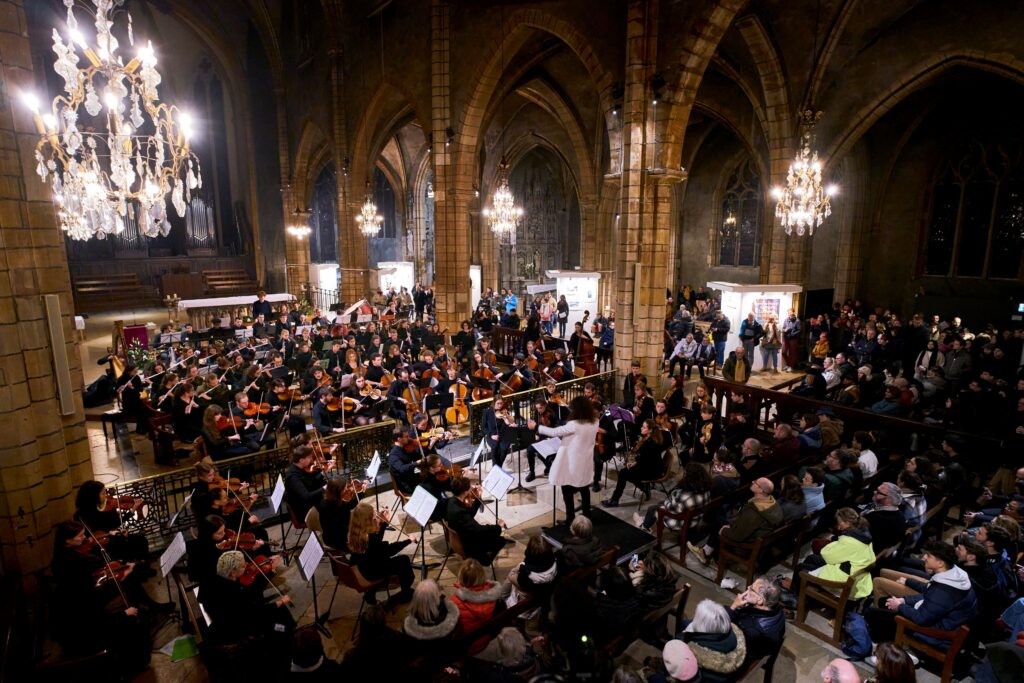
ENS Lyon is quite a small university, with two campuses about ten minutes apart on foot, and I found that this size made it quick and easy to settle in, meet people, and make friends. There was a really friendly atmosphere on the whole, and the university guaranteed accommodation for exchange students, so I got to live on campus and share a flat with French students. The accommodation itself is basic and not the most attractive in the world (though having come straight from an Oxford college perhaps skewed my perspective…), but it was incredibly cheap compared to Oxford – and made cheaper still by a French government subsidy, CAF, which was well worth the paperwork – meaning that I had plenty of money left from my student loan and Turing grant to fund my gallivanting across Europe on the long weekends. ENS Lyon also had a really active social scene, with regular ‘festives’ (basically BOPs à la française), ‘afterworks’ (French, believe it or not, for a weekday evening of drinks and a BBQ), a gala night, and plenty of extra-curricular activities. I joined the university orchestra and choir, and took beginner’s German classes too – but I had friends who did all kinds of sports, learnt to dance, and even joined the university’s beekeeping society.

James playing in a concert with Lyon’s university orchestra

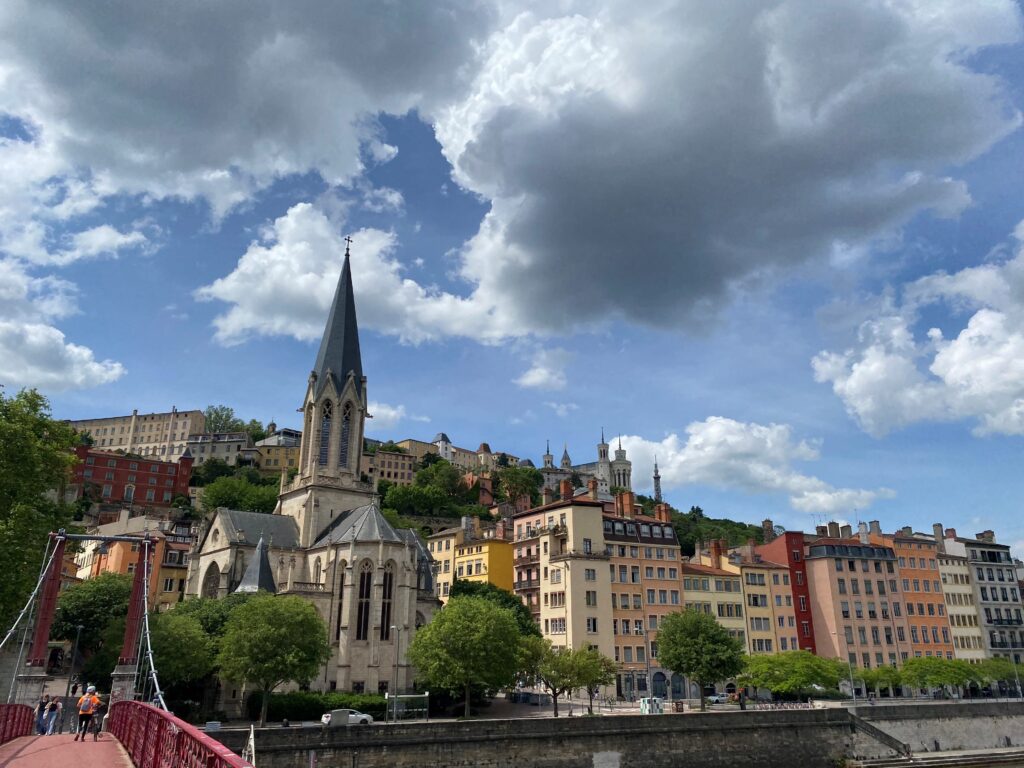
Lyon itself is now possibly my favourite city ever. I think it’s like the Goldilocks of French cities – not too big, not too small, not too hot, not too cold, not too English-speaking, not too critical of my occasionally very shoddy French (or very good Franglais, depending on your perspective), and it’s a truly beautiful city to live in. From the cobbled streets of the old town, Vieux Lyon, to the breathtaking Basilique de la Fourvière atop a hill overlooking the city, to the Parc de la Tête d’Or (with pedalos on the lake and a zoo – what more could you want?!), there was so much to see and do, as well as lots of cultural activities (museums, galleries, concerts, films, etc.) with really good student tickets.

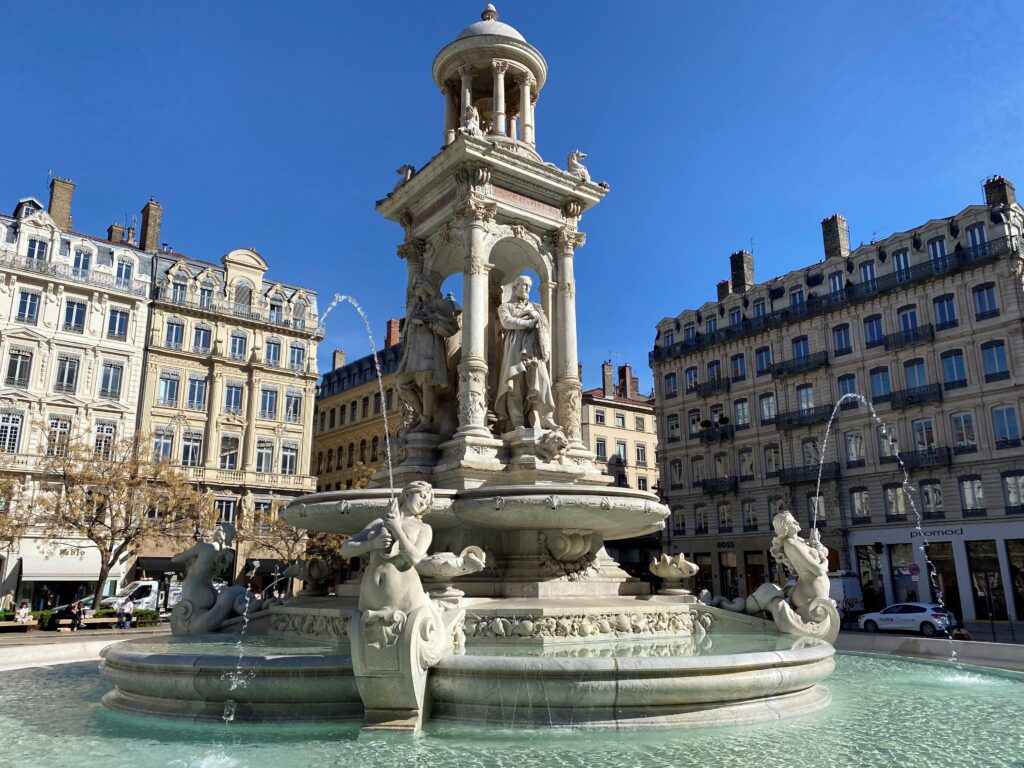
La Fontaine des Jacobins, Lyon

Although, of course, it took a little while to settle in, I soon felt completely at home in Lyon, so much so that I was very sad to eventually have to leave. Overall, my nine months in Lyon were some of the best of my life – it was transformative for my French language skills and cultural knowledge and appreciation, but more importantly I made great friends, saw so many amazing places, and left with nothing but incredible memories and a very full camera roll. And, as I discovered when I flew back home, 20kg of books I had ‘accidentally’ bought, perpetually unable to resist the allure of a good French bookshop.  

Modern Languages Taster Day – Balliol College

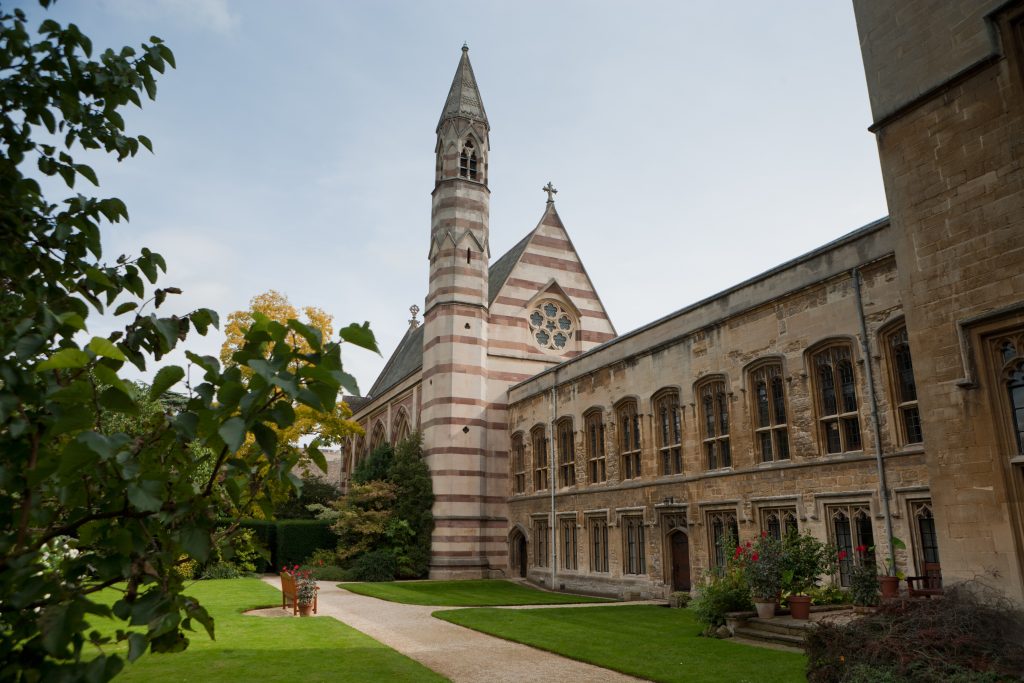
Balliol College are running a Modern Languages Taster Day on Monday 15th June. This will take place in person at the College.

Balliol College

The Taster Day is aimed at students in Year 12 who are seriously considering studying French, Italian, Spanish or Modern Languages and Linguistics at Oxford.

The event will include an admission session, lectures, a demonstration interview, and an opportunity to meet with undergraduates who are studying languages at Balliol. A two course hot lunch will be provided free of charge.

To apply to take part in this event, please complete this form by 24 May 2026. Balliol College will prioritise applications from disadvantaged students and from groups which are under-represented at the university.

If you have any questions about this event, please contact outreach@​balliol.​ox.​ac.​uk.

Virtual Modern Languages Study Day

Somerville College, Oxford offers an annual series of four virtual Study Days for Year 12 students attending a UK state school. 

Prospective students and their families look around Somerville College

These days feature taster lectures or workshops run by Oxford University academics, which will offer a challenging and entertaining introduction to university-level study of the subject. 

There will also be opportunities to hear advice from admissions and outreach staff about applying to Oxford and Cambridge, and to ask the college tutors and current undergraduates questions about their subject of interest.

The virtual Modern Languages Study Day will take place on Wednesday 18th February and the daily timetable for the day is as follows:

15:00-15:50: Admissions talk with Q&A
16:00-17:00: Academic taster session (attendees have a choice between 2 different subjects per day)
17:00-17:30: Subject Q&A with Academic and Student Ambassadors

The sessions are open to all Year 12 students at a UK state school who are considering a degree involving modern languages of any kind, whether that be French or another language.

For those still deciding what to apply for, we encourage you to attend in order to learn more about Modern Languages and what it might be like to study them at Oxford.

These sessions would also count as great examples of supercurricular activities, and might give you ideas about topics or further reading to include in the personal statement.

You can sign up for the Study Day here. The deadline for sign-ups is Monday 9th February at 9am. 

Please email access@some.ox.ac.uk with any questions.

Modern Languages Subject Taster Day

Happy New Year everyone! We hope you had a wonderful time and enjoyed the festivities over the Christmas holidays.

A new year brings new opportunities to explore your options of studying Modern Languages at Oxford.

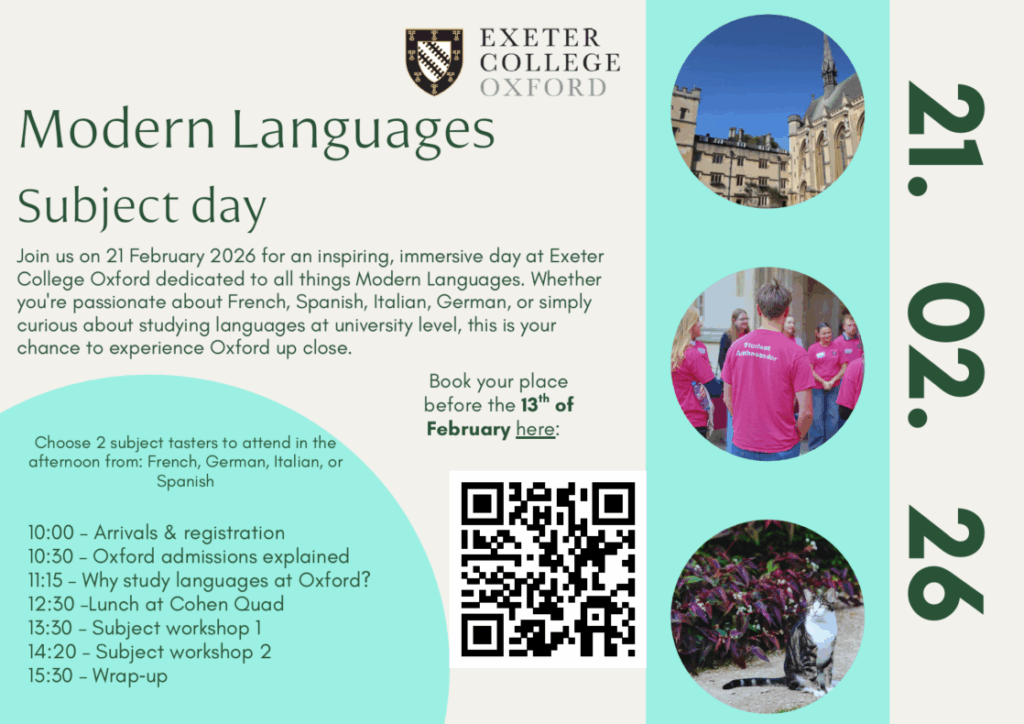
For example, on 21 February 2026, Exeter College is running an inspiring, immersive day dedicated to all things Modern Languages for Year 11 and 12 students.

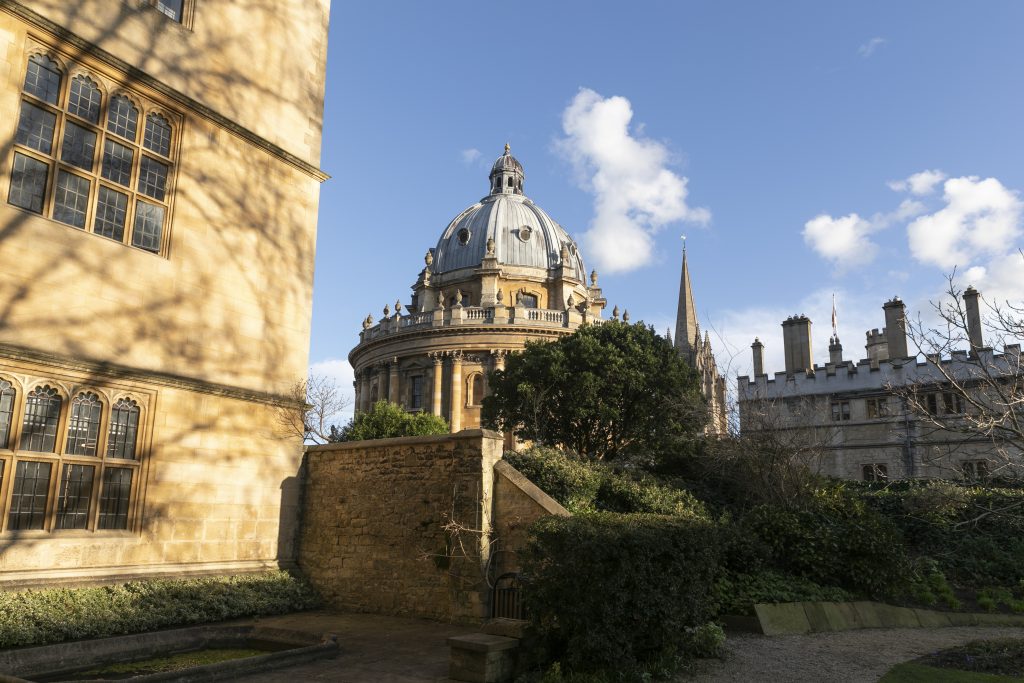
The Radcliffe Camera from Exeter College

Whether you’re passionate about French, Spanish, Italian, German, or simply curious about studying languages at university level, this is your chance to experience Oxford up close.

In the morning, you’ll explore the historic Turl Street site and gain a clear, insider’s view of the admissions process and what studying languages at Oxford is really like.

Across two afternoon sessions, you’ll take part in small‑group workshops led by Oxford tutors in French, Spanish, Italian, or German. Choose your languages, explore real academic material, and experience Oxford’s teaching style first-hand.

Apply here: Modern Languages Subject Day: Saturday 21 February 2026 – Fill in form. The form will close on 13 February 2026.

Subject Days are often oversubscribed and selection is based on academic merit and contextual factors. We warmly encourage applications from students who identify with any of the following criteria.

  • Students on Free School Meals.
  • Students from IMD Q1 and Q2 (*check your postcode at the link below)
  • Students who have been or are currently in care.

Please provide as many details about yourself to aid the shortlisting process.

The programme will be free of charge, lunch will be provided, and travel bursaries are available.

Questions can be directed to outreach@exeter.ox.ac.uk.

UNIQ 2026 – Applications now open!

Will UNIQ help you shape your future? Apply now and find out! 

What is UNIQ?

UNIQ is Oxford’s free access programme for UK state school students. Featuring a sustained contact programme and in-person summer residential, you’ll be taught by Oxford academics and explore subjects aligned with your academic interests. The programme encourages you to make friends with other UNIQ participants: you’ll meet them at regional events and live alongside them during the Oxford residential, where current undergraduates will also be supporting you and on hand to answer your questions about student life at Oxford. We’ll also support you to make a strong university application to a course at Oxford or elsewhere. 

What Modern Languages courses are available?   

For Modern Languages, there will be courses available for SpanishFrench, and German taking place over the summer of 2026. Each varied course allows students to explore several exciting elements of degree-level language studies, such as language, literature, theatre, film, and linguistics, and provides the opportunity to experience a taster of two other European languages at beginners’ level.

How can I apply?

Applying is quick and simple – just register and fill out the form on the UNIQ website. It shouldn’t take you more than 15 minutes. Before you apply you should check that you meet our eligibility requirements and browse carefully the 30+ courses on offer to decide on your first and second choice.  
 
Applications close on 13 January 2026. You can find out more about the programme and selection criteria on the UNIQ website (www.uniq.ox.ac.uk) and by following us on Instagram (@OxfordUNIQ). If you have any queries about the applications process, check out our FAQs or contact us at uniq@admin.ox.ac.uk.   

*****

We’ll be back in January 2026 with more blog posts. In the meantime, we wish you a restful and peaceful festive period and a Happy New Year!

2026 Flash Fiction Competitions now open!

The Faculty of Medieval and Modern Languages is delighted to announce that this year’s Flash Fiction Competitions in French, Spanish and German are now open!

Our annual Flash Fiction Competitions invite secondary school pupils to submit a complete story of no more than 100 words, in French, Spanish, or German, for the chance to win up to £100.

Our 2026 Competition marks the first year in which German will be included and we’re excited to be expanding the Competition after many successful years!

Entries are judged by a panel of academics who are primarily looking for creativity, imagination and narrative flair, as well as linguistic accuracy. Pupils’ language skills will be considered in the context of their age and year group: in other words, we will not expect younger pupils to compete against older pupils linguistically. Each language competition is divided into three age categories:

  • Years 7-9 (ages 11-14)
  • Years 10-11 (ages 14-16)
  • Years 12-13 (ages 16-18)

The judges will award a top prize of £100, as well as prizes of £50 to a maximum of two runners up, in each category. Certificates will also be awarded to pupils who have been highly commended by our judges. Results as well as the winning, runner up, and highly commended stories will be published her on our blog if entrants give us permission to do so.

More information and links to the submission forms can be found on our website. Pupils may only submit one story per language but are welcome to submit a story in two or three languages if they would like to. For some inspiration, they can have a look at last year’s winning entries in French and Spanish.

Please note that pupils must enter the competition themselves: teachers cannot enter on their behalf for reasons of GDPR compliance.

FAQs can be found here and any other questions can be directed to schools.liaison@mod-langs.ox.ac.uk.

The submission deadline is 12 noon on 31 March 2026.

Bonne chance à tous! ¡Buena suerte a todos! Viel Glück euch allen!

A summer internship in Mauritius

On the blog this week, second year French and History student, Eleanor, talks about her internship in Mauritius!

This summer, I completed an internship on the beautiful island Mauritius – a wonderful melting pot of different languages and cultures. During Trinity term (the final term of the Oxford year), I, like many other students, was scrolling through Oxford’s careers website to find a meaningful way to spend my summer. At Oxford, we’re really lucky to have access to hundreds of summer internship opportunities, and a supportive careers service who want to help build your professional skills. I came across an advertisement for a children’s NGO, M-Kids Association, who were looking for Humanitarian Interns to come and help with the management of the charity. The advertisement specified that French-speakers were desirable, which also motivated me to apply. As a French student, I am always on the lookout for any chance to use and improve my language skills – especially in a non-European environment. Also having years of experience working with children and volunteering under my belt, I decided to apply. 

After receiving my offer, I contacted the Oxford careers service to discuss funding options. Flights, accommodation, travel to the airport…Mauritius was not going to be cheap. However, I am very fortunate to be a receiver of Oxford’s Crankstart scholarship – a bursary which awards up to £3,200 to low-income students for unpaid or poorly paid internships. Oxford’s generous funding made this internship possible, which I am deeply grateful for.

I was initially really worried about travelling so far. I’d never been out of Europe alone, so a long-haul flight with a layover felt daunting. To calm my nerves, I spoke to members of staff at the airport, and asked them for help with checking in my bags correctly, finding the departure lounges and finding my seats on the planes. They were all more than happy to help me, which made me feel a lot more comfortable.

The charity is located near Port Louis, the capital of the country. Upon my arrival, I was instantly struck by the use of different languages. Officially, three languages are spoken in Mauritius: Créole (the most widespread), French and English. Out of French and English, my colleagues and the children I worked with tended to be most comfortable in French. 

I was given my work tasks the day after arriving. I would be working with another Oxford intern to research the Mauritian curriculum and attainment levels to design a new programme of remedial classes for children in the local area. The other intern and I decided to focus on teaching maths and English, and we created engaging games to keep the children interested. We focussed on reinforcing the foundations of these subjects, such as common vocabulary in English and basic multiplication in maths. 

The first twelve weeks of our programme would be a trial period to assess whether our games were working well. This included ‘maths hopscotch’ and drawing pictures to match up with English words. I taught mainly in French, but also encouraged some of the older children to speak English. This meant that my lessons were often a Franglais mix!

Any language learner would find working in Mauritius absolutely fascinating. My colleagues at the charity taught me basic phrases in Créole, such as ‘Ki manyèr ?’, which means ‘how are you?’. Tracking the developments in Mauritian Créole from French (for example, the phrase ‘Ki manyèr’ has developed from the French phrase ‘de quelle manière ?’) made me fully appreciate just how complex language can be. Language is always changing, and the way that languages are used today has been formed through historical events, such as colonisation

One of the key projects of the association is their ‘Share a Meal’ programme, in which they give free, hot and healthy meals to local children from low-income households. I really enjoyed taking part in this programme, as I felt fully integrated into Mauritian culture. The adults and children all prayed and ate together, and we carried out the Sunnah practice of sitting down to eat. I felt really lucky to be part of such a welcoming community and enjoyed learning from the children about their religious practices.

All religions exist in harmony in Mauritius. I visited Hindu temples, cathedrals and mosques whilst there. The colleagues at the charity were primarily Muslim, but they were still excited to show us other important places of worship. I really admired the respect between religions and how this makes up such a bright and interesting culture.

The experiences I’ve described make up only a fraction of my time in Mauritius – participating in an MMA lesson in Créole, meeting the British High-Commissioner to Mauritius and travelling widely were also highlights. My time here was one I will never forget, and my understanding of and love for other languages and cultures has grown significantly.

FREE Christmas Lectures for Year 13s

The Langton Language Centre, based at Simon Langton Girls’ Grammar School in Canterbury, is running an exciting series of online lectures aimed at Year 13 languages students.

These are a great opportunity to get a taste of studying languages at university and see if it’s for you!

These lectures are taking place from 8th to 19th December and are completely free. All lectures will take place in the evening, either from 18:00-19:00 or 19:00-20:00.

The programme of lectures can be found here. Lectures cover varied topics, from the French Revolution to Japanese films.

Students need to sign up individually via this form with just their school name. No personal details required!

For safeguarding reasons, microphones and cameras will be muted but students and lecturers will be able to interact via the chat. 

Please email David Stalley (dstalley@langton.kent.sch.uk) with any questions.