Category Archives: Uncategorized

SPANISH FLASH FICTION 2026: THE HIGHLY COMMENDED ENTRIES (Y7-9)

Following the publication of the winning and runner up entries, we are excited to present the highly commended entries for the Year 7-9 category of this year’s Spanish Flash Fiction competition!

A huge well done to all of our highly commended entrants!

****

La naturaleza se abre como un lugar tranquilo, un refugio donde todo brilla suavemente. La mariquita, roja como una fresa; el pez payaso, naranja como un lirio tigrado; la bocaraca amarilla, moviéndose en silencio; la oveja de mar, brillando en el mar oscuro; la rana dardo
azul, viva como un zafiro; la mariposa índigo, posándose en mi dedo; y la flabelina violeta, bailando entre las olas.

Entonces abro los ojos: ese arcoíris de vida sigue latiendo en mi mente, como si el mundo aún respirara en colores.

– Lucio Angeli Stella, Year 8

Las llaves siempre hacían ruido. Sonaban cuando se abría la puerta, cuando se cerraba, cuando alguien se iba. El reloj las escuchaba desde la pared, marcando cada segundo con paciencia. La puerta esperaba, inmóvil, sosteniendo historias que iban y venían.

El suelo sentía los pasos, algunos ligeros, otros cansados. La casa respiraba lentamente, guardando cada sonido en sus paredes.

Un día, las llaves no sonaron. El reloj siguió marcando el tiempo, pero todo parecía silencioso. La puerta permaneció cerrada. La luz no entró.

La casa entendió que a veces el silencio significa el fin.

– Ashvy Sasikumar, Year 9

Mi Clase de Cocina, ¡Qué Flipa!
¡La clase de cocina es lo más TOP! Siempre hay un jaleo total. Nos ponemos delantales, ¡listos para la comida! La Sra. Ralston escribe la receta, y yo copio todo súper rápido, ¡tope de emocionado! Pillamos las cosas: harina, huevos. ¡A la carga! Corto cebollas (¡me hacen llorar!). El cuchillo hace “chop, chop”. Mezclamos, batimos y probamos, ¡a ver si está rico! Huele súper bien. Es alucinante ver cómo cosas normales se convierten en comida buenísima, ¡es magia! Cuando mi plato sale del horno, calentito y burbujeando, ¡me siento súper GUAY! Lo hice yo. Me mola ver a mis colegas probar lo suyo. Cocina es aprender cosas divertidas y, lo mejor, ¡siempre comemos algo súper rico!

Ekamjot Kaur, Year 7

Largas dulces crujientes. Espeso rico delicioso. La frita masa de azúcar y mantequilla. La calidad del caliente chocolate. Solamente la estrella del recién cocinado chorro puede ir al lado del negro taza de sabor. Es tan delicioso. Tan rico, pero no raro ni caro. Hay una cosa que es tan buena como esto. Si quieres un sabor único para empezar tu día. Si quieres un desayuno rápido y delicioso de mucha energía. Esto es la única solución para ti. Comed unos increíbles churros con una más increíble copa de chocolate caliente. El sabor te espera.

Chocolate con churros.

– Denis Rodriguez Sanmartin, Year 7

Las Peonías

Bailaba en el prado mientras mi hermana, Valentina, corría. Entonces, tropecé y caí; lo último que vi fue una peonía brillante a mi lado.

Me arrastré por un pasadizo con suelos suaves y paredes cómodas: estaba dentro de un fuerte de cojines. Una luz apareció delante de mí: una peonía. Su dulce aroma me llamaba. Al tocar sus pétalos sedosos, aparecí en un prado soleado. El aire cálido del verano me rodeaba mientras saltaba feliz. Entonces alguien me llamó por mi nombre. Todo se desvaneció en la oscuridad.

“¿Marisol?”

Abrí los ojos.

“Marisol, has estado en coma durante tres años.”

– Tara Hayhoe, Year 8

La hermosa luna brillante que brilla en el cielo se esconde tras las nubes. Tiene miedo, pues siempre es menos preferida que el sol. Las estrellas susurraron su nombre, llamándola a salir. Pero la luna se sentía insegura. Una noche, un niño persigue algo en el bosque y se pierde. La luna lo ve y su luz tiembla. Pero decidió salir de las nubes y dejar que su luz brille, aunque no era tan fuerte ni tan querida como el sol. El niño entonces vio la luz brillante y la siguió a casa.

– Ruby Ayetigbo, Year 8

****

There were three highly commended entrants who did not consent to having their names and stories published on our blog.

MFL Teachers – we need you!

Here at Oxford, the Modern Languages Schools Liaison Team are looking to expand our teachers’ mailing list so that we can connect with and reach out to more schools across the UK.

We use our mailing list to send round semi-regular newsletters about upcoming events, outreach activities and opportunities for schools, such as Open Days, Study Days and one-off workshops. These are all related to Modern Languages and designed to promote the study of languages in schools so don’t worry, you will never be spammed with irrelevant content.

Photo by Nick Fewings on Unsplash

If you’re an MFL teacher, we would love for you to join our mailing list so we can keep you up-to-date with all the wonderful languages-related events and activities occurring at Oxford! If you’re already part of our mailing list, please do let you teacher friends and colleagues know about the list and how to sign up.

Signing up is really easy – all you need to do is email us at schools.liaison@mod-langs.ox.ac.uk. We’ve even drafted an email template for you to use to speed up the process:

Dear Schools Liaison Team,

My name is [insert name here] and I am an MFL Teacher at [insert school name here]. I would like to join your teachers’ mailing list and formally give my consent for you to hold my data for the purposes outlined below.

GDPR compliance statement: We are working to comply with the terms of the General Data Protection Regulations, and as such we want to ensure that you are aware of the ways in which we will be using/holding your data. We will hold the details you have provided to us (name, e-mail address, school name) in a secure environment, and will use them to send information by e-mail related to Modern Languages Schools Liaison at the University of Oxford. We will not pass these details on to external companies or individuals. We will hold the data until such time as you may ask to be removed from the lists – you may unsubscribe at any time and if/when you do so all the data you have provided will be deleted from our system.

Many thanks and best wishes,
[Insert name here]

*****

We look forward to welcoming you and your colleagues to our ever-growing network of MFL teachers!

German classic prize 2021

A German Classic 2021:

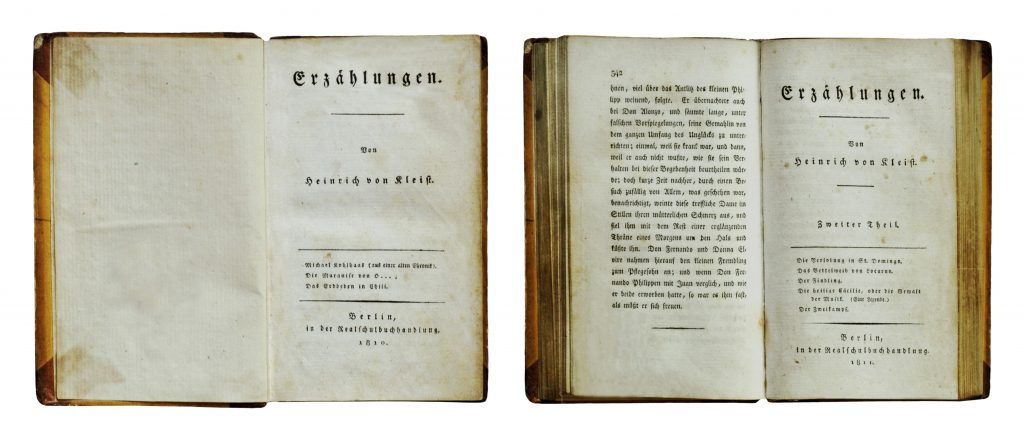
Heinrich von Kleist, Die Verlobung in St. Domingo

Participation Guidelines for Sixth Formers

We are delighted to announce the launch of the 2021 edition of ‘A German Classic’ – Oxford’s essay competition for sixth-form students. This year we would like to invite you to read with us one of the most influential German novellas of all time, Heinrich von Kleist’s Die Verlobung in St. Domingo (1811). The story is set in the Caribbean, in what is today the Republic of Haiti, at the time of the insurrection of self-liberated slaves against French colonial rule that led to the country’s independence in 1804. Against this dramatic historical background develops an ill-fated love story between Toni, a mixed-race teenage girl, and Gustav, a white traveller from Europe. Kleist’s take on race relations, civil unrest, and the power imbalance inherent in both colonial structures and gender dynamics has clear resonances in the twenty-first century. Told in Kleist’s signature narrative style, which has influenced countless writers since the nineteenth century, Die Verlobung in St. Domingo is an excellent introduction to German literature. We hope you will want to study it with us!

ELIGIBILITY

Entrants must fulfil the following requirements as of 15 September 2021:

  • be beginning their final year of full-time study at a secondary school in the UK (upper-sixth form, Year 13 or S6 in Scotland);
  • be between the ages of 16 and 18;
  • hold a GCSE, IGCSE or equivalent qualification in German offered in the UK, or have at least an equivalent knowledge of German, as confirmed by their teacher;
  • be resident in the United Kingdom.

Entrants are not, however, expected to have prior experience of studying German literature.

STUDY PACKS

Sign up at https://www.mod-langs.ox.ac.uk/mml_apps/community/public/form?id=ogn-classic-2021-signup by 12 noon, Friday, 25 June 2021 to receive free physical copies of the German original and an English translation of Kleist’s novella, as well as access to a set of free multimedia resources and essay writing guidelines created and curated by us especially for this competition. All study materials will be dispatched in early July.

PRIZES

Up to three prizes will be awarded: a first prize of £500, a second prize of £300, and a third prize of £100. Prizes will only be awarded if work is of sufficient merit. All entrants will receive a Prize Certificate or a Certificate of Participation. Results will be announced in early October 2021.

ESSAY QUESTIONS

Students can enter the competition by writing an essay of c. 1500 words answering one of the following questions:

  1. Why did Gustav not trust Toni? Discuss the breakdown of communication in Die Verlobung in St. Domingo.
  2. To what extent does Die Verlobung in St. Domingo offer a critique of European colonialism?
  3. How is the portrayal of race connected to the portrayal of gender in Die Verlobung in St. Domingo?
  4. Discuss Die Verlobung in St. Domingo as an ‘existential test case, designed to make the reader share in the protagonists’ anguish and question the explicability of human experience’ (Martin Swales).

SUBMISSION

Entries must fulfil the following requirements:

  • be submitted by 12 noon, Wednesday, 15 September 2021, via an online form available on the OGN website from 1 July 2021 – entries received by post, by email or after the deadline will not be considered;
  • answer one of the four essay questions listed above in c. 1500 words – the word count includes the footnotes, but excludes the bibliography;
  • be written in English, with quotations from Die Verlobung in St. Domingo in German;
  • have footnotes and a bibliography including all relevant works consulted;
  • use Times New Roman or Calibri 12 pt, margins of 1 inch, and numbered pages;
  • be submitted in one of the following formats: Microsoft Word document, Open Office document, or PDF;
  • be named in the following way: EntrantSurnameEntrantInitialGCP2021, e.g. BloggsJGCP2021;
  • be the work of the entrant without any additional help from staff, which needs to be confirmed by the entrant’s teacher via an online form available on the OGN website from 1 July 2021 by the submission deadline (12 noon, Wednesday, 15 September 2021); teachers will also be asked to state how long the entrant has been learning or speaking German.

JUDGING CRITERIA

The judges will consider the quality of intellectual and imaginative engagement with the work evident in the essay while taking account of the quality of understanding, analysis and argument, and – where appropriate – linguistic accuracy of the submission. They will also take account of prior opportunity to study German language and literature. The decision of the judges will be final, and no correspondence will be entered into.

QUERIES

If you have any questions, please email the Prize Coordinator, Dr Karolina Watroba, at germanclassic@mod-langs.ox.ac.uk.

Image credit: Foto © H.-P.Haack.

French flash fiction results 2021

We recently launched our annual Flash Fiction Competition, which closed in March. The competition was open to students in Years 7 to 13, who were tasked with writing a short story of no more than 100 words in French. We had a brilliant response, with entries coming in from across the UK and beyond, and in total we had more than six hundred submissions.

The judges were very impressed with the quality of the entries. We would like to thank everyone who entered the competition and commend you all for your hard work and creativity in writing a piece of fiction in a different language. This is a challenging exercise, and a significant achievement.

We are pleased to say we are now in a position to announce the winning entries.

In the Years 7-11 category, the winner is Cormac Mitchell in Year 7. The runner-up was Nandhitha Agilan in Year 9.

The judges also highly commended Scarlett Chappell, Marina Yu, Mairead Mitchell, Juliette Shaw, Adam Noad, Ava Preston, Chung Yu Kwok, Emily Seager, Alice Hadwen-Beck, and Gabriela Duniec.

In the Years 12-13 category, the winner is Chung Sze Kwok in Year 12. The runner-up was Holly Singleton in Year 12.

The judges also highly commended Harrison Cartwright, Elishe Lim, Joseph Oluwabusola, Safiyah Sillah, Teniola Ijaluwoye, Jamilya Bertram, Benjamin Fletcher, Charles Blagburn, Jamie Hopkins, and Allie Gruber.

Félicitations ! If anyone is curious to read the winning entries, we will be publishing them in the coming weeks. Congratulations to our winners, once again!

Artificial Intelligence in the World of Languages

This post originally appeared on the Creative Multilingualism blog, an AHRC-funded research project that explores the role of creativity in language learning.

What role will Artificial Intelligence play in the world of languages – will it be an opportunity or a threat for language learners? What impact might AI have on endangered languages? Will machine translation ever replace the need for language learning?

In September 2019, Creative Multilingualism worked in partnership with the University of Pittsburgh and JNCL (Joint National Committee for Languages) to hold a workshop on the topic of Artificial Intelligence in the World of Languages.

The event brought together academics, teachers and leaders in tech and AI to discuss the impact of improvements in machine translation and language learning technology on future language learners, teachers and speakers of endangered languages.

Watch the below film to hear from the workshop’s participants on three key questions:

  1. Is AI a threat or an opportunity for language learning?
  2. Could Google Translate replace the need for language learning?
  3. Why should we learn languages?

What do you think? Are the machines going to replace us?

A Year Abroad on the Côte d’Azur

This post was written by Charlotte, who studies French at Worcester College. Here, Charlotte tells us about her year abroad in France.

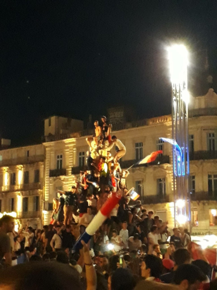
2018 was an exciting time to be in France for a year abroad. Over the summer temperatures rose in France with the thrill of the World Cup. Bars were brimming with enthused fans, roars matched every goal and with each win the streets became crowded with waving flags, trumpets and cheers of “Allez les bleus!”. In Montpellier, French football fans climbed on historic monuments and beeped car horns throughout the night. When I was caught watching a football match on my computer at work my boss sat down and joined!

In Montpellier there was a heatwave, or canicule, that summer so I spent my time between the beach and a natural lake, both of which were easy to get to by the tram system running through the city. It was warm enough to swim in the ocean up until the end of September! Every Friday in August there was a wine festival Les Estivales with live music and a range of food stands, every Wednesday there was a firework display at the beach, and every evening in the park Peyrou students relaxed in the cool evening, sometimes playing sport or dancing to music.

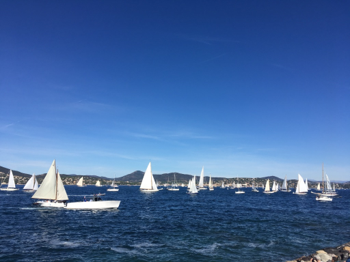
Autumn was an important time for me as I was working in a yacht brokerage, and autumn is the season of boat shows so I got to work on the marketing of several yachts across various regions in the South of France. September is also the season of Les Voiles de St-Tropez, a sailboat race in St.Tropez which attracts yachting teams from across the world to compete in.

Winter in Montpellier is very special. The Christmas markets opened at the beginning of December, and their opening was celebrated by a huge light show which saw historic buildings lit up with dazzling light projections.

Winter season also coincided with the beginning of the gilets jaunes movement in France, an important event which saw the President, Emmanuel Macron, cave to the demands of the protestors. A year later they are still to be seen on the streets of Paris. At a practical level, it meant that there was less food in the supermarket and it was more difficult to drive to places. Some students I met there got involved with the protests, it was a chance to engage in French social and political issues beyond reading about them in Le Monde.

Years abroad are not a holiday – I was working a full-time job! – but they are an opportunity to make the most of local events and culture which is not always possible in Oxford with the workload and tight deadlines. Towns and regions have different personalities throughout the year, and living abroad allows you to see and experience them all, getting to engage with language and culture beyond the textbook.

Languages at University – not just for specialists

This post was written by Marion Sadoux, Head of Modern Language Programmes at the University of Oxford Language Centre. Here, Marion explains what the Language Centre does, and interviews a current student, Hannah, who is studying History of Art.

Most universities have a Language Centre – this is where you will find the largest body of language learning taking place in the UK; this is also where many make up for lost time and opportunities. Here at Oxford, the Language Centre works closely with divisions, faculties, or departments to develop courses that specifically support, widen or enhance a specific field of study – whilst also offering general courses that support employability and international mobility. Students know that these courses offer a precious boost to their studies and future careers.

Marion Sadoux, Head of Modern Language Programmes for the Language Centre at Oxford University met up with Hannah Healey, a secondyear student on a BA History of Art course and an avid language learner who is keen to make the most of these opportunities to widen her horizons.  In her first year, Hannah joined the Language Centre on a compulsory course in Italian for Art Historians (French is also available, and German will soon be an option too).

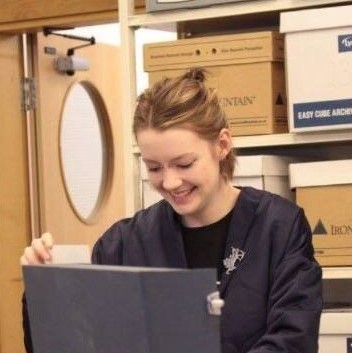
Hannah hard at work

In your first year, a specialist reading course was compulsory. How did you feel about that?

I think this is a wonderful opportunity and it has an enormous appeal to others too.  When I work as a student ambassador on the University Open Days, I get a lot of questions by prospective students about whether or not they will be able to continue with their language study when they come here and they are really happy to hear about this course and about the other opportunities through the Language Centre.  Thinking back on the course itself, I remember how at the beginning we all thought it was impossible that we would be able to read specialist texts and sources from the Renaissance by the end of the year… but we did it.  It was amazing and so good to build confidence.

Why do you think that learning languages is so important alongside a subject like History of Art?

For a start, if you look at any kind of job description for a curator or a researcher you will see that you need at least another European language.  In America for all the postgraduate courses in this field, you need German; you need to be able to read German.  Art History as a discipline has really important foundations in 1840’s Germany, a lot of core texts are in German and still today as much as is published in English is also published in German. There is a lot that you cannot access without reading German, because not all of it is available in translation, so there are huge areas that you cannot access if you can’t at least read the language.

You are now continuing with French which you studied at A Level, taking a Historian’s specialist course, in addition to a beginner’s course in German.  For German, you chose a comprehensive course rather than an academic reading course, why?

I do like to speak and write a language as well, I find it really interesting, so I like to do a bit of everything.  For German, I did learn it a little bit at school for two years. They stopped doing German at my school at this point but I didn’t actually like it at the time, I didn’t remember much of it because I didn’t actually enjoy it, nothing of it has stuck with me at all so that is why I have had to start with it right from the beginning again.  Now that I am older, I have been to Berlin and my husband would like to live there one day as well. I would really like to be able to speak it as well although it is primarily for an academic reason.   

I think it is really nice learning later in life because everyone who is there is really interested so the atmosphere of the class is really great.  In the French class (for Historians) I get to meet people on a similar course but in different colleges that I would not meet otherwise and in the German class it is great to have people doing PhDs in Chemistry – it makes it a nice break from your coursework.

Hannah has much to say about the importance of learning languages for global citizenship – what it means for her future. She also knows that any language learning she may need to do after she leaves University might be very expensive and time consuming – so for next year in Oxford she plans to make the most of the Language Centre and learn Spanish. 

Career profile: becoming a lawyer

This week we hear from another Modern Languages graduate from Oxford, Elen Roberts. Originally from Cardiff, Elen studied French and German at St Anne’s College and is now a Trainee Solicitor at Marriott Harrison LLP, London. 

I studied French and German at St Anne’s College from 2008 until 2012. I spent my year abroad in Munich, Nantes and Grenoble (15 months in total, as I did not spend either summer at home) where I worked as a marketing intern, au pair and translator respectively. The year abroad was without doubt one of the most enriching periods of my life, as I got to travel all around France and Germany and meet so many new and interesting people.

After graduating I undertook a TEFL course in Cardiff (my home city) and then taught English for two years at various private schools and universities in Hamburg and Berlin. My first teaching job was actually at Hamburg’s French Lycée! It goes without saying that my language skills came in useful there, as I was switching between English, French and German on a daily basis to teach different groups of children of various ages.

I then came back to the UK and did the law conversion course, which took a further two years. I am now in my final few months of training to be a solicitor at a small City firm, Marriott Harrison LLP. Although we are mainly instructed on UK matters, some of our deals and disputes have a foreign element where my French and German skills have come in very handy. So far, I have been asked to translate email correspondence, and analyse the corporate documents of various French, German and Swiss companies and then explaining them to senior colleagues. This has saved the firm the time and expense of having to hire professional translators and getting them to sign non-disclosure agreements. (A lot of our work is confidential).

In a nutshell, if you are considering a career in the law, or any field where you would have to engage with foreign businesses, a working knowledge of European languages is most definitely an asset!

How much is too much reality?

In May The Oxford Centre for Comparative Criticism and Translation, and St Anne’s College hosted a discussion between two of the best-known novelists writing in Spanish today, Javier Cercas and Juan Gabriel Vásquez. Beginning as an introduction to their recent publications, the conversation evolved into an exciting reflection on the role of storytelling in a post-truth age…

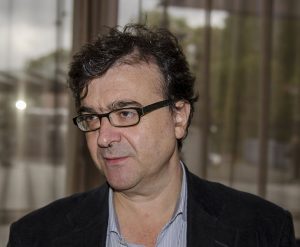
Javier Cercas at the Gothenburg Book Fair 2014. Photo by Albin Olsson, from Wikimedia Commons

Javier Cercas gave an insight into his 2014 novel, El Impostor (The Impostor), which tells the story of Enric Marco Battle, a trade unionist who became famous in Spain as a survivor of the concentration camps Mauthausen and Flossenbürg. Battle became a spokesperson for Spanish survivors of the Holocaust and was a prominent voice against Fascism. However, in 2005 it was revealed that Battle had deceived the public about his experience of the war and had never been held in a concentration camp. He was, in effect, an impostor.

Vásquez introduced his 2015 novel, La forma de las ruinas (The Shape of the Ruins), which traces two political assassinations in Colombia’s history: that of General Rafael Uribe Uribe, a senator and civil war veteran killed in 1914; and that of Jorge Eliécer Gaitán, a leader of the Liberal party and presidential candidate at the time of his murder in 1948. Vásquez’s novel includes a character called Carlos Carballo, a conspiracy theorist who believes the two crimes are linked, not only to one another, but also to the assassinations of John and Robert Kennedy.

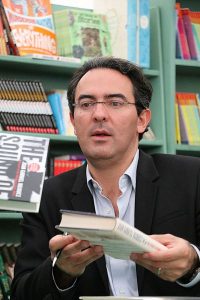
Juan Gabriel Vásquez at the Hay Festival 2016. Photo by Andrew Lih (User:Fuzheado), from Wikimedia Commons

Both novels, then, might to some degree be considered historical fiction, taking their storylines from history but marrying this with the imagination to create a version of the past that is closer to what we might expect from fiction. However, the two writers use their novels to problematise this genre, questioning the role fiction can play in an era of alternative facts.

The writers consider the figure of the fantasist, asking what motivates a fantasist to invent alternative scenarios and why such figures are believed. This begs the question, is the novelist a kind of fantasist? And if you can have a factual novel, what is it that makes it a novel, a work of the imagination?

Vásquez suggests that fantasists are fascinated by stories, by creating narrative out of the past as a way to meet their personal objectives. They are detectives of a kind, and the novel is a means of probing reality and humanity. As Ford Madox Ford said, the novel is a ‘medium of profoundly serious investigation into the human case.’ Cercas, meanwhile, draws a distinction between the different fantasists presented in the two novels: on the one hand, Battle, who distorts history to amplify or falsify his own role within it; on the other, Carballo, who cannot accept that history doesn’t make sense and is ‘a tale told by an idiot, full of sound and fury, signifying nothing’ (a reference to Shakespeare’s Macbeth), and therefore looks endlessly for connections in an effort to find the meaning in history.

What do both fantasists tell us about our relationship to narratives of the past though? Perhaps that history becomes more palatable when it is presented in the form of a story. Between the lack of a story and a lie, we prefer the lie and, to go a step further, when we are dealing with the worst elements of history, we try to mask it with narrative.It is for this reason, Cercas suggests, that General Charles de Gaulle aimed to convince French people that they had all been ‘résistants’ during the war, for, he said, ‘Les Français n’ont pas besoin de la vérité’ [French people do not need the truth].

In the current climate, we find other words for lying, referring to distortions of the truth as ‘alternative facts’. Social media allows us to create alternative chains of events and, for the first time, we have the impression of being able to choose the version of reality we want to hear. Consequently, people who are adept at manipulating storytelling have power. Vásquez points out that the German writer and philosopher Novalis asserted that ‘novels arise out of the shortcomings of history.’ The novel goes where history cannot, reframing history as a narrative that can be edited, manipulated, and used to dominate the political moment. This is because, in the words of the poet T. S. Eliot, ‘humankind cannot bear very much reality.’

It seems, therefore, that our present moment is defined by narratology, by storytelling. What do you think – are we facing a battle for the story?