Category Archives: German

2026 Flash Fiction Competitions: The results

In December 2025, we launched our annual Flash Fiction competitions, which closed at the end of March. The competitions were open to students in Years 7 to 13, who were tasked with writing a short story of no more than 100 words in French, German and/or Spanish.

We had an incredible response, with entries coming in from all areas across the country! In total, we received over 1100 submissions across the three languages!

We would like to thank everyone who entered the competitions and commend you all for your hard work and creativity in writing a piece of fiction in a different language. This is a challenging exercise, and a significant achievement – congratulations all!

We are delighted to be able to announce the winners, runners up, and highly commended entries for each language below. We will be publishing the stories here on the blog over the summer so you can read them for yourselves.

French

In the Years 7-9 category, the winner is Cindy Li. The runners-up are Esme Pritchard and Shanzeh Masood.

The judges also identified the following entrants as highly commended: Ema Danileviciute; Mahek Amjad; Elisabetta Margherita Federici; Heritage Agbaje; Anah Imran; Iqra Zaheen; Veer Khanna; Eva Madan; Ayaan Banerjee; and Kimberley Woollard.

In the Years 10-11 category, the winner is Ranvir Sharma. The runners-up are Joseph Nebel and Honorée Wallis.

The judges also identified the following entrants as highly commended: Nandana Dhanabal; Henry Bodal Hansen; Myrtle  Mitchell; Yakshita Ramdhony; Victoria Wang; Chloe Shin; Djihane Ounissi; Aarush Lala; Aadi Jhawar; and Jack Bolton.

In the Years 12-13 category, the winner is Julia Lee. The runners-up are Salome Gvindadze and Francesca Bardou.

The judges also identified the following entrants as highly commended: Isla Thurlow; Jude Shalaby; Ines Amraoui; Isabelle Lake; Erin Grimsey; Alexander   Andrews; Caterina Ciniselli; Sherisa Johnson Rock; Henrietta Coningsby; and Sophie Agmen-Smith.

The French judging panel commented the following about all the entries:

We have been really impressed by the inventiveness, courage, and linguistic flair shown by this year’s Flash Fiction Competition entrants. The winners, runners up, and commended entries demonstrated imagination, advanced vocabulary, and precise grammar to craft engaging, moving, or suspenseful narratives, all within the limits of 100 words.

We encountered a crime-fighting guinea pig, a rebellious swarm of insects, time capsules, apocalypses, many Mona Lisas, croissants, Monet’s garden, sentient bacteria, Nemo’s adventures abroad, talking teddy bears, battlefields both metaphoric and real, acrobats, celebrity frogs, airport encounters, surprise birthday cakes, atmospheric descriptions of the moon, and divinely ordained bins.

Your entries were a pleasure to read, and we are delighted to commend each one of you for your hard work and creativity. Our warmest congratulations to everyone for taking part! 

German

In the Years 7-9 category, the winner is Rynad Mohudeen. The runners-up are Heritage Agbaje and Sophia Pfrang.

The judges also identified the following entrants as highly commended: Donald Kuhn; Eva Monica Buckingham; Eva Davies; Habibur Kazi; Kayden Jace Miraflor; Kenji Ronan; Lili May Kuhn; Muhammad Anwaar Ul Haq; Thomas Lawrance; and Vakish Indrajith.

In the Years 10-11 category, the winner is Mariia Slobodyanyuk. The runners-up are Amelia Sinclair and Anonymous.

The judges also identified the following entrants as highly commended: Ananya Patrick; Ananya Subramonian; Ariel Xu; Eleanor Ziegler-Tan; Elsa Rauschenbach; Eva Howells; Evelyn Roberts; Flora Boney; India Davie-Thornhill; and Luca Goolamali.

In the Years 12-13 category, the winner is Leah Holmes. The runners-up are Edith Taussig and Uma Ahluwalia.

The judges also identified the following entrants as highly commended: Alexander Howell; Alexandra Hampton; Ayaan Jilani; Charlotte Kenyon; Chloe Louet; Elisabeth Tillett; Ellis Underwood; Florence Datta; Isabella Young; and Tarannum Jayaswal.

The German judging panel commented the following about all the entries:

We were delighted to have received so many entries across a range of topics. Some stories led us into mystical realms and fairy-tale-like settings, while others offered new dimensions and dystopian glimpses at a future where robots and AI had taken over. At heart of all these often quite poetic stories was a deep emotional connection with the world, encompassing questions around the self and relationships with others, memories, hopes and dreams as well as the perspectives of animals. It was clear to see many entrants thinking carefully about the vocabulary and grammar structures they had been learning, and about how they could take risks with these to creative, poignant, or amusing effect. We found it heartening to see so many young Germanists engaging with fiction in such a palpably enthusiastic way, asking themselves how we narrate, how we connect with each other, and what we learn about German – and ourselves – in the process.

Spanish

In the Years 7-9 category, the winner is Alessia Jain. The runners-up are Rishaan Sharma and Lilac Eis.

The judges also identified the following entrants as highly commended: Lucio Angeli Stella; Anonymous; Anonymous; Ashvy Sasikumar; Ekamjot Kaur; Denis Rodriguez Sanmartin; Anonymous; Tara Hayhoe; and Ruby Ayetigbo.

In the Years 10-11 category, the winner is Alfie Bailey. The runners-up are Amelie Rahman and Maya Maimaris.

The judges also identified the following entrants as highly commended: Jemima Tapp; Clothilde Salord; Alexandros Pallett; Jasmin Leong; Malena Sievers Mayo; Maria Chowdhory; Sophie Blundell; Siena Gurjar; Anagha Abrol; and Aisha Balde.

In the Years 12-13 category, the winner is Lila Rock. The runners-up are Celia Guasch Bloomer and Nicole Kilby.

The judges also identified the following entrants as highly commended: Katerina Garcia; Olivia Slater; Paul Olusegun; Richard Hall; Sienna O’Keefe; Alexa Lewis-Banks; Ava Spillane; Anonymous; Bella Trafford-Barton; and Charles Romeu-Villalobos.

The Spanish judging panel commented the following about all the entries:

As in previous years, there were lots of very interestingly organized and thought-provoking entries. This year, we noticed quite a different at the level of theme – some were very funny, others, more sobering reflections on modern life. It was very difficult to decide the overall winners and runners up and there were a number of other stories that we would have liked to have commended too. The level of the Spanish seemed a little stronger than in previous years, which is testament to your hard work. ¡Seguid estudiando y escribiendo!

Huge congratulations everyone – you should be very proud of your achievement!

German Olympiad Round 2

Following our post about Oxford’s annual German Olympiad, we are delighted to announce that Round 2 of the Competition is now open for entries!

There are three new exciting tasks for pupils in Years 8 to 12, as well as our prestigious Camden House Book Proposal for postgraduates and early-career researchers at a UK university.

To clarify: Round 1 and Round 2 are separate competitions. You may enter both, but do not need to have entered Round 1 in order to enter Round 2.

Entries should be submitted via the online form. Please note that we cannot accept postal or email entries. Entries received by post, by email or after the deadline will not be considered.

The deadline to submit your entries is 26 March 2026 at 12 noon.

Results will be published on our website in June 2026. Winners and runners-up will be contacted by email and invited to a prize-giving ceremony at the Bodleian Library, University of Oxford, in June 2026.

 If you have any questions please contact the Olympiad Coordinator at  olympiad@mod-langs.ox.ac.uk.

P.S. There’s still time to also enter Round 1 of the Oxford German Olympiad 2026!

Beginners’ Languages Taster Day 2026

On Saturday 7th March 2026, the Faculty of Medieval and Modern Languages will be holding its annual Beginners’ Languages Taster Day, an event dedicated to our beginners’ languages courses. This event offers students from UK secondary schools in Year 12 or equivalent an opportunity to gain greater insight into studying a language from scratch at Oxford. Students in Year 11 who are starting to consider their options for university are also welcome to attend.

Our beginners’ languages degree courses offer an exciting and rare opportunity for undergraduates to study a new language from scratch and engage with new cultures along the way, or to pick up languages they learned up to GCSE but could not continue at school. The courses are challenging yet rewarding, with many designed to bring students up to A-level standard within the first year.

The Taster Day will take place in the University’s brand-new Humanities building, the Schwarzman Centre for the Humanities. After an information and Q&A session in the morning, students will have the chance to attend taster sessions in two of our beginners’ languages. There will also be a Q&A session for companions in the afternoon which offers parents/guardians/teachers the chance to ask a panel of academics, undergraduates, and Faculty staff questions about supporting their children/students through applying to and studying at Oxford.

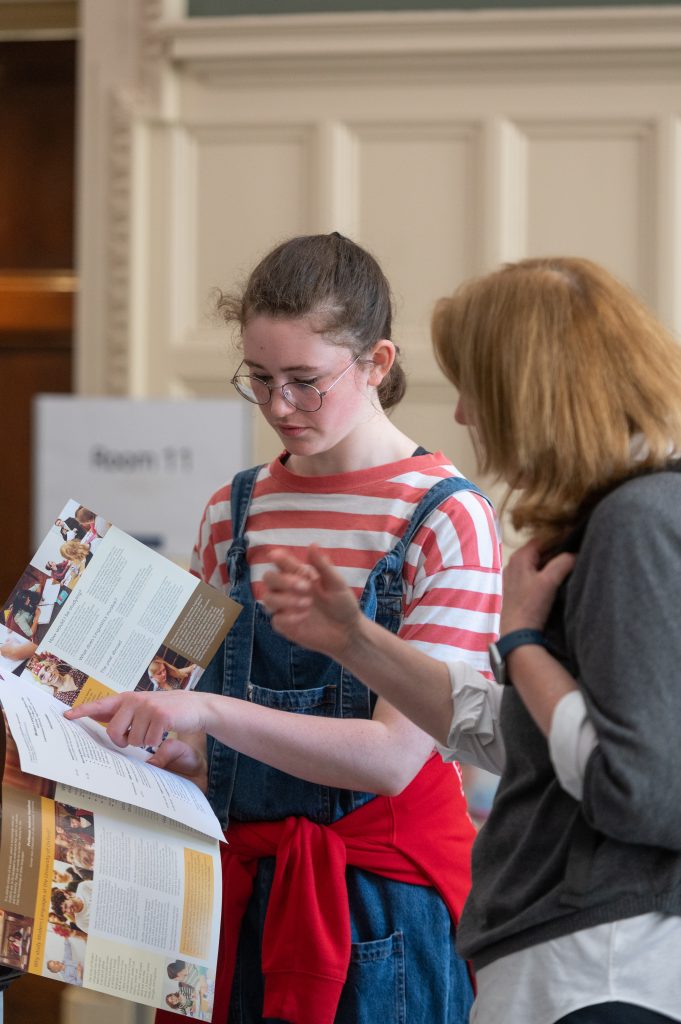
Modern Languages Open Day 2022
photo (c) John Cairns

The following languages will be represented at the Taster Day, with academics and current undergraduates present to provide further information about the course(s) and to answer students’ questions:

  • German
  • Portuguese
  • Italian
  • Russian
  • Czech (with Slovak)
  • Modern Greek
  • Polish

The provisional event programme for 2026 can be found here.

To register for the Taster Day, students should fill out this form by 12 noon on Friday 13th February so we know who to expect at the event. Please note that spaces will be allocated on a first-come, first-served basis, and the form will close once our maximum capacity has been reached.

For any queries or booking amendments, please get in touch with Nicola at schools.liaison@mod-langs.ox.ac.uk.

We are also pleased to be able to help students who are in need of additional financial support with reasonable expenses such as travelling to and from Oxford for the event. There is a space to include this information in the registration form.

Studying a language from scratch at Oxford

Our beginners’ languages courses offer an exciting and rare opportunity for students to engage with a new language and culture for the first time, or to pick up languages they studied at GCSE. The courses are challenging yet rewarding, with many designed to bring students up to A-level standard within the first year. Therefore, we would love to welcome students who are strong linguists and/or who are looking for a new challenge at University to this event.

As well as alongside a post-A-level language, most of our beginners’ languages can be studied in conjunction with subjects from the Humanities such as English, History, Linguistics, or Philosophy, for which applicants do not need to be studying a language to A-level or equivalent. With this in mind, we would also welcome students of Humanities subjects who are interested in picking up a language at University.

For further inspiration and information, below are some links to content from our tutors and undergraduates about why taking a language from scratch is so worthwhile:

  • Blog post – Why study Czech?
  • Video – Branching Out: Picking up a language from scratch
  • Video – Studying German for Beginners at Oxford:

We look forward to seeing you on 7th March!

Modern Languages Subject Taster Day

Happy New Year everyone! We hope you had a wonderful time and enjoyed the festivities over the Christmas holidays.

A new year brings new opportunities to explore your options of studying Modern Languages at Oxford.

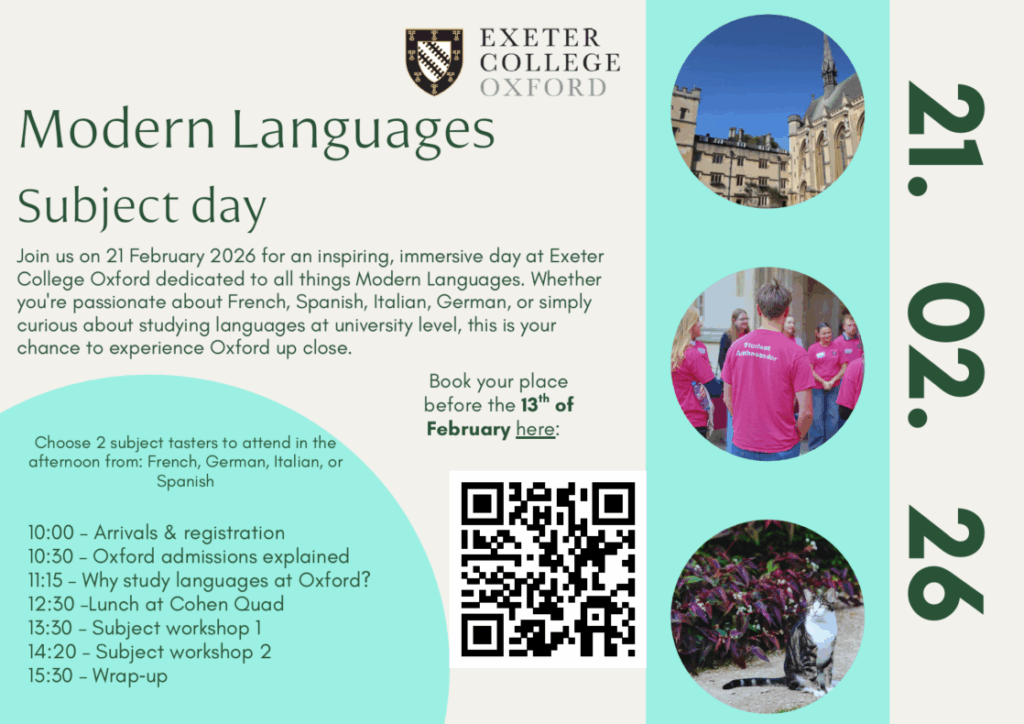
For example, on 21 February 2026, Exeter College is running an inspiring, immersive day dedicated to all things Modern Languages for Year 11 and 12 students.

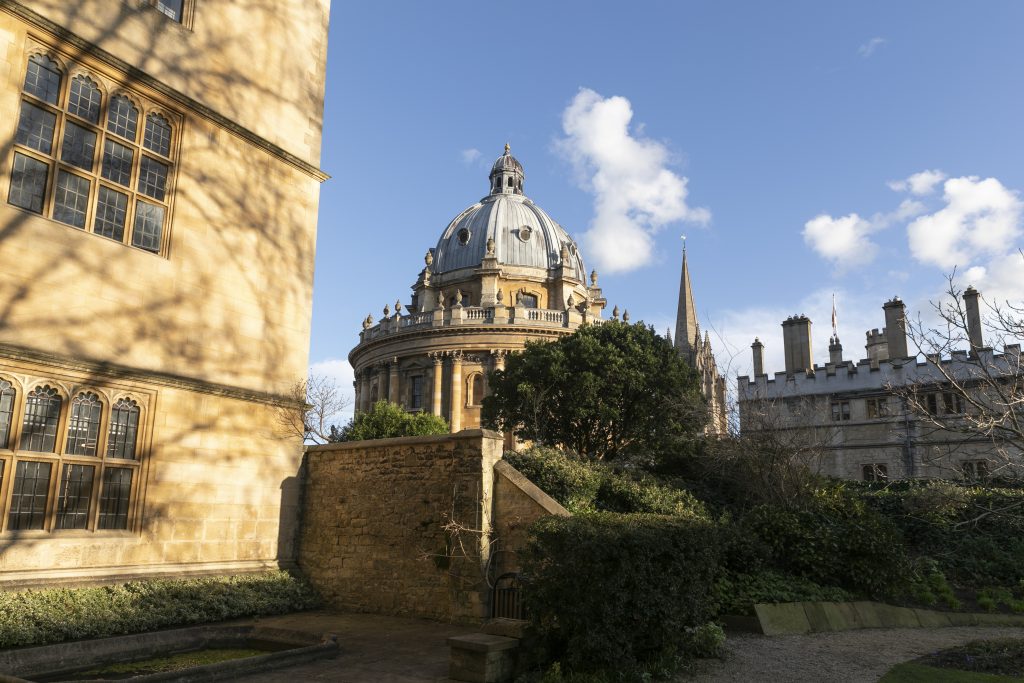
The Radcliffe Camera from Exeter College

Whether you’re passionate about French, Spanish, Italian, German, or simply curious about studying languages at university level, this is your chance to experience Oxford up close.

In the morning, you’ll explore the historic Turl Street site and gain a clear, insider’s view of the admissions process and what studying languages at Oxford is really like.

Across two afternoon sessions, you’ll take part in small‑group workshops led by Oxford tutors in French, Spanish, Italian, or German. Choose your languages, explore real academic material, and experience Oxford’s teaching style first-hand.

Apply here: Modern Languages Subject Day: Saturday 21 February 2026 – Fill in form. The form will close on 13 February 2026.

Subject Days are often oversubscribed and selection is based on academic merit and contextual factors. We warmly encourage applications from students who identify with any of the following criteria.

  • Students on Free School Meals.
  • Students from IMD Q1 and Q2 (*check your postcode at the link below)
  • Students who have been or are currently in care.

Please provide as many details about yourself to aid the shortlisting process.

The programme will be free of charge, lunch will be provided, and travel bursaries are available.

Questions can be directed to outreach@exeter.ox.ac.uk.

UNIQ 2026 – Applications now open!

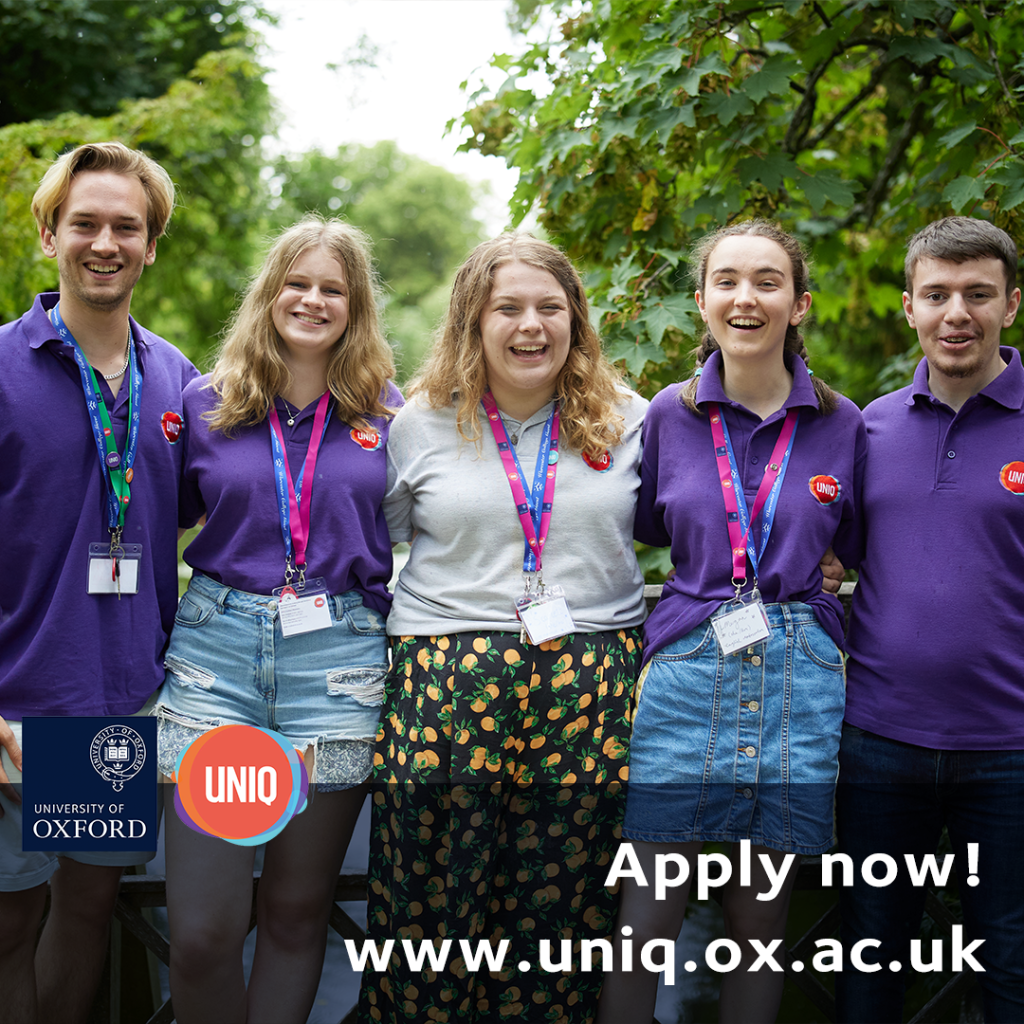
Will UNIQ help you shape your future? Apply now and find out! 

What is UNIQ?

UNIQ is Oxford’s free access programme for UK state school students. Featuring a sustained contact programme and in-person summer residential, you’ll be taught by Oxford academics and explore subjects aligned with your academic interests. The programme encourages you to make friends with other UNIQ participants: you’ll meet them at regional events and live alongside them during the Oxford residential, where current undergraduates will also be supporting you and on hand to answer your questions about student life at Oxford. We’ll also support you to make a strong university application to a course at Oxford or elsewhere. 

What Modern Languages courses are available?   

For Modern Languages, there will be courses available for SpanishFrench, and German taking place over the summer of 2026. Each varied course allows students to explore several exciting elements of degree-level language studies, such as language, literature, theatre, film, and linguistics, and provides the opportunity to experience a taster of two other European languages at beginners’ level.

How can I apply?

Applying is quick and simple – just register and fill out the form on the UNIQ website. It shouldn’t take you more than 15 minutes. Before you apply you should check that you meet our eligibility requirements and browse carefully the 30+ courses on offer to decide on your first and second choice.  
 
Applications close on 13 January 2026. You can find out more about the programme and selection criteria on the UNIQ website (www.uniq.ox.ac.uk) and by following us on Instagram (@OxfordUNIQ). If you have any queries about the applications process, check out our FAQs or contact us at uniq@admin.ox.ac.uk.   

*****

We’ll be back in January 2026 with more blog posts. In the meantime, we wish you a restful and peaceful festive period and a Happy New Year!

2026 Flash Fiction Competitions now open!

The Faculty of Medieval and Modern Languages is delighted to announce that this year’s Flash Fiction Competitions in French, Spanish and German are now open!

Our annual Flash Fiction Competitions invite secondary school pupils to submit a complete story of no more than 100 words, in French, Spanish, or German, for the chance to win up to £100.

Our 2026 Competition marks the first year in which German will be included and we’re excited to be expanding the Competition after many successful years!

Entries are judged by a panel of academics who are primarily looking for creativity, imagination and narrative flair, as well as linguistic accuracy. Pupils’ language skills will be considered in the context of their age and year group: in other words, we will not expect younger pupils to compete against older pupils linguistically. Each language competition is divided into three age categories:

  • Years 7-9 (ages 11-14)
  • Years 10-11 (ages 14-16)
  • Years 12-13 (ages 16-18)

The judges will award a top prize of £100, as well as prizes of £50 to a maximum of two runners up, in each category. Certificates will also be awarded to pupils who have been highly commended by our judges. Results as well as the winning, runner up, and highly commended stories will be published her on our blog if entrants give us permission to do so.

More information and links to the submission forms can be found on our website. Pupils may only submit one story per language but are welcome to submit a story in two or three languages if they would like to. For some inspiration, they can have a look at last year’s winning entries in French and Spanish.

Please note that pupils must enter the competition themselves: teachers cannot enter on their behalf for reasons of GDPR compliance.

FAQs can be found here and any other questions can be directed to schools.liaison@mod-langs.ox.ac.uk.

The submission deadline is 12 noon on 31 March 2026.

Bonne chance à tous! ¡Buena suerte a todos! Viel Glück euch allen!

FREE Christmas Lectures for Year 13s

The Langton Language Centre, based at Simon Langton Girls’ Grammar School in Canterbury, is running an exciting series of online lectures aimed at Year 13 languages students.

These are a great opportunity to get a taste of studying languages at university and see if it’s for you!

These lectures are taking place from 8th to 19th December and are completely free. All lectures will take place in the evening, either from 18:00-19:00 or 19:00-20:00.

The programme of lectures can be found here. Lectures cover varied topics, from the French Revolution to Japanese films.

Students need to sign up individually via this form with just their school name. No personal details required!

For safeguarding reasons, microphones and cameras will be muted but students and lecturers will be able to interact via the chat. 

Please email David Stalley (dstalley@langton.kent.sch.uk) with any questions.

GCHQ events and activities for schools

Our friends at GCHQ have lots of exciting events and activities planned for schools over the next couple of months… more details below!

GCHQ Language Outreach Virtual Session

Date: Tuesday 21 October, 10:30-11:30

Registration link: GCHQ Virtual Language Outreach Autumn 2025: Session dates and times

Description: Aimed at Year 9 students, during these one-hour sessions pupils will hear about the importance of languages, GCHQ, and the work our Language Analysts do, and will be given the opportunity to ask questions. They will then move on to a scenario challenge in a language they are currently studying (French, German or Spanish).

GCHQ National Language Competition

Date: 17-21 November 2025

Registration link: The GCHQ National Language Competition – GCHQ.GOV.UK

Description: We are pleased to announce the National Language Competition (NLC) will be returning in November this year. The NLC is open to Year 9 [England/Wales] / Year 10 [Northern Ireland] / S2 [Scotland] students, competing in teams of up to four. There is no maximum number of team entries per school. The NLC challenges vary in difficulty, require no prior language knowledge, and are worth varying amounts of points. We have an exciting new interactive format for your students to take on this year as well.

You can read all about the NLC 2024 winners visit to GCHQ Cheltenham on the GCHQ website.

****

Questions about both opportunities should be directed to languageoutreach@gchq.gov.uk.

A German Classic Prize 2025 – Rainer Maria Rilke’s New Poems (Neue Gedichte)

The Oxford German Network are delighted to announce the launch of this year’s ‘A German Classic’- our annual essay competition for sixth-form students. This year we would like to invite you to read with us a selection of poems by Rainer Maria Rilke (1875 – 1926), widely regarded as one of the most important German-language poets.

In addition to our essay competition, we introduce a Discovery Section designed especially for those with no prior knowledge of German, making the competition more accessible than ever.

We have put together a free study pack, including a set of multimedia materials, that will help you delve into Rilke’s compelling poems, even if it’s the first time you’ve read a poem.

Source: The Poetry Foundation

Selected poems:

  • Der Panther (The Panther)
  • Das Einhorn (The Unicorn)
  • Jugend-Bildnis meines Vaters (Portrait of My Father as a Young Man)
  • Römische Fontäne (Roman Fountain)
  • Das Karussell (The Merry-Go-Round)
  • Spanische Tänzerin (Spanish Dancer)
  • Archaïscher Torso Apollos (Archaic Torso of Apollo)
  • Papageien-Park (The Parrot House)
  • Die Flamingos (The Flamingos)
  • Der Ball (The Ball)

Prizes:

Up to three prizes will be awarded for each section:

  • for the essay competition, we will award a first prize of £500, a second prize of £300, and a third prize of £100
  • for the discovery section, we will award a first prize of £200, a second prize of £100, and a third prize of £50.

Prizes will only be awarded if work is of sufficient merit. All entrants will receive a prize certificate or a certificate of participation.

Study Packs:

Throughout July, we will be publishing ideas for further reading and free multimedia resources, including a series of podcast episodes we recorded especially for this competition, on our website.

We also encourage all students interested in entering the competition to email their UK correspondence address to the Prize Coordinator Santhia Velasco Kittlaus (germanclassic@mod-langs.ox.ac.uk) by 12 noon on 10
July to receive a free study pack.

After 10 July, study packs will be posted for free to those who request them by this date. If you get in touch after this date, we cannot guarantee to post you a full pack, but we will email you a copy of the secondary literature reader.

Eligibility:

Entrants must fulfil the following requirements as of September 2025:

  • be beginning their final year of full-time study at a secondary school in the UK (upper sixth form, Year 13 or S6 in Scotland);
  • be between the ages of 16 and 18;
  • hold a GCSE, IGCSE or equivalent qualification (in German for the essay) offered in the UK;
  • be resident in the United Kingdom. Entrants are not, however, expected to have prior experience of studying German literature.

Entries can be submitted via two online forms — here and here. The deadline for submitting your entry is Monday 8th September at 12 noon.

More details about the prize — including essay questions, submission guidelines, judging criteria, and more — can be found here.

Viel Glück!

GCHQ Language Outreach virtual sessions!

GCHQ are excited to invite teachers and their Year 8 & 9 students to participate in their upcoming GCHQ Language Outreach virtual sessions! 

Our program aims to inspire and encourage students to explore new languages or advance their existing skills.

Session Overview:

  1. Introduction to work at GCHQ

Discover the mission behind GCHQ and how languages play a significant part in our work.

  1. Taster sessions

Engage in interactive sessions for Spanish, German and French, designed to provide students with a glimpse into each language and its culture.

We believe that exposing students to different languages can spark interest and motivate them to pursue language studies further.  Please follow the guidance below if you feel this maybe of benefit to you and your students.

RSVP:

To confirm your participation, please fill out this Microsoft Form.

We understand that some school computer network policies may not allow access to hyperlinks so if you do encounter any issues, or would rather reply directly, please feel free to email Gordon54585@gchq.gov.uk with your attendance confirmation, choice of date and language.  The slide above provides a brief breakdown of the session but we are happy to respond to any questions you may have or give more details.

Virtual session dates & times:

Friday 6th June 2025, 11.30-12.30: French, Spanish, German

Wednesday 25th June 2025, 10.30-11.30: French, Spanish, German

Tuesday 15th July 2025, 13.30-14.30: French, Spanish, German