Tag Archives: French

FRENCH FLASH FICTION 2025: THE HIGHLY COMMENDED ENTRIES (Y7-9)

Following the publication of the winning and runner up entries, we are excited to present the highly commended entries for the Year 7-9 category of this year’s French Flash Fiction competition!

A huge well done to all of our highly commended entrants!

****

Mon grand-père n’a jamais été un homme patient. Correspondant de guerre, il a passé sa vie dans les régions les plus dangereuses du monde, armé d’un stylo et d’un bloc-notes. Il aimait les mots et m’a appris leur pouvoir. À 67 ans, on lui a diagnostiqué un cancer de l’œsophage, d’un cancer du poumon en phase terminale. Alors que les traitements faisaient leurs ravages, il semblait habiter un corps dont la peau n’était plus à sa taille tandis que ses yeux noirs et flamboyants s’assombrissaient sous l’épuisement. Tout au long de cette épreuve, c’était l’écriture qui nourrissait son corps exténué. Son message à tous était de continuer à écrire.

– Tabitha Bridgeman, Year 9

Le Désir Brûlant de Pouvoir

Les flammes dansent désespérément: implorant la liberté. Tentatives de persuader que s’ils étaient libérés de leurs contraintes, les vrilles fumantes jeteront des étincelles avec une intensité inimaginable, prêtes à servir et à obéir. Les mortels aiment bien se chauffer le dos. Les chefs les exploitent pour que la quintessence du carnage fonctionne pour eux. Que pourrait on faire avec un tel pouvoir? Transformation, réformation, une métamorphose. La capacité de créer un nouveau royaume, un empire, celui que même le Diable serait fier d’appeler le sien. Hélas, je ne suis qu’un simple enfant, regardant pensivement dans les profondeurs du feu.

– Sarwin Shangar, Year 9

Des éclats de métal volent dans l’air, les cris des passagers ricochent dans la cabine pressurisée. La roue tourne inutilement là où elle est montée sur le tableau de commande, les lumières aveuglant mes yeux. Chaque flash est un rappel rythmé de notre descente. Rapidement. Je maudissais tous les pilotes qui m’avaient formé, pour ne pas m’avoir mieux préparé à un accident. Alors que nous nous rapprochons dangereusement de la Tour Eiffel, je me mets à réfléchir aux règles de sécurité pour essayer de nous sauver. Mais ce ne sera pas suffisant. Je l’admire avant que tout… ne devienne… noir.

– Ellie Malloch, Year 9

Le chêne

Le printemps. Les feuilles sortent des bourgeons verts. L’arbre se reveille après un sommeil long.

L’été. Le soleil sourit avec amore au le chêne. Les enfants rirent et jouent sous la canopée ombragée.

L’automne. Les feuilles sont peintes on or. Ils tombent par terre. Les glands sont disperses par une terre brune. Un écureuil sautes sur les branches, pépiement joyeusement.

L’hiver. Le soir, un hibou s’assoit sur le creux de l’arbre. Le chêne bras nus se balance sur le vent calme. Le clair de lune est plus blanc que le lait. Le chêne se prépare pour l’année prochaine.

– Jemima James, Year 9

Le vieux piano

Le vieux piano de la maison abandonnée portait encore sa mélodie. Clara en chassa la poussière, hésitante, tandis que la lumière dorée filtrait à travers les fenêtres brisées.

Elle appuya sur une touche. Puis une autre. Une mélodie s’éleva—douce, mélancolique, familière. La chanson de son père.

Les larmes lui montèrent aux yeux. Il la jouait autrefois, avant que la maladie ne l’emporte. Elle ne se souvenait presque plus de sa voix, mais la musique était restée.

Alors que la dernière note s’épanouissait, une brise murmura :

“Magnifique, ma chérie.”

Clara sourit. Elle n’était jamais seule.

– Prem Patel, Year 9

Les arbres s’effondrent. Ma maison, mon refuge, se brise. Les géants où je jouais sont réduits à néant. L’air sent la mort et la destruction. Je serre une branche, ma dernière connexion avec la canopée.

Les humains reviennent, leurs machines grondant plus violemment. Je fuis, mais il n’y a nulle part où aller. Le sol est stérile. Ma famille a disparu. La forêt est silencieuse. Je suis seul, perdu dans une terre qui ne m’appartient plus.                               

– Dhilan Thanki, Year 9

Au revoir, Papi:

La tristesse m’envahit, la douleur me déchire le cœur et mon âme fond
comme une bougie éteinte par un vent violent. Dans les rues de mon cœur, ce vent engloutit tout pour laisser place au désespoir. Il crée un vide. Un vide dépourvu de joie et d’amour . Un vide encombré de pensées obscures, ressemblant à une nuit sans étoiles. Dans ce vide affreux, mon âme se perd, engloutie par la mélancolie. Pourtant, une lueur essaye péniblement d’éclairer ce trou. C’est Espoir. Une autre lumière s’allume alors. Souvenirs. Unies, elles repoussent la tristesse. Ensemble, elles disent au revoir.

– Laonie Caron, Year 9

À Petit Pas

Il était une fois un escargot nommé Léo qui voulait devenir chef cuisinier. Un jour, il a trouvé une recette pour un plat rapide. Léo a dit, “Parfait, je vais fini en un rien de temps !” Mais un voisin, une fourmi, a répondu, “Toi ? Rapide ? Quel escargot est rapide ?” “Eh bien, je vais à mon propre rythme, mais je ne suis jamais en retard dans ma coquille !” Leo a dit. Finalement, Léo a ouvert son restaurant appelé “À Petit Pas” et est devenu célèbre pour ses repas… lents mais délicieux !

– Silvia Herratt, Year 9

Paix.

Il était une fois un monde en parfaite harmonie, où quatre nations
prospéraient sous la bénédiction de leur monarque céleste : les tribus du feu, le royaume de l’eau, les temples de l’air et l’empire de la terre. Grâce à leurs pouvoirs uniques, ils ont créé des innovations technologiques inimaginables. Pendant des siècles, la paix a régné… jusqu’à l’arrivée du Maître des Ombres. Son assaut brutal plongea le monde dans le chaos, brisant des civilisations entières. Mais même au milieu de la destruction, un souvenir demeure, une phrase qui résonne à travers les âges : le véritable pouvoir réside dans la coexistence.

– Eva Graciova, Year 8

FRENCH FLASH FICTION 2025: THE RUNNERS UP

We are delighted to publish the runner up entries for this year’s French Flash Fiction competition! We’ll be publishing the runner up entries for Spanish, as well as the highly commended entries for both languages in each age category over the coming weeks.

Years 7-9 runners up

Arc et Triomphe

Sous l’énorme paysage de Paris habitent beaucoup de gentils trolls. Ils savent que le soleil est mauvais pour les trolls. Ils ne peuvent sortir que la nuit.

Il y a deux trolls qui sont frères. Ils s’appellent Arc et Triomphe. Ils écoutent un crie. Ils quittent la cave pour aider. Il y a une personne qui est blessée. C’est le matin et les trolls se réalisent leur erreur. Ils ont peur et se lèvent les bras et se tiennent la main.

Leurs têtes fondent et leurs corps se transforment en pierre. Ici se trouve l’Arc de Triomphe.

– Christian Thomas, Year 7

“courir comme une fille”

Mes poumons brûlent et je sanglote à chaque respiration haletante. À chaque pas, mes pieds me brûlent davantage. J’ai envie de m’arrêter, d’abandonner et d’accepter mon destin, mais je ne peux pas encore laisser la douce étreinte de la mort me priver d’adrénaline. Mes jambes me font mal et je trébuche tandis que le vent violent me fouette les cheveux. Le bruit de ses pas lourds derrière moi est ma seule motivation. J’ai envie de crier, mais je n’y arrive pas, seule la terreur me fait avancer. Voilà ce que signifie courir “comme une fille”.

– Poppy Simblet, Year 9

Years 10-11 runners up

L’Envol

Je suis né dans l’ombre, brisé, une
poussière sous les pieds des autres.
Ignoré, piétiné, anéanti. Puis un jour, le
vent m’a arraché. J’ai fendu l’air comme
une lame, frôlé les cimes, défi é les
tempêtes. Le monde, gigantesque et
sauvage, battait sous moi—un océan
d’énergie brute. Les tempêtes ont voulu
me briser, mais j’ai tourbillonné, libre et
indomptable. Plus haut. Plus loin. Les
doigts d’un enfant me frôlent,
tremblants. Il me regarde, souffle coupé,
comme si j’étais un miracle tombé du
ciel. Un souffle. Je disparais, m’élançant
vers l’inconnu. Je ne suis qu’une plume,
mais je défi e le ciel.

– Benedict Onalo, Year 11

C’est quoi un monstre?

Un monstre, c’est une chose
qui ravage les hameaux, les villages, les villes
qui incendie des forêts, massacre les humains, les animaux,
qui dévore sans cesse, crachant des nuages de fumée noire
qui couvrent les horizons,
qui infecte nos sources, nos ruisseaux, nos rivières, nos océans.

Un monstre, c’est une chose
qui tourne en rond, en ne pensant qu’à eux-mêmes dans un monde impitoyable,
qui ne sapitoie que sur eux-mêmes.

Un monstre, c’est une chose qui gãche, qui pollve, qui vide les ressources, qui creuse, avi construit, qui detruit,
dans un cerole perpétuel.

Les monstres,
c’est nous.

– Arthur Mourot, Year 10

Years 12-13 runners up


Le vieux piano est encore intact, ses touches d’ivoire ternies par la poussière. Elle les parcourt, se rappelant comment les doigts de sa mère y dansaient, remplissant les après-midi de Chopin et de rires. La maison, autrefois vibrante de musique et de chaleur, semble caverneuse, ses échos rappelant l’absence plutôt que la présence. Elle a appuyer sur une touche, mais la note a vacillé, fragile et incomplète. Le chagrin gonfle dans sa gorge. Elle s’est rendue compte que certaines choses ne peuvent pas être jouées deux fois de la même manière. Certaines mélodies se terminent avant que nous soyons prêts.

– Nini Ren, Year 12

Qu’ils boivent du thé!

«Monsieur le Premier ministre, est-il vrai que votre gouvernement a dépensé cinq millions de livres en biscuits l’année dernière?»

Silence.

La majorité des questions de ce soir concernaient les sujets habituels: l’inflation, le chômage… Ces questions n’étaient pas des plus agréables, mais la paperasserie a été utile. Ils n’auraient pas pu connaître cet accord! L’économie dépendante du thé est chancelante. Les gens pouvaient à peine rassembler une pitance, mais l’accord est suffisant pour servir des scones pour toute la nation.

«La démocratie repose sur le thé, et le thé nécessite des biscuits». Il soulève sa tasse à thé lentement

– Ka Kin Andreas Lam, Year 12

Félicitations tout le monde!

FRENCH FLASH FICTION 2025: THE WINNERS

We are delighted to publish the winning entries for this year’s French Flash Fiction competition. We’ll be publishing the winning entries for Spanish, as well as the runners up and the highly commended entries for both languages in each age category over the coming weeks.

Thank you and huge congratulations to everyone who entered! The French judging panel were extremely impressed with all the entries we received this year (over 847 of them!), and commented the following about the competition:

Thank you all for another year of delightful and intriguing stories. In just a hundred words, you impressed us with pieces about family love, mischievous cats, talking music boxes, aeroplane fiascos, mysterious mirrors, alien invasions, snail restauranteurs, and doner kebabs. We particularly enjoyed the creative range of literary styles: verse poetry and prose, theatre and slang, riddles and tongue-twisters. Congratulations to all of you for your courage in experimenting with language in such fascinating ways.

Without further ado, here are the winning stories! We hope you enjoy reading them as much as the judges did.

Years 7-9 winner

Photo by Javier Miranda on Unsplash

La berceuse d’une libellule
J’ai vu
Les dinosaures apparaître et disparaître,
Le continent de Pangée se diviser en sept morceaux,
Le roi être né,
Les sorcières brûlées,
Versailles en silence,
L’archiduc assassiné,
Des alliances formées
Et brisées,
La Pologne envahie,
Des innocents morts,
Des livres détruits,
A huit heures le port-aux- perles en décombre.
La bombe,
Une nouvelle guerre.
La terre se réchauffe.
Une libellule presque invisible se repose par terre,
Sa petite tête baissée,
Ses ailes cassées,
Elle ne voit plus.

– Alexandra Davies, Year 9

Years 10-11 winner

Photo by Jacqueline Munguía on Unsplash

Une énigme pour vous…
Je brise la glace sans un bruit;
Une étoile filante au milieu de la nuit.
J’éclaire la journée,
Mais je ne suis pas le soleil.
Je travaille le mieux
Quand tout semble désespéré.
Je peux être en retard,
Mais jamais trop vite.
Je n’utilise pas de mots;
La langue la plus pratique.
Je me cache parmi les étrangers,
Mais je suis seulement en train de reposer,
Un diamant brut,
Beau une fois révélé.
Le reflet d’un coeur heureux,
Je ne veux jamais dire adieu.
Qu’est-ce que je suis?
Un vrai sourire.

– Ayami Ginneliya, Year 10

Years 12-13 winner

Les Mots Qu’on Traduit Pas
Un mur contient chaque mot; l’encre coule. Si l’on pose le doigt, n’importe quel mot peut être tracé ; les autres restent invisibles.
Je suis assis, observant la mer anglaise. Juste la semaine dernière, j’étais à Pont Neuf, me sentant un peu frileux.
Il semble que j’aie l’air troublé. Ma tante, locale, m’introduit à Falmouth, puis sourit bienveillamment. “You’ll adapt,” dit-elle.
Sur le sable, elle écrit « peace ». Moi, je trace dépaysement.
Les vagues effacent nos mots, mais la rémanence demeure. Et c’est très bien comme ça. Au-delà des actualités et banalités, il existe un calme dans les mots qu’on traduit pas.

– Sela Keliane Diasivi, Year 12

Félicitations à tous nos gagnants!

2025 Flash Fiction Competition Results

In December 2024, we launched our annual Flash Fiction competitions, which closed at the end of March. The competitions were open to students in Years 7 to 13, who were tasked with writing a short story of no more than 100 words in French and/or Spanish.

We had an incredible response, with entries coming in from all areas across the country! In total, we received over 1200 submissions across the two languages!

We would like to thank everyone who entered the competition and commend you all for your hard work and creativity in writing a piece of fiction in a different language. This is a challenging exercise, and a significant achievement – congratulations all!

We are delighted to be able to announce the winners, runners up, and highly commended entries for each language below. We will be publishing the stories over the summer so you can read them for yourselves.

French

In the Years 7-9 category, the winner is Alexandra Davies. The runners-up are Christian Thomas and Poppy Simblet.

The judges also identified the following entrants as highly commended: Tabitha Bridgeman, Sarwin Shangar, Ellie Malloch, Jemima James, Prem Patel, Dhilan Thanki, Laonie Caron, Silvia Herratt, and Eva Gracovia.

In the Years 10-11 category, the winner is Ayami Ginneliya. The runners-up are Benedict Onalo and Arthur Mourot.

The judges also identified the following entrants as highly commended: Maryam Zulqarnain, Will Eyre, Todd Graham, Zara Amjad, Faith Obum-Uchendu, Elizabella Macleay-Wood, Florence Datta, Izzy Anderson, Aayushi Dhelaria, and Antoinette Aluge.

In the Years 12-13 category, the winner is Sela Keliane Diasivi. The runner-ups are Nini Ren and Ka Kin Andreas Lam.

The judges also identified the following entrants as highly commended: Sofia McAllister, Dominica Kay-Shuttleworth, Eddie Henderson, Eva Saunders, Preona Mohan, Gia Namoa, Luke Roberts, Amelia Richardson, Andreea Denisa Taranu, and Annabelle Lavin.

The French judging panel were very impressed with this year’s submitted stories, and commented the following about all the entries:

Thank you all for another year of delightful and intriguing stories. In just a hundred words, you impressed us with pieces about family love, mischievous cats, talking music boxes, aeroplane fiascos, mysterious mirrors, alien invasions, snail restauranteurs, and doner kebabs. We particularly enjoyed the creative range of literary styles: verse poetry and prose, theatre and slang, riddles and tongue-twisters. Congratulations to all of you for your courage in experimenting with language in such fascinating ways.

Spanish

In the Years 7-9 category, the winner is Grace Fulcher. The runner up is Willa Stevenson.

The judges also identified the following entrants as highly commended: Qaya Anand, Benjamin Brown, Maria Temowo, Sai Sudharshana Sathish Kumar, Ella Gabso, Momore Sina-Atanda, Kimora Newby, Chloe Crowther, Jasparan Leeson-Kings, and Zaynah Arshad.

In the Years 10-11 category, the winner is Anonymous. The runners-up are Jaami Sheikh and Jaya Sharma Patel.

The judges also identified the following entrants as highly commended: Cecilia Linden, Anonymous, Anonymous, Tulaxsaa Sutharsan, Ilana Bartlette, Kashvi Maharshi, Isabel Marchi-Abatti, Jasmine Dix, Madeline Sandford, and Lalith Surapaneni.

In the Years 12-13 category, the winner is Gabriel Dada. The runners-up are Lydia Furniss and Ohemaa Ofosua Bruce Oppong-Agyare.

The judges also identified the following entrants as highly commended: Heloise Morel, Mahi Sainani, Melissa Muthama, Monica Singh, Thea Spackman, Yuet Ching Gabrielle Kam, Samiah Iqbal Kausar, Luke Roberts, Gagani Katugampala, and Amelie Pugsley.

The Spanish judging panel were very impressed with this year’s submitted stories, and commented the following about all the entries:

We greatly enjoyed reading all of this year’s entries and, as always, were impressed with the level of creativity and inventiveness. We particularly liked the stories that were playful with their perspectives and structure, which we could see had come from moments of personal thought and showcased different opinions and ways of seeing. It was wonderful to see a good command of Spanish throughout, as well as an ability to manipulate the language imaginatively.

****

Huge congratulations everyone – you should be very proud of your achievement!

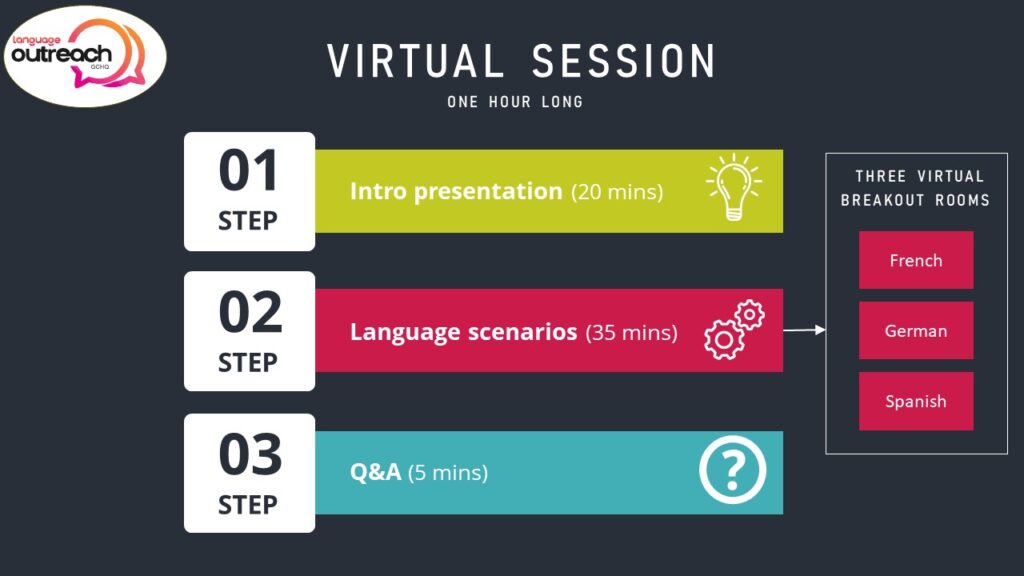
GCHQ Language Outreach virtual sessions!

GCHQ are excited to invite teachers and their Year 8 & 9 students to participate in their upcoming GCHQ Language Outreach virtual sessions! 

Our program aims to inspire and encourage students to explore new languages or advance their existing skills.

Session Overview:

  1. Introduction to work at GCHQ

Discover the mission behind GCHQ and how languages play a significant part in our work.

  1. Taster sessions

Engage in interactive sessions for Spanish, German and French, designed to provide students with a glimpse into each language and its culture.

We believe that exposing students to different languages can spark interest and motivate them to pursue language studies further.  Please follow the guidance below if you feel this maybe of benefit to you and your students.

RSVP:

To confirm your participation, please fill out this Microsoft Form.

We understand that some school computer network policies may not allow access to hyperlinks so if you do encounter any issues, or would rather reply directly, please feel free to email Gordon54585@gchq.gov.uk with your attendance confirmation, choice of date and language.  The slide above provides a brief breakdown of the session but we are happy to respond to any questions you may have or give more details.

Virtual session dates & times:

Friday 6th June 2025, 11.30-12.30: French, Spanish, German

Wednesday 25th June 2025, 10.30-11.30: French, Spanish, German

Tuesday 15th July 2025, 13.30-14.30: French, Spanish, German

First year French Sole student’s experience of Oxford University

On the blog this week, current French Sole student, Livleen, reflects on her first year here at Oxford and shares what the course entails.

Me (on the right) and my friend Amber on matriculation

Heya, I’m Livleen! I’m in my second year doing French at St Catherine’s College, and I’ve absolutely loved my time here so far at Oxford. It’s such a beautiful place to live in, me and my friends often describe living here as a ‘fever-dream’: when you come home between term time it feels like you’ve been living in a fantasy! However, that’s not to say that my first year was a breeze, I was challenged not only academically, but socially too. Oxford is an amazing place to study because it really makes you filter out the things you genuinely enjoy doing, making you prioritise what is truly important, and become quicker at completing tasks in general.

In terms of my academic experience, I must say that I improved so much from when I first set foot in my seminar room back in October. The French course here at Oxford is very literature heavy, so bear that in mind if you’re considering applying here. Here are some details on what the French and French sole course is like:

For core French modules (this is what everyone does in first year French, regardless of what subject combinations you do), you have around 2 lectures a week on the text you are studying. In Michaelmas term (first term), the first couple of weeks are introductory, where you’ll have lectures on how to approach literature, and how to write essays and commentaries.  And then you’ll study 3 commentary texts: Montaigne: ‘Des Cannibales’, Racine: ‘Phedre’ and Verlaine: ‘Romances Sans Paroles’. In Hilary (second term), you study your last commentary text ‘Papa Doit Manger’ by Marie Ndiaye, and then you move onto your essay texts: ‘Le Chastelaine de Vergy’, ‘Les Liaisons Dangereuses’, ‘Indiana’, and then you study ‘Traversée de la Mangrove’ in the beginning of Trinity term (third term). Also, as part of French core, you have weekly grammar, translation and speaking classes. You have grammar classes and translation classes around twice a week, and speaking every other week. However, this varies depending on your college.

In terms of the French Sole modules, the sole papers are Film, French Thought (Philosophy) and Literary theory. You’ll study four texts/films for each paper and attend a seminar and write an essay (or commentary) on each in English. For our year, we studied all the films in Michaelmas, Philosophy in the second half of Michaelmas and first half Hilary and then critical theory in the last half of Hilary and first half of Trinity. The films that we watched were: Pierrot le Fou, À Nos Amours, Beau Travail and Portrait de la jeune fille en feu. The philosophy texts were: Descartes: Discours de la méthode, Rousseau: Discours sur l’origine de l’inégalité, Beauvoir: Le Deuxième Sexe, and Césaire: Discours sur le colonialisme, suivi de Discours sur la Négritude. The critical theory authors you study are: Paul Valéry: ‘Questions de poésie’ and ‘Poésie et pensée abstraite, Sartre: Qu’est-ce que la littérature?, Barthes: Critique et vérité  and Hélène Cixous: ‘Le rire de la Méduse’. Overall, I would say that although I struggled with the Sole modules, I’m so glad that we studied them because I feel so much more informed about French literature and culture, which others doing joint honours will not have in their first year. There is also the myth that those who do French Sole means that you do less work as opposed to someone who does a joint honours, and I would say this is completely untrue. Whilst you are not doing additional language work for another language, you’ll be wrapping your head around complex philosophical concepts and getting your grips around abstract ideas in critical theory.

There is also the myth that at Oxford, you spend every day in the library, and will have no time for fun. This is also completely untrue. This year, I was playing in 2 orchestras a week, attended weekly dance classes, spent many nights hanging out with friends in the JCR (the college social area for undergraduates), went clubbing from time to time, took part in uni-wide society events and many more. Although you do spend a lot of time here studying (which is normal with every university student), I would say that the life here only gets intense because of all the social opportunities Oxford has to offer that you want to cram into your schedule haha.

Me and my friends at a cartoon themed entz* 🙂
*college-organised social event

In terms of how I’ve found my college experience, I’ve absolutely loved being at St Catherine’s College (or more affectionately, ‘Catz’). Although we had troubles with the RAAC, it made our community come together, and the friends I’ve made has made my first year so worth it.

Me and my friend Amara at a South Asian ball!!

One thing I’d like to mention is writing a bit about my experience being an ethnic minority here at Oxford, having come from a predominantly South Asian community in London. What surprised me was that coming to Oxford brought me closer to my culture because I attended many India Society events and becoming ethnic minority rep at my college. So, I would say that there is a way to stay / become connected to your roots even if the stereotypes suggest the opposite.

Lastly, for those who are thinking of applying to Oxford, and considering applying to do French, I would recommend that you give it a go, especially if you have an interest in literature. For me, getting into Oxford was as stab in the dark and the process seemed very daunting, but it all it worked out! And no matter how far you get in the process, the application experience is so valuable. Wherever you end up, things will always work out for the best, and you’ll no doubt have the best years of your life 🙂

– Livleen

If you want to see a taster of a week in the life of a French Sole student, I’ve filmed a video which you can watch below:

‘Try Before You Buy’ Days!

Balliol College is running a series of free ‘Try Before You Buy’ Days over the course of May and June 2025.

These are an opportunity to experience a taste of Oxford undergraduate teaching, with participants taking part in a tutorial having completed and submitted work prior to the event. Students will also take part in an admissions session and college tour with undergraduates. A free lunch will also be provided in the Balliol Dining Hall.

Balliol College, Oxford

The Days are aimed towards prospective applicants of a variety of subjects, but in terms of languages, are open to Year 12 students hoping to apply for degrees with French (starting in 2026). Under-represented groups will be prioritised for this event.

These events are in great demand so applicants must ensure that they are able to attend and can complete the work and return it by the deadline which is usually a week before the event.

More information about the days can be found here and students can register for the sessions at the links below:  

Modern Languages Summer School

Applications are now open for Wadham College‘s annual five-day Modern Languages Summer School. The residential will take place at the college, based in the centre of Oxford, from 18th to 22nd August 2025.

Summer schools are designed to give UK pupils studying in Year 12 a taste of what it’s like to be an undergraduate studying at the University of Oxford.  Pupils will take part in an academic programme, live in College, meet student ambassadors studying at Oxford, and receive information, advice and guidance on applying to university. Wadham’s Summer Schools are free and the college will provide financial support to pupils to cover their travel costs.

Wadham are delighted to be able to run these events in-person allowing participants the best experience of life at the university.  The feedback from last year’s Summer Schools was hugely positive with over a third of participants subsequently securing offers to study at the university.

“After the summer school I am much more confident that I would fit in at Oxford and feel like I am more ready to move away from home”

– Summer School participant, 2022

For Modern Languages more specifically, pupils will engage in a seminar series led by Wadham’s language tutors, including language classes in their selected language of study (French, German or Spanish) with opportunities to try other languages as beginners (including German, Portuguese and Russian). Students will complete an assignment on a main topic with feedback from tutors. Pupils will also be able to receive support from current undergraduates and from the College on making successful applications to top universities.   

A Summer School French class

For more information and to apply, click here: Wadham College Summer Schools. Pupils should be studying French, German or Spanish at A-level or equivalent to apply. Applications close on 5th May.

If you have any queries, please contact access@wadham.ox.ac.uk

Reminder: Flash Fiction Competitions

With just under a month to go until the deadline, there’s still a chance to enter our Flash Fiction Competitions in French and/or Spanish – don’t miss out on your chance to win £100! A reminder of the competition details and how you can enter can be found below…

What is Flash Fiction?

We’re looking for a complete story, written in French or Spanish, using no more than 100 words.

Did you know that the shortest story in Spanish is only seven words long?

Cuando despertó, el dinosaurio todavía estaba allí.
(When he woke up, the dinosaur was still there.)

– Augusto Monterroso Bonilla (1921-2003)

What are the judges looking for?

Our judging panel of academics will be looking for imagination and narrative flair, as well as linguistic ability and accuracy. Your use of French or Spanish will be considered in the context of your age and year group: in other words, we will not expect younger pupils to compete against older pupils linguistically. For inspiration, you can read last year’s winning entries for French here, and for Spanish here.

What do I win?

The judges will award a top prize of £100, as well as prizes of £25 to a maximum of two runners up, in each age category. Certificates will also be awarded to pupils who have been highly commended by our judges. Results as well as the winning, runner up, and highly commended stories will be published on this blog, if entrants give us permission to do so.

Poster for the 2025 Flash Fiction Competitions

How do I enter?

You can submit your story via our online forms at the links below.

FrenchSpanish
Years 7-9Years 7-9
Years 10-11Years 10-11
Years 12-13Years 12-13

Click on the links to be taken to the correct submission form for your age/year group.

You may only submit one story per language but you are welcome to submit one story in French AND one story in Spanish if you learn or study both languages. Your submission should be uploaded as a Word document or PDF.

The deadline for submissions is 12 noon on Monday 31st March 2025.

Due to GDPR regulations, teachers cannot enter on their students’ behalf: students must submit their entries themselves.

Please note that the competition has changed slightly this year. We are now only accepting entries from UK secondary school pupils.

If you have any questions, please check our FAQs here. If these still don’t answer your question(s), please email us at schools.liaison@mod-langs.ox.ac.uk.

Bonne chance à tous! ¡Buena suerte a todos!

Balliol College Modern Languages Taster Day 

Balliol College, Oxford is delighted to be running a Modern Languages Taster Day on Tuesday 27th May 2025, 10.15 – 15.45!

Academic Taster Days are a great opportunity for students in Year 12 to spend a day exploring a subject they enjoy and might pursue at University, meet with some current students, experience a taste of academic teaching, and enjoy lunch in the dining hall.

Balliol College

This specific event is designed for Year 12 UK state school students who are currently studying a Language A-Level or equivalent, and who intend to apply to study French, Italian or Spanish, or Modern Languages and Linguistics as a single honours (on its own) or a joint-honours (with another language/subject) degree at Oxford University. Balliol will prioritise applications from disadvantaged students and from groups which are under-represented at the university. This event will include academic sessions, admissions information, and a demonstration interview. You will have the opportunity to speak to tutors and current undergraduates. 

Before submitting an application, please ensure you can attend the day in its entirety. For many schools this event will fall in the half term holiday. The event will be held in person at Balliol College in Oxford. 

You can apply here. The deadline for applications is 5pm on Tuesday 6 May 2025.

Please contact outreach@balliol.ox.ac.uk with any questions.