Category Archives: Recommended Reading

How much is too much reality?

In May The Oxford Centre for Comparative Criticism and Translation, and St Anne’s College hosted a discussion between two of the best-known novelists writing in Spanish today, Javier Cercas and Juan Gabriel Vásquez. Beginning as an introduction to their recent publications, the conversation evolved into an exciting reflection on the role of storytelling in a post-truth age…

Javier Cercas at the Gothenburg Book Fair 2014. Photo by Albin Olsson, from Wikimedia Commons

Javier Cercas gave an insight into his 2014 novel, El Impostor (The Impostor), which tells the story of Enric Marco Battle, a trade unionist who became famous in Spain as a survivor of the concentration camps Mauthausen and Flossenbürg. Battle became a spokesperson for Spanish survivors of the Holocaust and was a prominent voice against Fascism. However, in 2005 it was revealed that Battle had deceived the public about his experience of the war and had never been held in a concentration camp. He was, in effect, an impostor.

Vásquez introduced his 2015 novel, La forma de las ruinas (The Shape of the Ruins), which traces two political assassinations in Colombia’s history: that of General Rafael Uribe Uribe, a senator and civil war veteran killed in 1914; and that of Jorge Eliécer Gaitán, a leader of the Liberal party and presidential candidate at the time of his murder in 1948. Vásquez’s novel includes a character called Carlos Carballo, a conspiracy theorist who believes the two crimes are linked, not only to one another, but also to the assassinations of John and Robert Kennedy.
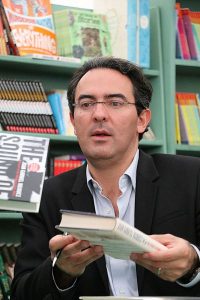
Juan Gabriel Vásquez at the Hay Festival 2016. Photo by Andrew Lih (User:Fuzheado), from Wikimedia Commons

Both novels, then, might to some degree be considered historical fiction, taking their storylines from history but marrying this with the imagination to create a version of the past that is closer to what we might expect from fiction. However, the two writers use their novels to problematise this genre, questioning the role fiction can play in an era of alternative facts.

The writers consider the figure of the fantasist, asking what motivates a fantasist to invent alternative scenarios and why such figures are believed. This begs the question, is the novelist a kind of fantasist? And if you can have a factual novel, what is it that makes it a novel, a work of the imagination?

Vásquez suggests that fantasists are fascinated by stories, by creating narrative out of the past as a way to meet their personal objectives. They are detectives of a kind, and the novel is a means of probing reality and humanity. As Ford Madox Ford said, the novel is a ‘medium of profoundly serious investigation into the human case.’ Cercas, meanwhile, draws a distinction between the different fantasists presented in the two novels: on the one hand, Battle, who distorts history to amplify or falsify his own role within it; on the other, Carballo, who cannot accept that history doesn’t make sense and is ‘a tale told by an idiot, full of sound and fury, signifying nothing’ (a reference to Shakespeare’s Macbeth), and therefore looks endlessly for connections in an effort to find the meaning in history.

What do both fantasists tell us about our relationship to narratives of the past though? Perhaps that history becomes more palatable when it is presented in the form of a story. Between the lack of a story and a lie, we prefer the lie and, to go a step further, when we are dealing with the worst elements of history, we try to mask it with narrative.It is for this reason, Cercas suggests, that General Charles de Gaulle aimed to convince French people that they had all been ‘résistants’ during the war, for, he said, ‘Les Français n’ont pas besoin de la vérité’ [French people do not need the truth].

In the current climate, we find other words for lying, referring to distortions of the truth as ‘alternative facts’. Social media allows us to create alternative chains of events and, for the first time, we have the impression of being able to choose the version of reality we want to hear. Consequently, people who are adept at manipulating storytelling have power. Vásquez points out that the German writer and philosopher Novalis asserted that ‘novels arise out of the shortcomings of history.’ The novel goes where history cannot, reframing history as a narrative that can be edited, manipulated, and used to dominate the political moment. This is because, in the words of the poet T. S. Eliot, ‘humankind cannot bear very much reality.’

It seems, therefore, that our present moment is defined by narratology, by storytelling. What do you think – are we facing a battle for the story?
An Introduction to Effi Briest

This post was written by Katie Wilson, a first-year student of French and German at Oriel College. Katie gives us a glimpse of one of the texts studied in the first year of the German course at Oxford, and makes the case for Effi Briest as an early feminist novel.

Theodor Fontane’s Effi Briest is the first text we study in Hilary Term (in Oxford, this is the term that runs from January to March) of the first year, and the first German novel we study during the degree. The text is about seventeen year old Effi, who is forced by her parents into an arranged marriage with an older man: Baron Geert von Innstetten. Becoming quickly entrapped in her inevitably unhappy marriage, Effi seeks to fight against boredom and depression in her marital home in any way that she can. We read the novel following the study of four German plays in Michaelmas Term (the term that runs from October to December). As interesting as they are, the plays are primarily focused on male characters, and all written by male authors. There are female characters in only some of the plays, and they’re not the heroines that female students want to read about.

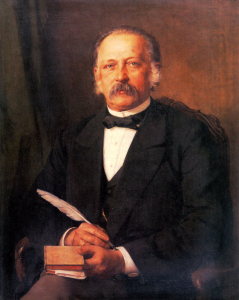
Theodor Fontane (1819-1898), portrait by Carl Breitbach

The novels for Hilary Term don’t look much more promising on the surface. There’s still no female authors, and we’re treated to a round of soldiers, a magician and an ungeheuren Ungeziefer (the ‘monstrous bug’ of Kafka’s metamorphosis)*. Fontane’s novel, however, is a game changer. Although it’s written by a man, the novel is structured so that we share our experiences with the female protagonist. When Effi’s bored, Fontane takes up page after page to explain her boredom, so that we’re bored with her. When Effi’s happy, we’ll only experience a page of excitement because time flies when we’re having fun.

This is no accident. Sharing Effi’s experiences means we’re naturally sympathetic towards her, so when she takes actions that were unforgivable in her Victorian Prussian context – ie: having an affair with married womaniser Major Crampas – we understand her motivations and direct our animosity towards the privileged few that oppress Effi.

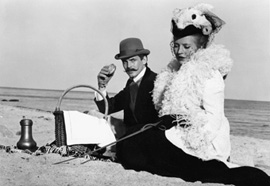
Hanna Schygulla played Effi in Rainer Werner Fassbinder’s 1974 adaptation. (Prod Co: Tango Film Prod, Dir: Rainer Werner Fassbinder, Phot: Jürgen Jürges, Dietrich Lohmann, Ed: Thea Eymèsz, Art Dir: Kurt Raab).

Of course she’s young, naïve, and perhaps not the greatest heroine we could have hoped for. However, Effi Briest ticks all the boxes for a first wave feminist text that highlights women’s issues in Fontane’s context. Everyone should be very excited about studying this author!

* If you’re curious about translating the phrase ‘ungeheuren Ungeziefer’, check out this article by professional translator Susan Bernofsky.

Virtual Book Club: Italian takes a turn

The Virtual Book Club is back once again, this time with an episode on Italian. The Italian episode features a discussion about a poem by Patrizia Cavalli, which was published in 1992. Here, doctoral student Nicolò Crisafi guides two undergraduates, Kirsty and Hannah, through the poem, looking at topics like gender, voice, and form.

If you would like to receive a copy of the poem to follow as you watch the discussion, or if you would like future Virtual Book Club updates, please email us at schools.liaison@mod-langs.ox.ac.uk

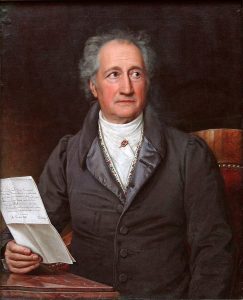
A Two Minute Introduction to Goethe

This post was written by Isabel Parkinson, who studies German & Philosophy at Worcester College.

Johann Wolfgang von Goethe was born, rather poetically, on a summer’s day in Frankfurt in 1749 just as the church bells were striking noon. In true sensitive-artist style he studied law as a young man and detested it, preferring to attend poetry lectures instead and write Baroque-style verse for his lover. Goethe became a literary celebrity at just twenty-five when he wrote Die Leiden des jungen Werthers – a quite beautiful story that’s not only unchallenging enough to be read for pleasure, but has been so excellently translated that no knowledge of German is required. It’s achingly melancholy and endearingly optimistic in equal measure with a core of reverent, self-sacrificial, and occasionally obsessive love; the young hero Werther is so desperately infatuated with Lotte that he sends his servant to her house when he himself cannot visit, just to have someone in his home who has seen her.

Werther made Goethe an overnight success, and by the 1790s he was collaborating and communicating with the other major player in the German literature scene, Friedrich Schiller. In 1809 Goethe published his third novel, Elective Affinities. It is written in prose, rather than in the epistolary style of Werther and is a similarly excellent story, with not so much a love triangle as a love square or maybe even a pentagon.

Goethe turned his hand to many things – politics, science, prose – and his epic reworking of the classic legend Faust is an example of his dabbling in the closet drama genre. Part One is closely connected to the original famous legend, while Part Two – published in 1832, the year of Goethe’s death – pushes the story and the soul wager to its conclusion. The rich detail and sheer length of Goethe’s Faust may unfairly paint it as an impenetrable work; these misconceptions hide a vividly imagined and often quite humorous tale. It is true that one can make much of the religious, moral, and philosophical questions, but they are balanced with lighter touches such as a shape-shifting poodle and Mephistopheles accompanying Faust on a double date through a garden – and what Oxford student can fail to identify with the dissatisfied academic who trades his soul for knowledge and pleasure?

Virtual Book Club goes French

Last month saw the launch of our virtual book club with an episode in Russian.

This month, we’ve moved on to discuss an extract of a text written in French. This episode focuses on a passage from Suzanne Dracius’s La Virago. Dracius is an author and playwright who was born in the Caribbean island of Martinique, which is a French overseas territory. Dracisu grew up on the outskirts of Paris, and her writing draws on her dual heritage as both Caribbean and French.

Watch as Dr Vanessa Lee guides some undergraduates through a discussion of gender assumptions, narrative suspense, and reader expectations in this text, touching on details like the use of tenses and imagery. To receive a copy of the text, as well as future book club updates, email us at schools.liaison@mod-langs.ox.ac.uk with your name and school.

Look out – it’s our Virtual Book Club!

Last month, the Modern Languages Faculty at Oxford launched our virtual book club. For all you bookworms out there, this is a chance to engage more with literature beyond your school curriculum, and in languages other than English.

Each month we will focus on a different language but will always provide the text in translation, as well as in the original language. At the start of the month, we will circulate the texts chosen, which will be poems or short prose extracts, by email. At the end of the month we will upload a video discussion of the text with some of our academics and undergraduates.

The first episode focussed on a passage from the Russian novel The Naked Year, by Boris Pilnyak. It is available below. To receive a copy of the text or to sign up for future episodes, email us at schools.liaison@mod-langs.ox.ac.uk with your name and school.

Post-WW2 Italian Literature: Calm in the face of a storm?

This post was written by Kirsty Bailey, a second-year French and Italian student at Exeter College

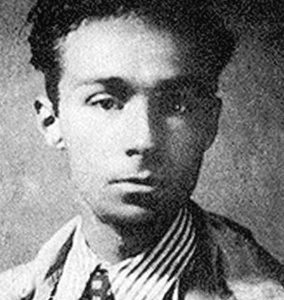
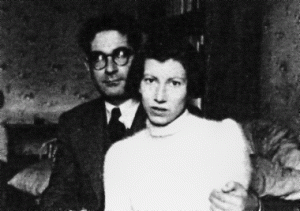
Picture the scene. It is post-WW2 Italy, and two Italian Jewish writers, Primo Levi and Natalia Ginzburg, are writing about their wartime experiences. Levi was a prisoner at the Auschwitz concentration camp, while Ginzburg’s husband was killed for his anti-Fascist activism.

You might expect, in these circumstances, that Levi’s memoir, Se Questo è un uomo (If This is a Man, 1947) would be emotionally charged, with an angry or despairing narrator. While the work does pack an emotional punch, leaving the reader horrified at what the camp’s inmates were forced to endure, Levi’s narrative style is surprisingly measured – he remains calm; even detached. He seeks to analyse the situation, allowing the reader to draw their own conclusions. He never laments his own personal struggles, but reflects on the experiences of the prisoners as a collective:

Bisogna risalire la corrente; dare battaglia ogni giorno e ogni ora alla fatica, alla fame… O anche, strazzare ogni dignità.” (“One has to fight against the current; to battle every day and every hour against exhaustion, hunger… Or else, to throttle all dignity.”)

The narrative style of Ginzburg’s autobiographical work, Lessico Familiare (Family Sayings, 1963) is similar to Levi’s, in that the narrator never expresses outrage or despair over the atrocities of the war. Her work, as suggested by its title, is rooted in her family and friends, rather than the larger workings of history. She remains detached from her own personal emotions – even when her husband dies, she worries more about his friend, Cesare Pavese (a fellow twentieth-century Italian writer), than her own grief:
“Era stato il suo migliore amico. Forse annoverava quella perdita fra le cose che lo straziavano.” (“He had been his best friend. That loss may have been one of the things which tortured him”).

A sense of detachment and restraint can therefore be found in both Levi and Ginzburg’s works, despite their emotive subject matter. Their respective narrative voices succeed in remaining calm in the face of a terrifying, terrible storm – making for intriguing narratives well worth a read.

Writing the Great War

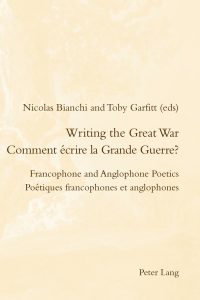
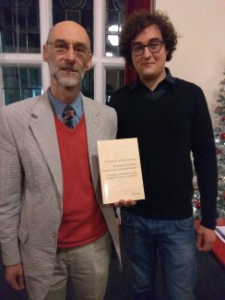
There have been many events commemorating the centenary of the First World War and its key moments. A new book edited jointly by an Oxford academic, Toby Garfitt, and a young researcher from France, Nicolas Bianchi, takes a fresh look at some of the literary responses to the conflict on both sides of the Channel. The volume is deliberately bilingual, and is entitled Writing the Great War/Comment écrire la Grande Guerre? This was very much a collaborative, interdisciplinary project, bringing together specialists from departments of English and French Studies in Britain, France and Belgium, and the preface is by the distinguished war historian Sir Hew Strachan.

The subtitle, ‘Francophone and Anglophone Poetics’, makes it clear that the word ‘Writing’ in the main title is essential. Just how do you write such an overwhelming and unprecedented experience? French authors favoured prose, with some major exceptions, but how far could and should prose negotiate the line between realism and invention? English authors favoured verse, but that verse needs to be appreciated in a wider context of writing. There is a proliferation of voices, registers and styles, with traditional genre-distinctions often breaking down. How can one reconcile the complexity of experience and perception with literary form or political ideology? What is the place of irony and humour? What types of character are developed? What do we know about non-European, non-white perspectives on the war as revealed in poetry and songs from across the world?

You may know, or think you know, about Owen and Sassoon, Apollinaire and Barbusse and Céline, but what explains their different perspectives? What about their personal letters, what about the process of writing and correcting? This book offers a stimulating challenge to readers on both sides of the Channel to broaden their understanding of texts, contexts, and critical studies (the bibliography is particularly full and helpful).

No et moi: Who lives in the Invisible City?

posted by Simon Kemp

‘La ville invisible’ (the invisible city) is the metaphor that introduces the final section of Lou’s presentation to her class in Delphine de Vigan’s No et moi. The novel reproduces the section in full (in fact, it’s the only part of Lou’s speech that the book does include). Here’s what she says:

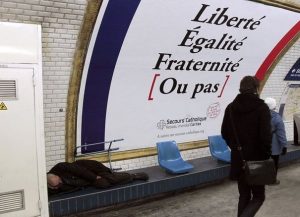
Il y a cette ville invisible, au cœur même de la ville. Cette femme qui dort chaque nuit au même endroit, avec son duvet et des sacs. À même le trottoir. Ces hommes sous les ponts, dans les gares, ces gens allongés sur des cartons ou recroquevillés sur un banc. Un jour, on commence à les voir. Dans la rue, dans le métro. Pas seulement ceux qui font la manche. Ceux qui se cachent. On repère leur démarche, leur veste déformée, leur pull troué. Un jour on s’attache à une silhouette, à une personne, on pose des questions, on essaie de trouver des raisons, des explications, et puis on compte. Les autres, des milliers. Comme le symptôme de notre monde malade. Les choses sont ce qu’elles sont. Mais moi je crois qu’il faut garder les yeux grands ouverts. Pour commencer. (p. 70)

 à même le trottoir : (right) on the pavement

recroquevillé : huddled up

faire la manche : to beg

se cacher: to hide

repérer: to spot, notice

la démarche : the way [they] walk

déformé: stretched out of shape

troué: with holes in it


So the ville invisible is the same city in which everyone else lives (Paris, in Lou’s case), but it is the city made up of homeless people. Her first examples are those we might expect: people sleeping on the streets surrounded by their belongings, under bridges, in stations, lying on cardboard or huddled on benches. Begging for small change. They’re invisible because people choose not to see them: embarrassed, afraid or indifferent, we walk past without acknowledging the presence of the homeless, acting as if there was nobody there.

But these are not the only people Lou is talking about, and this is not the only kind of invisibility in the invisible city. The homeless are not just the people we avoid looking at, but the people we see without realizing they are in distress. The second part of Lou’s paragraph focuses on the people who hide their homelessness, but whose status can be betrayed by small clues in their appearance:

On repère leur démarche: You can spot them by the way they walk (because of drugs or alcohol? untreated injuries? or simply the fact of having nowhere to go?)…

On repère […] leur veste déformée: You can spot them by a stretched-out jacket (bulked out by extra layers of clothing beneath it for warmth?)…

On repère […] leur pull troué: You can spot them by the holes in a worn-out jumper.

Lou has found herself starting to ‘tune in’ to the presence of these people, people like No, and she’s here encouraging her classmates to try to do the same thing. The first step is to see the invisible people, to start to realize just how many of them there are. Then you can try to do something to help them.

The idea of the invisible city crops up several more times in the course of the novel, for instance on p. 76 and 119. As Lou thinks more about it, it develops into an image of a parallel world, occupying the same space as ours but treated as if in a different dimension: ‘ce monde parallèle qui est pourtant la nôtre’ (p. 119). Lou refuses to accept that her world must remain separate from No’s. The story is her quest to find ‘un endroit où les mondes communiquent entre eux’ (p. 76).

No et moi: What’s with the kitchen gadgets?

posted by Simon Kemp

Here’s an odd little detail from No et moi, Delphine de Vigan’s novel about a thirteen-year-old genius who befriends an older homeless girl. Towards the end of the novel, Lou (the thirteen-year-old) is feeling overwhelmed by the situation. A few weeks earlier, the story almost seemed to have reached a happy ending, with No installed in Lou’s family home, happy, sober and in employment, and Lou’s mother lifted out of the long depression caused by the death of Lou’s baby sister Thaïs by the experience of helping No put her life back on the rails.

Now, though, all of this has fallen apart. No’s drinking and pill-stealing have seen her thrown out of Lou’s home, and Lou has reason to believe that the temporary refuge she has found with Lucas is now under threat. Lou’s own secret crush on Lucas is running up against the harsh reality of their four-year age difference, and she is filled with jealousy at his attention to other girls his age. When No gives Lou an expensive thank you gift, Lou is struck by the contrast between the bleakness of No’s situation and the fake glamour of the perfume advertisement on a poster that forms the backdrop to the scene.

She heads home in a black mood, slams her bedroom door in her mother’s face, and later tells her father:

Depuis que Thaïs est morte maman m’aime plus. 

(The scene, by the way, is pp. 221-22 in the Livre de Poche edition.) Her father tells her she’s mistaken:

Lou, tu te trompes. Maman t’aime, elle t’aime de tout son cœur, elle ne sait plus très bien comment faire, pour le montrer, c’est un peu comme si elle avait perdu l’habitude, comme si elle se réveillait d’un long sommeil, mais dans ses rêves elle pensait à toi, beaucoup, et c’est pour ça qu’elle s’est réveillée.

Lou says ‘d’accord’ to show she’s understood him, and even smiles. But inwardly, she’s thinking… what?

She’s thinking about kitchen gadgets:

J’ai pensé aux vendeurs devant les Galeries Lafayette, perchés sur leurs petits stands, ceux qui font des démonstrations avec des machines incroyables qui découpent les trucs en cubes, en tranches, en rondelles, en lamelles, en roses des vents, qui râpent, pressent, broient, mixent, bref qui font absolument tout et qui durent toute la vie.

N’empêche que moi je ne suis pas tombée du dernier RER.

And there the chapter ends. What does it mean?

Galeries Lafayette is a deluxe department store in Paris, and these salespeople are in the street outside it. (Do they work for the department store, or are they just hoping for a little reflected glory on the product they’re selling?) The kitchen gadget they’re demonstrating is a kind of miracle all-in-one food preparation device that can dice, slice, grind, mix and do all of the other things listed above, plus more besides, and which will never break down as long as you live. Or at least, that’s what they claim.

Lou’s comment on this loosely translates as ‘Even so, I didn’t fall off the last RER’, the RER being the Paris crossrail linking the suburbs to the city centre. Even if you don’t spot the similarity to the more usual French expression, ‘je ne suis pas tombée de la dernière pluie’, you can probably guess from the context that this is Lou’s urban version of the expression meaning ‘I wasn’t born yesterday’.

With that, things start to become clear. The gadgets are just too perfect: they do everything, you can rely on them for ever. Clearly, the salespeople are lying, and the thing will spend a couple of weeks grinding when it’s supposed to grate and slicing when it’s supposed to dice before breaking down completely and spending the rest of its life at the back of a cupboard.

If the kitchen gadgets are a symbol, then, they must symbolize the idea that Lou’s father’s reassurance is also a lie, that the picture he paints of a mother who loves her daughter dearly but just needs a little more time to recover from her depression is also too perfect to be true.

Lou has witnessed how No managed to bring her mother out of her shell, make her smile again and engage with the world, in a way that Lou herself has never been able to. Earlier, Lou was left ‘très en colère’  (on p. 157) when her mother shared a bottle of wine with No and opened up to her about Thaïs in a way she never had with Lou. So Lou is jealous of her mother’s relationship with No, and resentful that her mother hasn’t shown so much closeness to her for years.

It’s never clearly expressed, but we can also speculate about what may lie beneath these feelings: is Lou secretly afraid that her mother would rather that she, Lou, had died and Thaïs had lived?

And if so, is she right to be afraid of that?

We’re left to make up our own minds about these questions. My own view is that Lou’s father is largely right: Lou’s mother has behaved like she has because she has been suffering from depression, not because she does not love her daughter. Lou’s sceptical thoughts about food-processors tell us more about her own (understandable) feelings of insecurity, than they do about her mother’s true attitude towards her.

You may read it differently. However you interpret it, though, it definitely forms a part of the novel’s deeper story about how Lou slowly comes to understand that in real life there are no fairy-tale happy endings, and that broken people cannot be easily fixed.