Academic Taster Days are a fantastic opportunity aimed at Year 12 students (or equivalent) to explore a specific subject area, meet tutors and current students, experience a taste of academic teaching at Oxford, and find out more about studying at university.
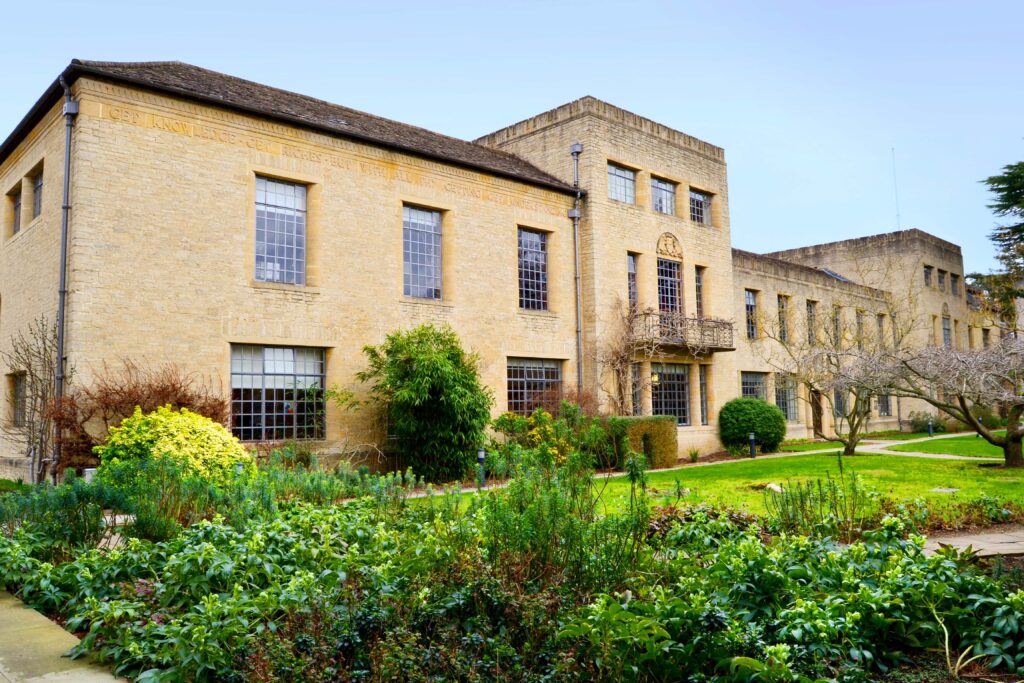
S Catherine’s College (Catz), Oxford are running a Modern Languages and Linguistics Day on Weds 27th May.
St Catherine’s College (Catz), Oxford
This will include a demonstration interview with a current student and academic session options, including sessions for attendees already studying French, Spanish or German. It also includes beginners’ sessions in Linguistics and German. Details of further beginners’ sessions will be added to our webpage and may include: Czech, Italian, Modern Greek and Portuguese.
All events are free to attend, including any refreshments or lunch. We prioritise students from UK state schools and our link region of Wales.
For further information and to apply, please visit the Catz website.
The deadline for applications is midday on Monday 27 April. If you have any questions about booking or accessibility requirements, please contactou******@**********ac.uk.
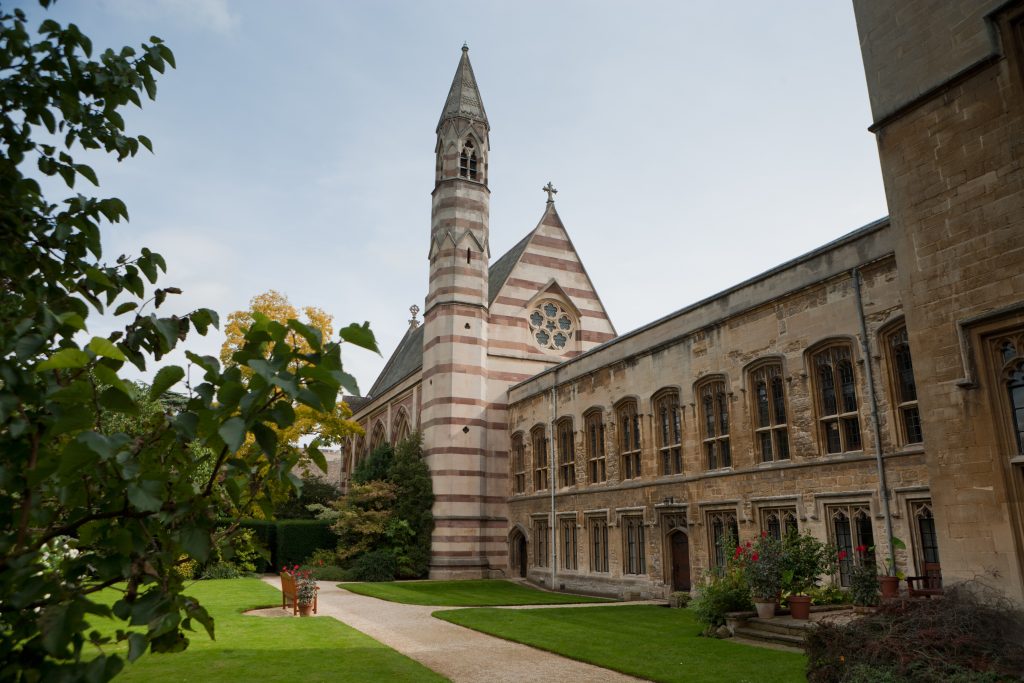
The Faculties of History and Medieval and Modern Languages along with St Anne’s College, Oxford are delighted to be offering a Study Day dedicated to Year 12 state school students looking to study History and a Modern Language at University/Oxford!
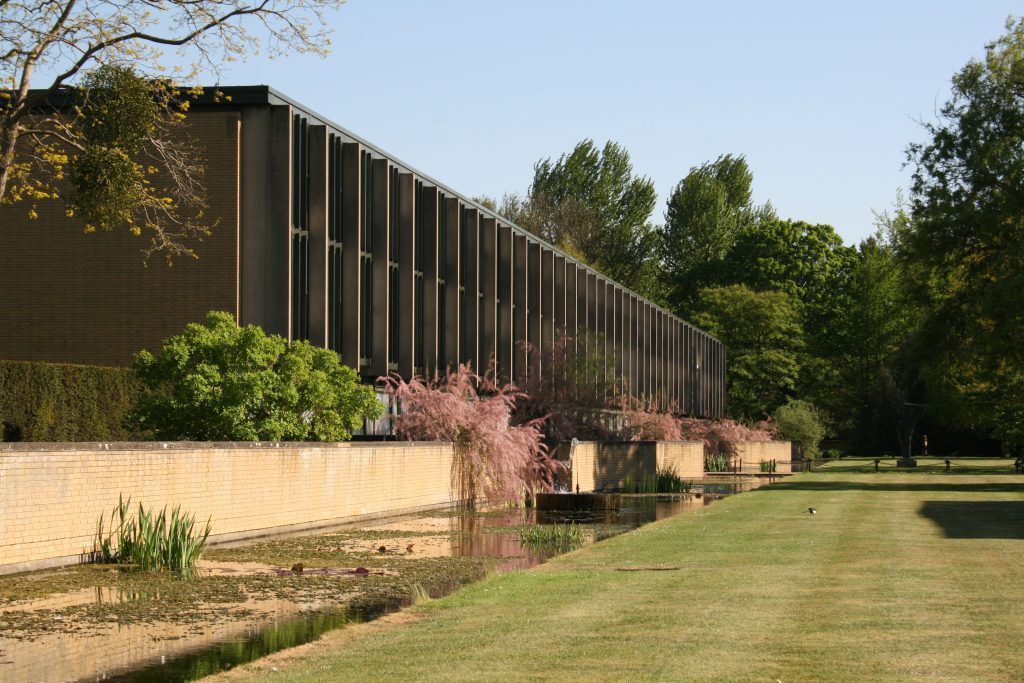
This event will take place on Monday 25th May at St Anne’s College.
St Anne’s College, Oxford
The Study Day will offer students the chance to:
experience academic taster sessions in both History and a Modern Language (that they are studying at A-level or in a brand-new language that they might wish to take from scratch* alongside History);
meet and ask questions to current History and Modern Languages students;
hear about the History and Modern Languages course and admissions process;
meet other students who are interested in studying History and a Modern Language at University/Oxford;
visit an Oxford college and learn more about Oxford’s collegiate structure.
Please note, students do not need to be studying History or a Modern Language at A-level in order to attend the event but must have a serious interest in studying the two subjects as a joint degree at University in order to apply.
There is no cost for attending the Study Day and participants will receive a free lunch at the college. We are committed to ensuring that students are not prevented from attending this event due to costs. Therefore, we are pleased to be able to offer financial support to students for reasonable travel expenses to and from Oxford for the Study Day.
Students who are interested in taking part can apply via this form by Sunday 26th April.
In the case of oversubscription to the event, priority will be given to applicants who are currently under-represented in higher education. More information about this and the University’s commitment to increasing access can be found here.
* Our beginners’ languages courses offer an exciting and rare opportunity for students to engage with a new language and culture for the first time, or to pick up a language they studied at GCSE. The courses are challenging yet rewarding, with many designed to bring students up to A-level standard within the first year.
This week’s blog post was written by Emma, a final year German and Linguistics student, about Oxford’s best night out!
At Open Days, one of the most-asked questions is ‘what is the highlight of studying languages at Oxford University?’ Answers tend to range from the world-class teaching on niche aspects of medieval Spanish literature or modern German linguistics to the unforgettable year abroad. While these are undoubtedly highlights, they overlook the biggest night of term for language societies in Oxford: European Night!
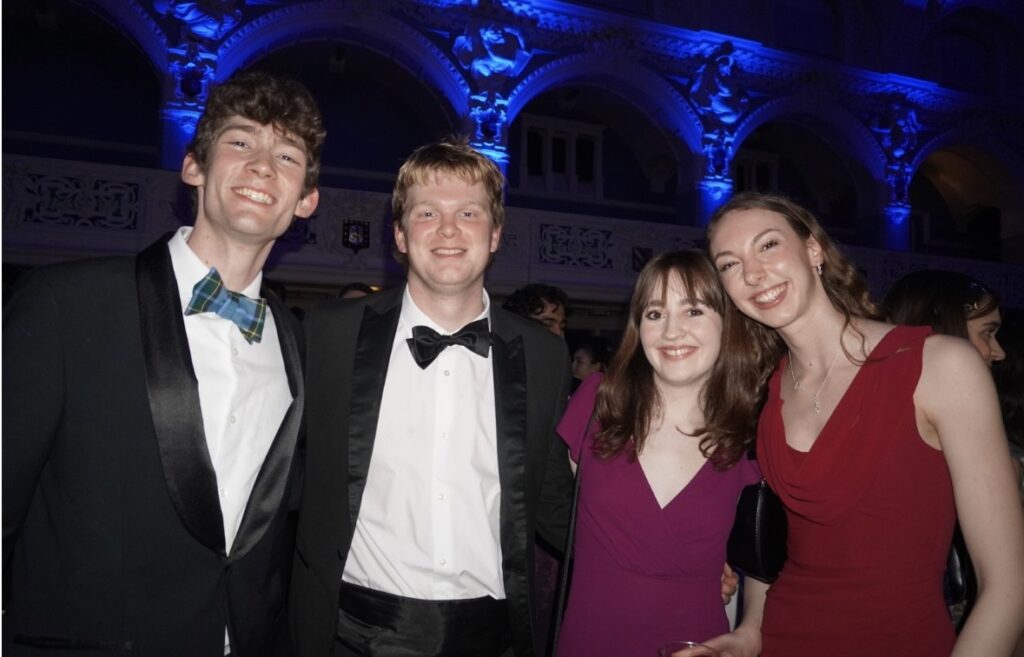
Emma and friends at European Night! Photographer: @leopoldine.grl
European Night is an evening characterised by formal attire, cocktails, and Euro anthems. The event takes place towards the end of each term and is well-known for selling out in a matter of seconds. In Michaelmas (autumn) term of this year, the event proved so popular that I was unable to get my hands on a ticket… Getting tickets for Taylor Swift’s Eras Tour had felt easier! Fortunately, Hilary (spring) term brought better luck and my friends and I secured tickets on the first release.
European Night is organised by the French Society but is an opportunity for students from all of the language societies to get dressed up and party together. You can expect to meet a wide range of people from the Italian, German, Spanish, Belgian, Scandinavian, Swiss, and Polish societies, just to name a few! Language societies bring native speakers and language learners together and form part of Oxford’s vibrant network of over 400 student societies. Every term, they host a series of exciting events such as cultural celebrations, bar crawls, and pub quizzes. As a languages student attending European Night, you will inevitably bump into friends from your society as well as your college and your subject, making it a highlight of the social calendar!
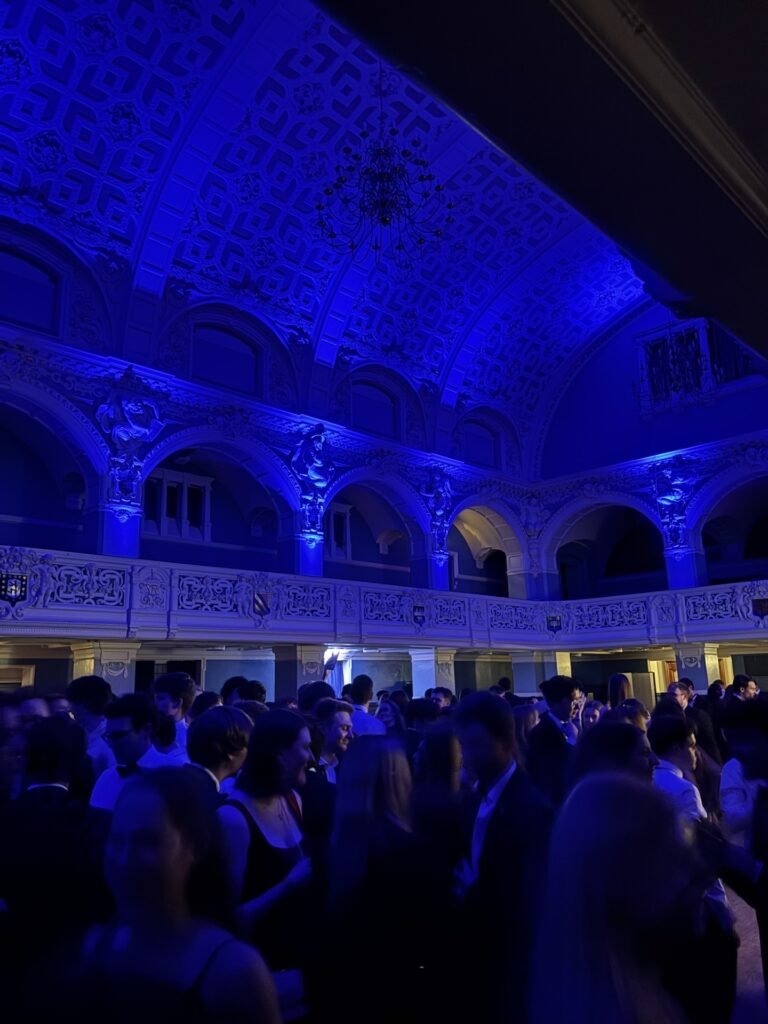
Oxford Town Hall on European Night
Over the years, European Night has been held in a variety of iconic venues across Oxford. In my first year, I attended the event at Freud, a function space in a converted church. In both my second year and my final year, the event has been held at Oxford Town Hall, a striking location with a main hall that is reminiscent of a ballroom. Last term, the event was even hosted at the Oxford Union! The dress code for the event is black tie, which means a tuxedo with a black bow tie or a long, elegant dress. However, the formal dress code doesn’t stop guests from dancing their hearts out. The town hall was practically bouncing as Swedish House Mafia’s Don’t You Worry Child, Nena’s 99 Luftballons and, of course, ABBA’s Gimme! Gimme! Gimme! blasted from the speakers, every lyric belted out in unison across the packed dance floor.
So, if you’re wondering what makes studying languages at Oxford so appealing, let me propose the following: work hard, play hard. For students who spend their days untangling linguistic nuance in complex texts, European Night is a celebration of multilingualism which serves as a reminder of why we pursue languages in the first place: human connection.
Balliol College are running a Modern Languages Taster Day on Monday 15th June. This will take place in person at the College.
Balliol College
The Taster Day is aimed at students in Year 12 who are seriously considering studying French, Italian, Spanish or Modern Languages and Linguistics at Oxford.
The event will include an admission session, lectures, a demonstration interview, and an opportunity to meet with undergraduates who are studying languages at Balliol. A two course hot lunch will be provided free of charge.
To apply to take part in this event, please complete this form by 24 May 2026. Balliol College will prioritise applications from disadvantaged students and from groups which are under-represented at the university.
We are delighted to welcome prospective students to Oxford on Saturday 16th May for our annual Modern Languages Open Day. The event will be held from 10.30am-4.30pm in the in the brand-new Schwarzman Centre for the Humanities.
The Schwarzman Centre for the Humanities
This Open Day is designed to provide further information about and insight into studying a modern language and the various degree combinations we offer at Oxford.
As a Faculty, we offer the following languages: French, Spanish, German, Portuguese, Italian, Russian, Czech with Slovak, Modern Greek, and Polish, all of which will be represented at this event. These can be combined with another language from beginners’ level (with the exception of French and Spanish which cannot be studied from scratch), or another Humanities subject (History, English, Philosophy, Linguistics, Classics, and a Middle Eastern Language).
After a general information and Q&A session in the morning, students and their companions will have the chance to attend subject-specific sessions in the afternoon, where they can meet tutors and current students from those subjects.
Modern Languages Open Day 2022
photo (c) John Cairns
A full programme for the Open Day will be made available shortly.
Please fill out this form by 12 noon on Wednesday 13th May to register for the Open Day so we know who to expect at the event.
Please note that we can only host one companion (parent/carer/teacher) per student. Spaces will be allocated on a first-come, first-served basis, and the form will close once our maximum capacity has been reached.
If you have any questions or would like to amend your booking, please get in touch with Nicola Brown, Schools Liaison and Outreach Officer, at sc*************@*************ac.uk.
Wadham College, Oxford are introducing a virtual Book Club for Year 12 students attending a state school who are currently studying English Literature and/or Modern Languages or who would be interested in studying these subjects for their university degree.
A French session at the 2021 Wadham College Summer School
The Book Club will involve three online sessions, as well as the chance to attend a final, in-person session and Taster Day at Wadham College. Each session will involve a short lecture, breakout room discussion with current Oxford students, and recommendations for further reading and support.
The theme for these sessions will be ‘Possible Worlds’, considering the ways that writers have thought about the possible futures that may await humanity. The aim is to build on core A-Level English texts by thinking about their wider literary contexts with the aim of bridging the gap between A-Level and university study. In the 3rd session, Dr Cat Parry (Tutor for Portuguese) will also incorporate poetry in translation in order to develop appreciation for world literature. Participants will be required to read 1-3 short extracts (provided) ahead of the sessions.
The sessions will be held on the following dates: Session 1: Monday 27th April, 16:30-17:30, Prose/Drama with Dr Douglas Clark (Tutor for English)
Session 2: Monday 18th May, 16:30-17:30, Prose/Drama with Dr Douglas Clark
Session 3: Monday 8th June, 16:30-17:30, Poetry with Dr Douglas Clark and Dr Cat Parry (Tutor for Portuguese)
Session 4 (Taster Day): Monday 22nd June
Sessions 1-3 will be held online via Microsoft Teams.
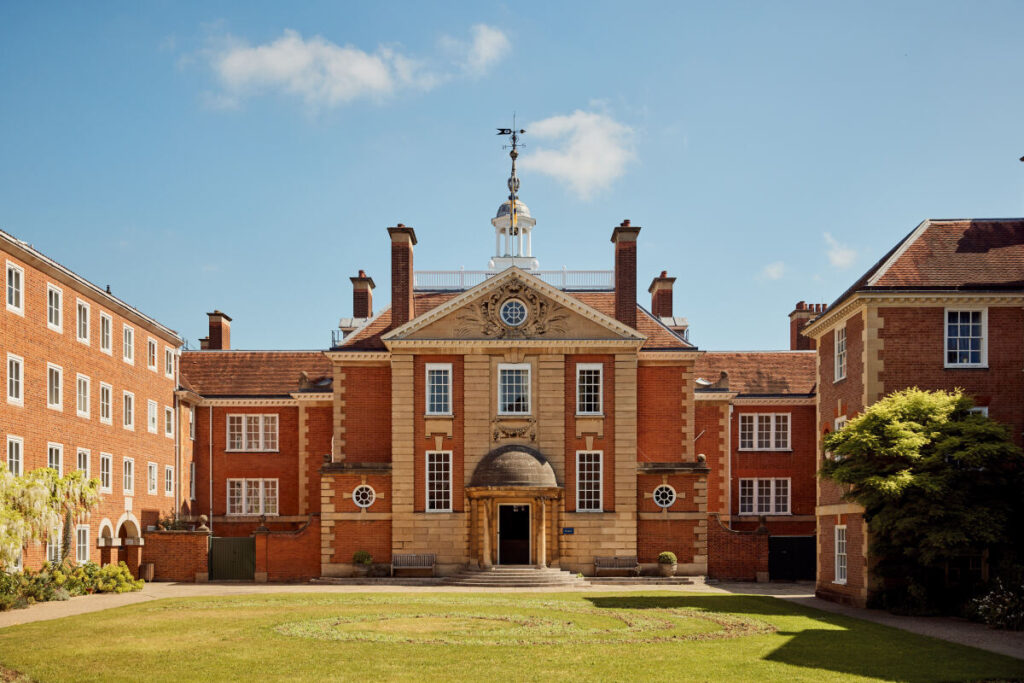
Year 12 students from state schools and colleges across the UK are invited to join Lady Margaret Hall (one of our lovely Oxford colleges) for a Modern Languages and Linguistics Taster Day on Wednesday 22nd April.
Lady Margaret Hall Fisher Studios LTD
This Modern Languages and Linguistics Taster Day gives students the opportunity to experience the richness and diversity of our undergraduate degree programmes. Lady Margaret Hall (LMH) tutors will offer a series of taster workshops focusing on French literature and Spanish cinema, alongside introductory sessions to Portuguese, Russian and the study of Linguistics. These tasters will give an indication of the variety of areas and approaches that make up a Modern Languages course, which extends across literature, language, film, history, culture, and thought, and of the wide range of skills our students hone through their in-depth study.
The day will include a discussion of the Modern Languages and Linguistics application process at Oxford, a mock interview, and a Q&A with tutors and current undergraduate students in Modern Languages. All attendees will also have a tour of LMH with one of our student ambassadors and a free lunch in the college hall.
We welcome any Year 12 student from a UK state school who has a keen interest in languages and linguistics, who is studying at least one language (French, German, Spanish) at A-level, and is considering studying modern languages at university. No prior knowledge of a specific language or of linguistics is required in order to attend a taster session on that topic.
There are three new exciting tasks for pupils in Years 8 to 12, as well as our prestigious Camden House Book Proposal for postgraduates and early-career researchers at a UK university.
To clarify: Round 1 and Round 2 are separate competitions. You may enter both, but do not need to have entered Round 1 in order to enter Round 2.
Entries should be submitted via the online form. Please note that we cannot accept postal or email entries. Entries received by post, by email or after the deadline will not be considered.
The deadline to submit your entries is 26 March 2026 at 12 noon.
Results will be published on our website in June 2026. Winners and runners-up will be contacted by email and invited to a prize-giving ceremony at the Bodleian Library, University of Oxford, in June 2026.
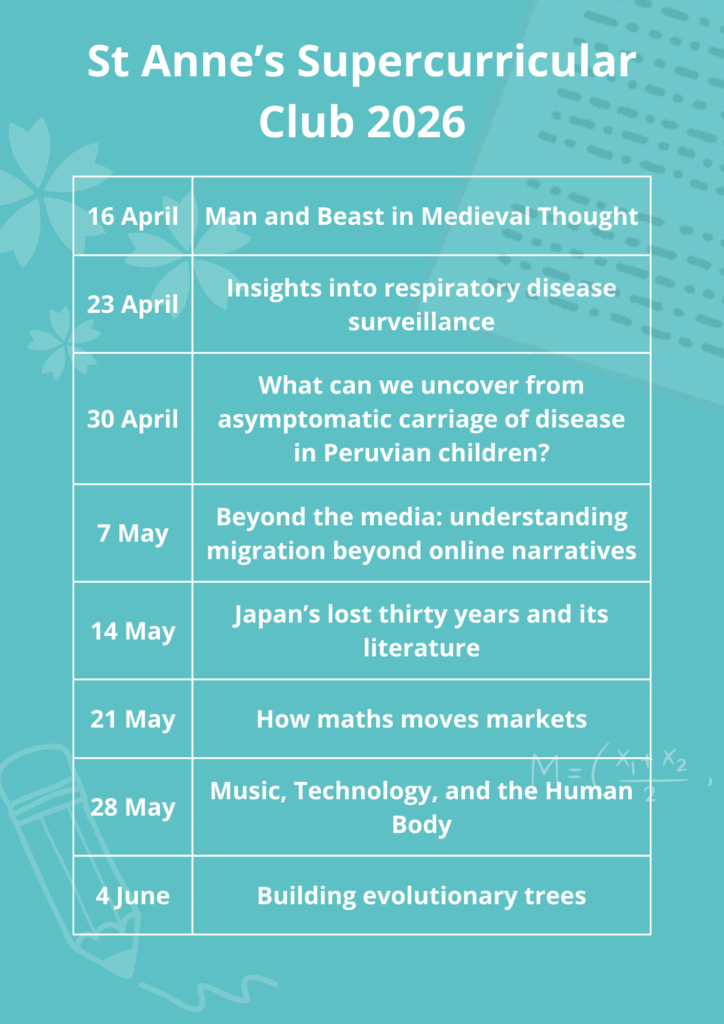
St Anne’s College runs a Supercurricular club – a series of online seminars aimed at Year 12 students looking to explore their interests ahead of applying to university.
This year, St Anne’s will be running eight sessions on a range of different subjects (from pathogens to music to Japanese literature) at 4-5pm every Thursday from 16 April to 4 June 2026.
Each taster session will be one hour long and will introduce students to our researchers’ work, and what this subject area might be like to study at undergraduate level. Open to Year 12 students who would like to get a taste of their subject at this level and learn from an Oxford University academic!
A list of the session topics can be found below:
More information and recordings of last year’s sessions, including one on how to read a medieval poem (with our lovely Tutor in German Dr Anna Wilmore), can be found on the St Anne’s website here: St Anne’s Super-Curricular Club
Oxford’s University College, Magdalen College, and the Faculties of History and Modern Languages are delighted to announce that the virtual BAME Humanities Study Day will return for 2026 on Wednesday 8th April!
This event offers UK state school students with Black, Asian or Minority Ethnic (BAME) heritage an exciting opportunity to engage with academic taster sessions from across the Humanities subjects, and also to access insight into Oxford student life and support with the admissions process.
The day will open with an introduction to the University of Oxford followed by the opportunity to attend two humanities subject lectures. Students will learn more about the Oxford application process in our subject-specific admissions workshops. The day will conclude with a live student life Q&A where you will have the opportunity to ask your questions to current Oxford students from BAME backgrounds.
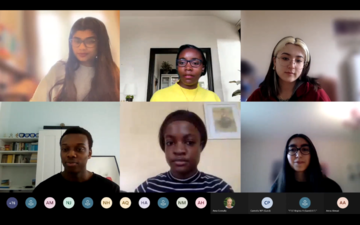
Screenshot of the Q&A with undergraduates from the 2021 Humanities Study Day
For the academic lectures you will be able to choose from the following subjects:
Asian and Middle Eastern Studies
Classics
English
History
History of Art
Modern Languages
Linguistics
Philosophy
Theology.
You will be able to specify your preferred lectures on the application form. All lectures will be recorded and available to watch after the event. If you are unable to attend live on the day but would like access to the recordings and resources, then please still submit an application via the form below.
Before attending the subject day, I had no prior ideas about attending Oxford, nor was I really interested. This was mostly because I thought Oxford was an unreachable place for someone like me, a coloured girl who does not come from a highly prestigious background, which I believed Oxford to be the opposite. Attending the study day made me realise Oxford is actually a very accessible and open place for someone of my background…
– 2023 Study Day participant
Eligibility Criteria:
Year 12
Black, Asian, or Minority Ethnic (BAME) Heritage
Attend a UK State School (unless you have extenuating circumstances or meet several of the priority criteria listed below)
If spaces are limited, priority will be given to students who meet one or more of the following: first generation in your family to attend university, have experience of being in care, are a young carer, are eligible for Free School Meals/Pupil Premium, are from an area of deprivation or area with a low rate of progression to university.
Applications are now OPEN and will close on 2nd March. You can apply via this online form.
If you have any questions about this event please email one of the organisers, Nuala Marshall (Senior Outreach & Access Officer, Magdalen College) at ou******@********ac.uk.
A blog for school students and teachers and anyone else with an interest in Modern Languages and Cultures, written by the staff and students of Oxford University. Updated every Wednesday!
Data Protection: Like most websites, this site collects some user data in order to function properly.
In order to use this site we need you to consent to this by clicking I agree. I AcceptTell Me More
Privacy & Cookies Policy
Privacy Overview
This website uses cookies to improve your experience while you navigate through the website. Out of these, the cookies that are categorized as necessary are stored on your browser as they are essential for the working of basic functionalities of the website. We also use third-party cookies that help us analyze and understand how you use this website. These cookies will be stored in your browser only with your consent. You also have the option to opt-out of these cookies. But opting out of some of these cookies may affect your browsing experience.
Necessary cookies are absolutely essential for the website to function properly. This category only includes cookies that ensures basic functionalities and security features of the website. These cookies do not store any personal information.
Any cookies that may not be particularly necessary for the website to function and is used specifically to collect user personal data via analytics, ads, other embedded contents are termed as non-necessary cookies. It is mandatory to procure user consent prior to running these cookies on your website.