At the University of Oxford you can study Modern Languages in combination with a number of other subjects: Classics, English, History, Linguistics, Middle Eastern Languages, and Philosophy. In this post, Georgina Ramsay, who studies French and English at The Queen’s College, tells us about what motivated her to do a Joint Schools degree. More information about Joint Schools Degrees can be found through the course listings on the University admissions pages. Over to Georgina…
It wasn’t until I was applying to university that I came across the term ‘joint-honours’ but I was definitely glad when I did. I had always assumed that I would apply to study English at university but following GCSEs, the first year of A-Levels and then attending the UNIQ Summer School I started to really consider the possibility of studying French. As excited as I was by the prospect of continuing to improve my French skills I was still conflicted between my two favourite subjects.

It was whilst researching degree courses that I realised that it was possible for me to continue with both English and French as there were some universities, including Oxford, that offered joint-honours degrees. I narrowed down my options, taking into account the split between the two subjects (some institutions place more emphasis on one subject) and what I liked about the Oxford course was that there was a 50:50 split.
As an avid reader and bibliophile I had wanted to study English Literature because I liked the window it gave me into the world, history and different cultures. However, these reasons also applied to why I wanted to study French. A-Level French had been my first introduction into reading literature in another language and I had really enjoyed it. I realised that in studying French I would have access to a whole new world of Francophone literature.
After now having completed a full academic year I am certain that deciding to apply for both English and French was the right decision. I am now in my second year and I am still realising more and more the connections that can be made between the two sides of my course. For example, last year on the English side of my course I was really interested in postcolonial literature and looked at works by Frantz Fanon, a Martinican writer. I also studied Aimé Césaire in my French classes where I also learnt more about France’s colonial history. As a result I was able to see Fanon’s influence on Césaire and ultimately each side of the course was enriched by the other – which was what I had hoped for when I decided to apply.
Next week Georgina will tell us some things to consider when applying for a Joint Schools degree.
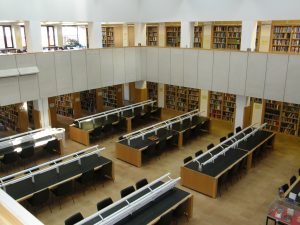
PS. We maintain that Modern Languages has a prettier library. 😉
 The narrative style of Ginzburg’s autobiographical work, Lessico Familiare (Family Sayings, 1963) is similar to Levi’s, in that the narrator never expresses outrage or despair over the atrocities of the war. Her work, as suggested by its title, is rooted in her family and friends, rather than the larger workings of history. She remains detached from her own personal emotions – even when her husband dies, she worries more about his friend, Cesare Pavese (a fellow twentieth-century Italian writer), than her own grief: