In May The Oxford Centre for Comparative Criticism and Translation, and St Anne’s College hosted a discussion between two of the best-known novelists writing in Spanish today, Javier Cercas and Juan Gabriel Vásquez. Beginning as an introduction to their recent publications, the conversation evolved into an exciting reflection on the role of storytelling in a post-truth age…
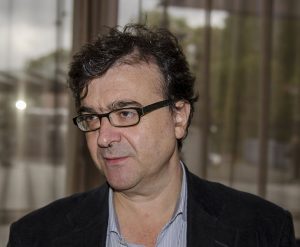
Javier Cercas gave an insight into his 2014 novel, El Impostor (The Impostor), which tells the story of Enric Marco Battle, a trade unionist who became famous in Spain as a survivor of the concentration camps Mauthausen and Flossenbürg. Battle became a spokesperson for Spanish survivors of the Holocaust and was a prominent voice against Fascism. However, in 2005 it was revealed that Battle had deceived the public about his experience of the war and had never been held in a concentration camp. He was, in effect, an impostor.
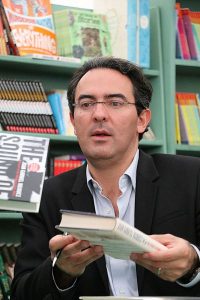
Vásquez introduced his 2015 novel, La forma de las ruinas (The Shape of the Ruins), which traces two political assassinations in Colombia’s history: that of General Rafael Uribe Uribe, a senator and civil war veteran killed in 1914; and that of Jorge Eliécer Gaitán, a leader of the Liberal party and presidential candidate at the time of his murder in 1948. Vásquez’s novel includes a character called Carlos Carballo, a conspiracy theorist who believes the two crimes are linked, not only to one another, but also to the assassinations of John and Robert Kennedy.
Both novels, then, might to some degree be considered historical fiction, taking their storylines from history but marrying this with the imagination to create a version of the past that is closer to what we might expect from fiction. However, the two writers use their novels to problematise this genre, questioning the role fiction can play in an era of alternative facts.
The writers consider the figure of the fantasist, asking what motivates a fantasist to invent alternative scenarios and why such figures are believed. This begs the question, is the novelist a kind of fantasist? And if you can have a factual novel, what is it that makes it a novel, a work of the imagination?
Vásquez suggests that fantasists are fascinated by stories, by creating narrative out of the past as a way to meet their personal objectives. They are detectives of a kind, and the novel is a means of probing reality and humanity. As Ford Madox Ford said, the novel is a ‘medium of profoundly serious investigation into the human case.’ Cercas, meanwhile, draws a distinction between the different fantasists presented in the two novels: on the one hand, Battle, who distorts history to amplify or falsify his own role within it; on the other, Carballo, who cannot accept that history doesn’t make sense and is ‘a tale told by an idiot, full of sound and fury, signifying nothing’ (a reference to Shakespeare’s Macbeth), and therefore looks endlessly for connections in an effort to find the meaning in history.
What do both fantasists tell us about our relationship to narratives of the past though? Perhaps that history becomes more palatable when it is presented in the form of a story. Between the lack of a story and a lie, we prefer the lie and, to go a step further, when we are dealing with the worst elements of history, we try to mask it with narrative.It is for this reason, Cercas suggests, that General Charles de Gaulle aimed to convince French people that they had all been ‘résistants’ during the war, for, he said, ‘Les Français n’ont pas besoin de la vérité’ [French people do not need the truth].
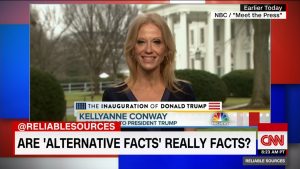
In the current climate, we find other words for lying, referring to distortions of the truth as ‘alternative facts’. Social media allows us to create alternative chains of events and, for the first time, we have the impression of being able to choose the version of reality we want to hear. Consequently, people who are adept at manipulating storytelling have power. Vásquez points out that the German writer and philosopher Novalis asserted that ‘novels arise out of the shortcomings of history.’ The novel goes where history cannot, reframing history as a narrative that can be edited, manipulated, and used to dominate the political moment. This is because, in the words of the poet T. S. Eliot, ‘humankind cannot bear very much reality.’
It seems, therefore, that our present moment is defined by narratology, by storytelling. What do you think – are we facing a battle for the story?