Last month we showcased the runners up in the Years 7-11 category of the Spanish Flash Fiction competition. Now we are delighted to feature the runners up in the older category, Years 12-13. Congratulations to Salome, Year 12, The College of Richard Collyer, and Alexandra, Year 13, Bradfield College.
Huge thanks to everyone who entered the competition this year and made the task of judging both enjoyable and difficult. We hope the winning stories have given you some inspiration and that you will consider entering the contest again in 2020. ¡ Muchas gracias!
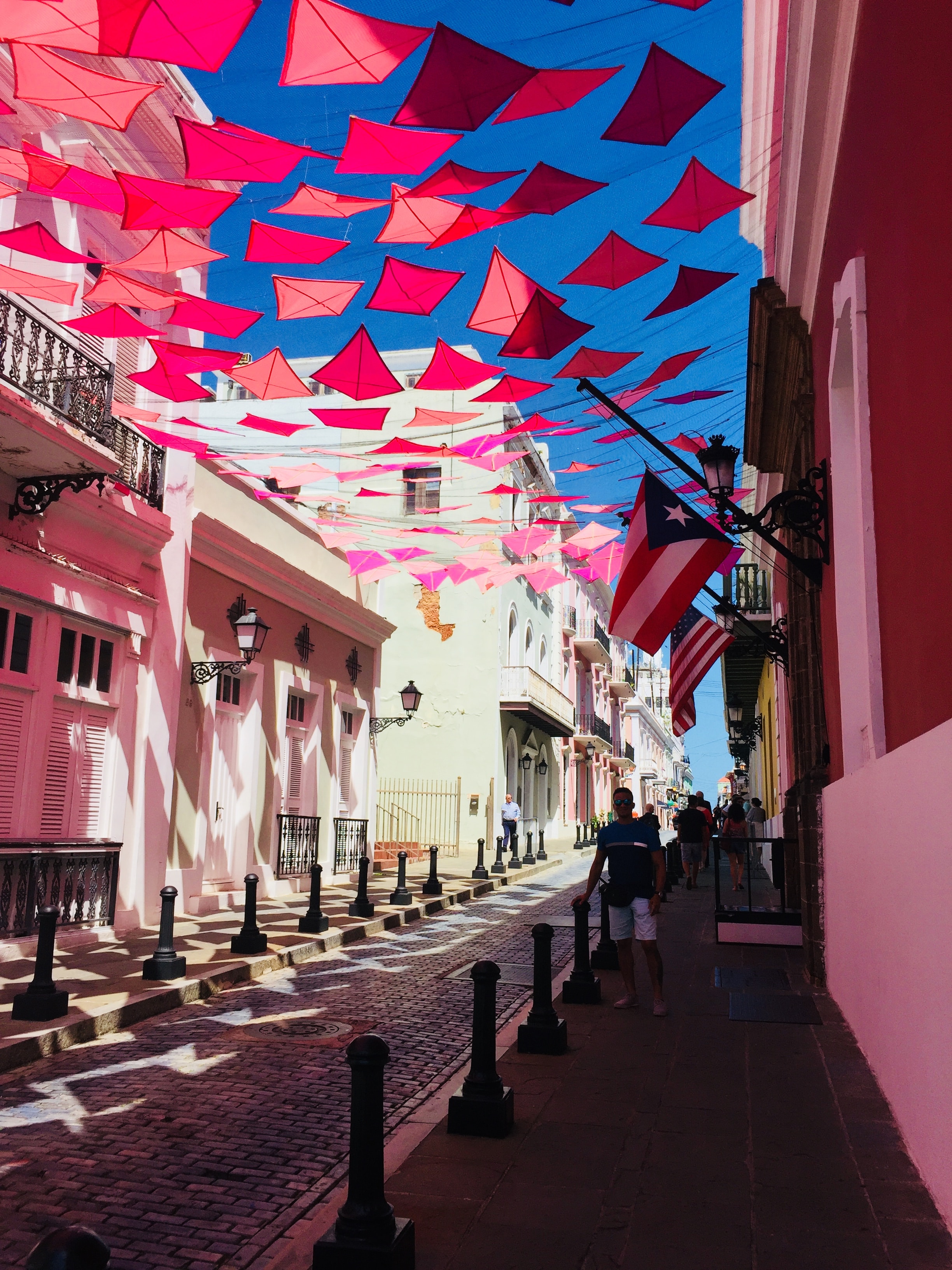
La gente vivía enredada entre la destrucción, casi todos aceptando su destino injusto. El caos dejó almas perdidas y los escombros sofocaron la cuidad. Todo consecuencia de la guerra. Había un hombre con un niño a cada lado, ambos agarrando la mano de su padre. Mire al edificio al que iban: ‘El colegio de Al-Amin’. De repente, los rebeldes, pioneros de la destrucción dispararon, primero a un niño y luego al otro recordándonos donde estábamos. Cayeron como hojas y el padre poco después, reconociendo la poda de su árbol de familia. Al padre lo perdonaron, no porque se sentían culpables, sino porque querían cosechar su perdida.
— Salome, Year 12, The College of Richard Collyer
Su pecadillo letal
Con una golondrina, se libera de sus inhibiciones; se escapa a un mundo de euforia temporal. La sustancia se desliza por su garganta y desencadena una serie de reacciones químicas internas, invisibles a simple vista, que hacen que la realidad parezca absurda. Pero era una serie de reacciones químicas que su cuerpo no podía comprender ni aguantar. Con una sola golondrina, cayó en las garras fatales de una sustancia desconocida. Su estado de euforia se disipó rápidamente, pero gastó todo su dinero en una fantasía, era demasiado tarde para comprar un billete de vuelta a la realidad.
Two weeks ago we announced the hotly anticipated results of our Spanish Flash Fiction Competition. Congratulations to both winners and the four runners up, and well done to everyone who entered what turned out to be a fiercely competitive contest.
We featured the winning entry from the older category on our blog earlier this month. Now, it’s our pleasure to showcase the two runners up from the younger category, Years 7-11: Kasia and Fakyha. You will find their stories below – we hope you enjoy them.
¡ Felicidades, Kasia y Fakyha!
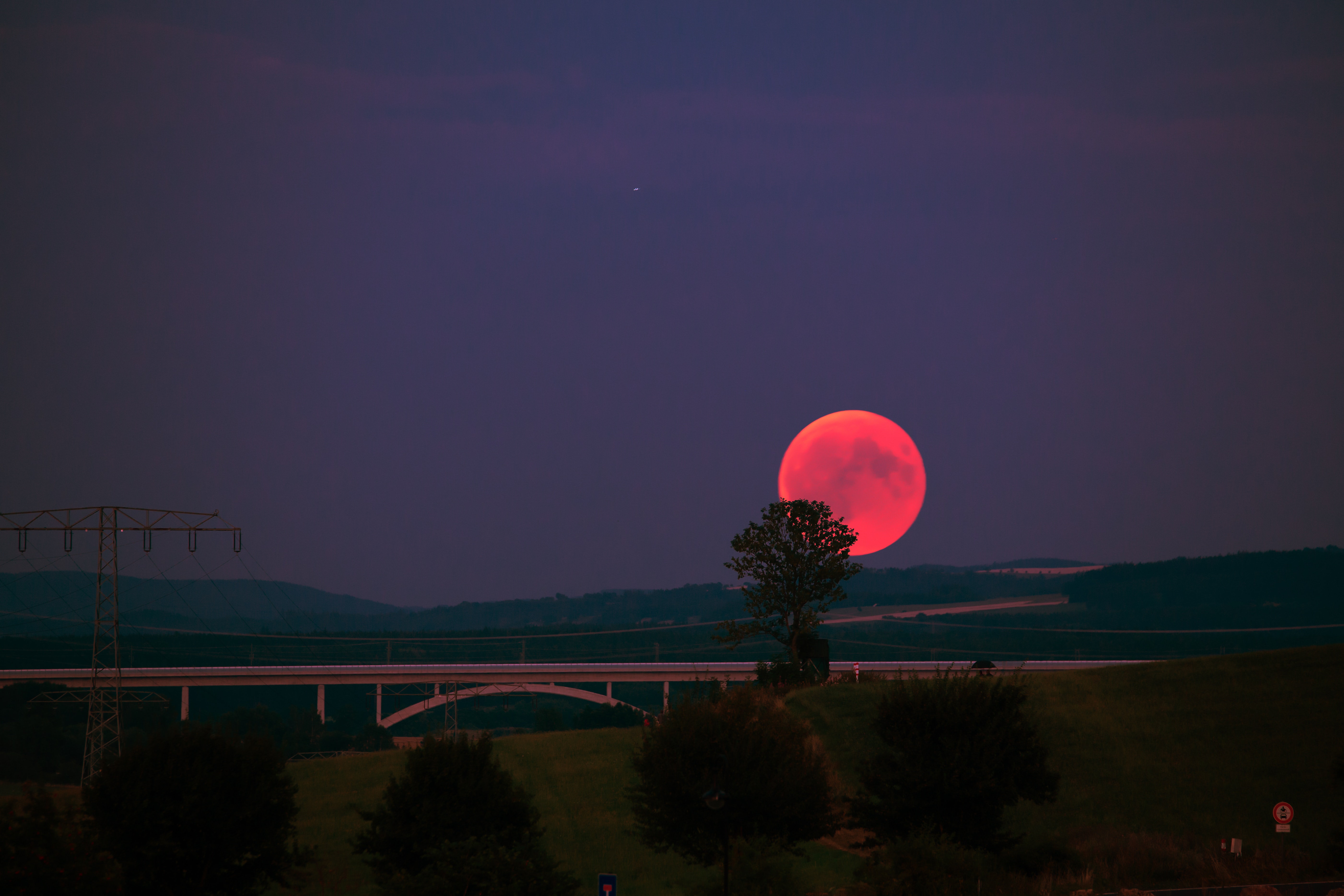
más allá Nunca olvidaré junio de 1988, la forma en que me observaron cuando mi mandíbula cayó al suelo. Sus ojos tan negros como la noche oscura, se veían rectos, no a mis ojos no del todo, sin a ellos. Era una forma de vida terriblemente, totalmente extraña… pero tenían intelligencia… la cosa y sus compañeros. Vi mi reflejo en ellos, una cara sorprendida con la piel tan pálida como la nieve. Mi mente se puso en blanco: todo lo que sabíam todo lo que sé, todo lo que sabré, ha explotado. Nunca olvidaré junio de 1988.
— Kasia, Year 7, Westcliff High School For Girls
Photo by Robert Wiedemann on Unsplash
“Abuelito, no puedo dormir,” dijo el niño. “Ay muchacho, deja te cuenta una historia. Una vez, un fragmento de la luna se cayó a la tierra. Ese día el cielo estaba encendido en fuscia y oro. El fragmento aterrizó en un campo de rosas. ¿Qué pasó depués? Bueno, una palabra: avaricia. Mucha gente trataron de robar el fragmento pero fallaron. ¿Por qué? El fragmento conocía sus intenciones; desapareció de los captores y cada vez volvió al campo. “¿Abuelito, dondé está el fragmento ahora?” Le mostro un collar y allí está el fragmento. “Vino a mí.” yo dije. “¡Qué chulo, abuelito!”
Last week we shared the results of our French Flash Fiction Competition. This week, we bring you the results of our equivalent competition in Spanish. Students in Years 7-13 were invited to submit a short story in Spanish of no more than 100 words. There were two categories: Years 7-11 and Years 12-13. We were delighted to receive almost 600 eligible entries, which covered all sorts of topics, from butterflies to the apocalypse, from a love story between two monkeys, to a personification of war. We even received a memorable recipe for Sangria!
After much deliberation, the judges have selected a winner and two runners up in each age group. The winner of the Years 7-11 category is Catherine, in Year 8, from Churchers College, and the runners up are Kasia, Year 7, Westcliff High School For Girls and Fakyha, Year 10, Nonsuch High School for Girls. The winner of the Years 12-13 category is Freya, Year 12, Aylesbury High School, and the runners up are Salome, Year 12, The College of Richard Collyer, and Alexandra, Year 13, Bradfield College. Huge congratulations to all the winners and runners up!
We would like to say a massive well done to everyone who entered. The standard was extremely high, and we were thrilled to see a vast array of topics and narrative styles which demonstrated imagination and linguistic flair. Choosing the winners was no easy feat, and we would really like to thank all of the entrants for the time and careful thought they put into their stories. Writing a story in 100 words is a tall order, and to do so in a language that may not be your mother tongue is especially commendable. Please do keep using your Spanish creatively and think about entering the competition again next year.
We’ll leave you with one of the winning entries. This one’s by Freya, in the older category, and is a beautifully subtle and delicate meditation on loss.
Pareces tan hermosa cuando duermes. Una fractura en el paso del tiempo, un rincón encubierto del mundo bullicioso, entre los árboles ondulantes y los suaves trazos de la brisa de verano. El vacío me llenó, y el silencio era casi abrumador. Entonces sus pasos pesados atravesaron ese refugio, cada paso fracturando la escena congelada, como rascarse en una pintura. Te seguí. En silencio, en silencio, hasta que no podía aguantarlo más. Es hora de convertir esa pintura roja. Aquel silencio sofocante se rompe cuando caes al suelo, y la hierba comienza a oscurecer. Pareces tan hermosa cuando duermes.
Good news, bookworms! After an extended hiatus while this year’s cohort of undergraduates settled into the academic year, the Virtual Book Club is back, this time with an episode focussing on Spanish. This episode features a discussion about an extract from El castigo sin venganza (Punishment Without Revenge), a seventeenth-century play by Lope de Vega.
The discussion is led by doctoral researcher Rebecca, with undergraduates Lottie and Hector. They consider how the extract deals with questions of masculinity, honour, and morality, and ask how our reading as a twenty-first-century audience might differ from that of an early modern audience. Sixth formers interested in the Medieval and Modern Languages course at Oxford might be interested to know that the course offers the opportunity to study literature throughout the ages, from the medieval to the present. This episode is designed to offer a glimpse into the early modern period, and how some of the central questions asked by writers at that time continue to resonate in new ways today.
If you would like to receive a copy of the text, which will be provided in both the original Spanish and an English translation, or if you would like future Virtual Book Club updates, please email us at schools.liaison@mod-langs.ox.ac.uk
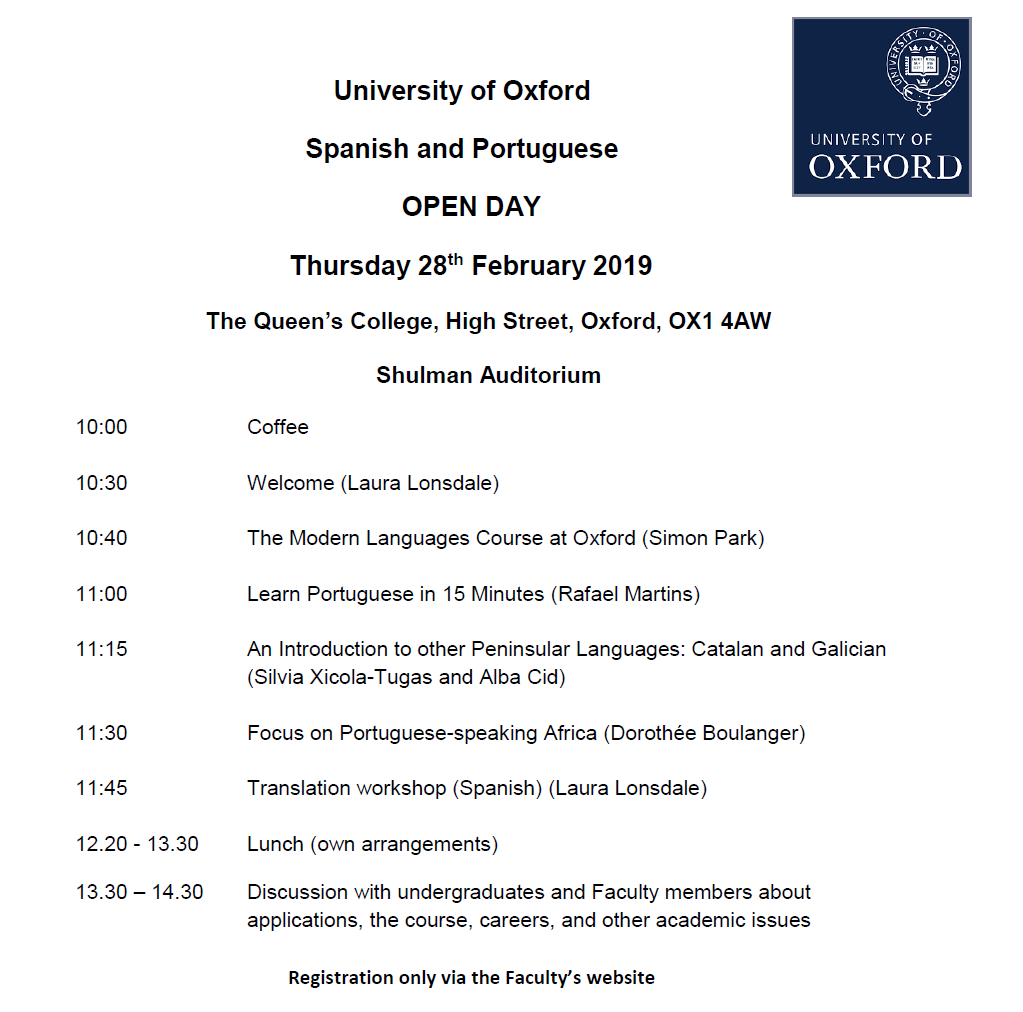
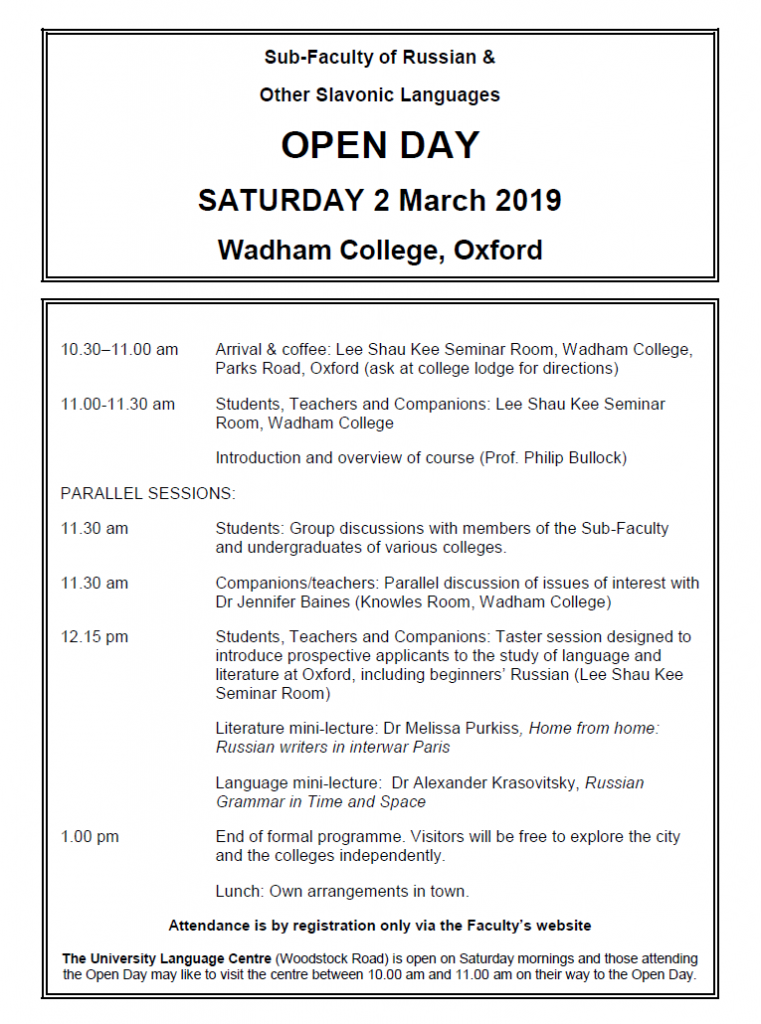
A couple of weeks ago, we posted about our upcoming German open day, a chance for you to learn about the German course at Oxford. This week, we continue the theme by bringing you news of our open days in Spanish and Portuguese (Thursday 28 February at The Queen’s College), and Russian and other Slavonic Languages (Saturday 2 March at Wadham College).
As with the German open day, these events are a fantastic opportunity for you to explore what an Oxford degree in those languages looks like. They offer a mixture of academic tasters so you can get a feel for the content of the degree, information about applying to Oxford, and interactions with tutors and current students, who will be happy to answer any questions you have about languages at Oxford.
Highlights of the Spanish and Portuguese open day include: an introduction to Portuguese in 15 minutes, an introduction to other peninsular languages (Catalan and Galician – for more on Galician, see our post here); a spotlight on Portuguese-speaking Africa; and a Spanish Translation workshop.
Highlights of the open day in Russian and other Slavonic Languages include: a mini lecture on ‘Home from home: Russian writers in interwar Paris’; a mini lecture on ‘Russian Grammar in Time and Space’; and a parallel discussion for parents and teachers.
The open days are open to anyone in Year 12 who is interested in studying those languages at Oxford, including if you are interested in picking up the language from scratch (with the exception of Spanish, which we do not offer from scratch). Sessions will be suitable for learners who have no prior knowledge of the language, as well as those hoping to apply post-A Level. There are a limited number of places for accompanying parents and teachers. The events are free of charge but a place must be booked through the faculty’s website.
The full programmes are below, or available to view at https://www.mod-langs.ox.ac.uk/schools/meet-us
This year, instead of our usual French Film competition, we will be running a Flash Fiction Competition in both French and Spanish. If you are in Years 7-13, you are invited to send us a very short story to be in with a chance of winning up to £100. Read on to find out more…
What is Flash Fiction?
We’re looking for a complete story, written in French or Spanish, using NO MORE THAN 100 WORDS.
How short can it be?
Well, candidates for the World’s Shortest Story include a six-word story in English by Ernest Hemingway:
‘For sale: baby shoes, never worn.’
Or a seven-word story in Spanish by Augusto Monterroso, called El dinosaurio:
‘Cuando despertó, el dinosaurio todavía estaba allí.’
You don’t have to be as brief as that, but anything from six to a hundred words will do. Just not a single word more.

What are the judges looking for?
We’ll be looking for imagination and creativity, as well as your ability to write in French or Spanish. Your use of French or Spanish will be considered in the context of your age and year group: in other words, we will not expect younger pupils to compete against older pupils linguistically.
What do I win?
There are two categories: Years 7-11 and Years 12-13. A first prize of £100 will be awarded to the winning entry in each category, with runner-up prizes of £25. The winning entries will be published on our website.
How do I enter?
The deadline for submissions is noon on Sunday 31st March 2019.
If you would like to submit a story in French please do so via our online sumission portal here.
If you would like to submit a story in Spanish please do so here.
You may only submit one story per language but you are welcome to submit one story in French AND one story in Spanish if you would like to. Your submission should be uploaded as a Word document or pdf.
The online page will ask you to fill in some details, which are used for the purpose of administering our outreach activity. To understand how your data is used for this purpose, please read the Privacy Policy.
You will then be sent an automated email (check your spam folder if you can’t find this), which will include a link to validate your email address. Please click this link, which will take you to the Modern Languages Faculty website (you will be given an option to sign up to the newsletter. You do not have to sign up to the newsletter in order to enter the competition, although you are welcome to do so). Once you have clicked the confirmation link in the email, your entry has been submitted.
If you have any questions, please email us at schools.liaison@mod-langs.ox.ac.uk
This week we are delighted to showcase the winning entry in the Year 12-13 category of our 2018 Spanish Flash Fiction Competition. This story comes from Charlotte Collerton and is a poignant evocation of familial relations across generations, told in a simple but graceful style. The judges were impressed by Charlotte’s excellent command of idiomatic Spanish, but also her poetic sense of rhythm that permeates both the form (vocabulary and sentence structure) and the content of the text (the action of knitting, the rhythm of seasons and sequence of generations).
¡ Felicidades, Charlotte!
Las bufandas
Ella empezó tejer la primera bufanda hace cuarenta años cuando estaba embarazada de su primer hijo. El invierno era constante y la bufanda se convirtió en manta para el bebé.
Ella tenía siete hijos y cada bebé tenía su propia bufanda como una manta para proteger de los inviernos atroces.
Con los años los bebés crecían y ellos creaban la próxima generación y las agujas de tricotar se reanimaban de nuevo.
Cuando ella colgó el guante la familia recogió todas las bufandas y cosió un chal de cada uno. El invierno era impotente contra la tibieza en su ataúd.
Photo by Philip Estrada on Unsplash
The Scarves
She started knitting the first scarf forty years ago when she was pregnant with her first child. Winter was constant and the scarf became a blanket for the baby.
She had seven children and each baby had her own scarf as a blanket to protect it from the severe winters.
Over the years the babies grew and they created the next generation, and the knitting needles were revived again.
When she passed away, the family gathered all the scarves and sewed a shawl from each one. Winter was powerless against the warmth of her coffin.
This year’s Spanish Flash Fiction Competition ran from December to March and received almost 400 entries. We were amazed at the entrants’ command of, and enthusiasm for, Spanish, and the imagination and grasp of narrative techniques evident in the submissions. Stories ranged from a tale about a vegetarian lion to one about a zombie Christmas. We would like to thank everyone who submitted an entry. The judges were throughly entertained, and choosing the winners was no easy task. Congratulations to the winners below and, to everyone who took part – please do continue to use your languages creatively!
Years 7-11 Category
The winner for this category was “Traición?” by Ivo Reeve. Besides the author’s excellent command of Spanish, we were especially impressed by how well wrought the text is: how Ivo managed to balance poetic language with military description. All of that in a piece of veritable historical flash fiction. We also want to commend the two runners-up for this category: “El monstruo brillante” by Chloe Cheng and “No la sorprendió cuando vinieron…” by Elizabeth McDonald, who both showcased excellent command of Spanish and true literary sensitivity. Finally, we want to give an honorary mention to Savannah Culpepper’s piece, “Una noche, Jesús y yo…”, for its deft use of humour and ingenuity.
Years 12-13 Category
The first prize in this category goes to “Las bufandas” by Charlotte Collerton (Year 12), a seemingly simple yet powerful and tender story. We would like to congratulate Charlotte for her excellent command of idiomatic Spanish, but also her poetic sense of rhythm that permeates both the form (vocabulary and sentence structure) and the content of the text (the action of knitting, the rhythm of seasons and sequence of generations). There was one close runner-up: “El día que lo tosió…” by Hannah Corsini (Year 12), which truly impressed us with her originality and her use of bold yet successful metaphors. The text itself, which describes sickness through literary terms and references, made us think of a Quixotic “literary sickness” or “literatosis”, as it were: seeing everything in the world through the lens of literature (we are afraid to report no cure has been found against this “terrible disease” yet…). Lastly, we would like to give an honorary mention to two entries: “El francotirador” by Jacob Murray (Year 12) and “El estimado rey” by Oliver Pearey (Year 12) for their underlying philosophical message and their successful use of narrative tension in such brief texts, including a final plot twist that leaves readers pondering and quesstioning their own assumptions.
We hope to feature some of the winning entries on this blog in the coming weeks. ¡ Felicidades !
In May The Oxford Centre for Comparative Criticism and Translation, and St Anne’s College hosted a discussion between two of the best-known novelists writing in Spanish today, Javier Cercas and Juan Gabriel Vásquez. Beginning as an introduction to their recent publications, the conversation evolved into an exciting reflection on the role of storytelling in a post-truth age…
Javier Cercas at the Gothenburg Book Fair 2014. Photo by Albin Olsson, from Wikimedia Commons
Javier Cercas gave an insight into his 2014 novel, El Impostor (The Impostor), which tells the story of Enric Marco Battle, a trade unionist who became famous in Spain as a survivor of the concentration camps Mauthausen and Flossenbürg. Battle became a spokesperson for Spanish survivors of the Holocaust and was a prominent voice against Fascism. However, in 2005 it was revealed that Battle had deceived the public about his experience of the war and had never been held in a concentration camp. He was, in effect, an impostor.
Vásquez introduced his 2015 novel, La forma de las ruinas (The Shape of the Ruins), which traces two political assassinations in Colombia’s history: that of General Rafael Uribe Uribe, a senator and civil war veteran killed in 1914; and that of Jorge Eliécer Gaitán, a leader of the Liberal party and presidential candidate at the time of his murder in 1948. Vásquez’s novel includes a character called Carlos Carballo, a conspiracy theorist who believes the two crimes are linked, not only to one another, but also to the assassinations of John and Robert Kennedy.
Juan Gabriel Vásquez at the Hay Festival 2016. Photo by Andrew Lih (User:Fuzheado), from Wikimedia Commons
Both novels, then, might to some degree be considered historical fiction, taking their storylines from history but marrying this with the imagination to create a version of the past that is closer to what we might expect from fiction. However, the two writers use their novels to problematise this genre, questioning the role fiction can play in an era of alternative facts.
The writers consider the figure of the fantasist, asking what motivates a fantasist to invent alternative scenarios and why such figures are believed. This begs the question, is the novelist a kind of fantasist? And if you can have a factual novel, what is it that makes it a novel, a work of the imagination?
Vásquez suggests that fantasists are fascinated by stories, by creating narrative out of the past as a way to meet their personal objectives. They are detectives of a kind, and the novel is a means of probing reality and humanity. As Ford Madox Ford said, the novel is a ‘medium of profoundly serious investigation into the human case.’ Cercas, meanwhile, draws a distinction between the different fantasists presented in the two novels: on the one hand, Battle, who distorts history to amplify or falsify his own role within it; on the other, Carballo, who cannot accept that history doesn’t make sense and is ‘a tale told by an idiot, full of sound and fury, signifying nothing’ (a reference to Shakespeare’s Macbeth), and therefore looks endlessly for connections in an effort to find the meaning in history.
What do both fantasists tell us about our relationship to narratives of the past though? Perhaps that history becomes more palatable when it is presented in the form of a story. Between the lack of a story and a lie, we prefer the lie and, to go a step further, when we are dealing with the worst elements of history, we try to mask it with narrative.It is for this reason, Cercas suggests, that General Charles de Gaulle aimed to convince French people that they had all been ‘résistants’ during the war, for, he said, ‘Les Français n’ont pas besoin de la vérité’ [French people do not need the truth].
In the current climate, we find other words for lying, referring to distortions of the truth as ‘alternative facts’. Social media allows us to create alternative chains of events and, for the first time, we have the impression of being able to choose the version of reality we want to hear. Consequently, people who are adept at manipulating storytelling have power. Vásquez points out that the German writer and philosopher Novalis asserted that ‘novels arise out of the shortcomings of history.’ The novel goes where history cannot, reframing history as a narrative that can be edited, manipulated, and used to dominate the political moment. This is because, in the words of the poet T. S. Eliot, ‘humankind cannot bear very much reality.’
It seems, therefore, that our present moment is defined by narratology, by storytelling. What do you think – are we facing a battle for the story?
This post was written by Hector Stinton, a third-year Spanish & French student at Keble College.
As an undergraduate reading French and Spanish, I have chosen to spend my year abroad working in Santiago de Chile (August 2017 – June 2018) and Paris (July – September 2018) as a British Council English teacher and Assistant Film Producer, respectively. In the summer before starting the Spanish half of my year, I set myself three main objectives: to enhance my understanding of Hispanic culture, to improve my Spanish, and to challenge myself professionally.
Being embedded in life and work in Chile has given me great insight into Latin culture. For example, in England, flying or wearing our flag is uncommon and has nationalistic associations, even on St George’s Day; whereas in Chile, La Estrella solitaria is seen far more frequently, especially on Independence Day in September. Dig a little deeper, however, and you find that it is still a legal obligation, though rarely enforced, to fly a flag from every house or tower block – a hangover in the constitution written by Pinochet, demonstrating his pervasive legacy. At the other end of the spectrum, and typifying the wry sense of humour, the beverage of choice – a litre of sweet fermented wine with pineapple ice-cream – is called a terremoto (‘earthquake’), despite the fact that tremors regularly raze towns and villages, and have left the capital without any pre-modern architecture.
It is said that if you can speak Castilian in Chile, you can speak it anywhere in the world, since Chilean Spanish has a fearsome reputation for its thick accent, fast delivery, and plethora of peculiar idioms and neologisms, known as chilenismos. Separated from Peru and Bolivia by the Atacama Desert to the north, from Argentina by the Andes to the east, and surrounded by ocean to the south and west, Chile’s geography has seen its language develop hermetically. Even when Chile became more accessible, wars with her neighbours, and continuing mutual suspicion, have made the distinct speech a point of national pride. For this reason, Chilean vocabulary has been particularly enriched by its immigrant and native communities: ya (‘yeah’) from the German ja, ¿cachai? (‘you know?’) from the English ‘to catch one’s drift’, cancha (‘field’) from the Quechua kancha. The grammar, too, prefers the Italian ai or ei ending to the Iberian as or es when using the informal tu form in the present tense, and rejects completely the peninsular vosotros ‘you plural’. Acquiring all these subtleties, and many more besides, has made me a more complete linguist.
Professionally, working at the biggest language school in Santiago, the Instituto Chileno-Británico de Cultura, has presented its own set of challenges. On Friday evenings, I teach an advanced one-on-one student who happens to be the philosophy chair at the top university, and is preparing to deliver a series of lectures at Yale. A few hours later, on Saturday mornings, I go from feeling more like a tutorial student with the aforementioned academic, to helping a class of six-year-old girls colour and annotate big A3 sheets with titles like ‘My Zoo’ and ‘My Favourite Food’. ‘Variety’ is certainly the watchword at the ICBC, because every day I engage with and adapt to a huge range of different ages, backgrounds and abilities.
Thus far, I would go as far as to say I’m meeting or exceeding the objectives I set myself at the beginning of the year, thanks to an opportunity in Chile made possible by the British Council and Instituto Británico. Now I might even have time for some of my secondary objectives: learning to dance, learning to cook, and learning Portuguese…
A blog for school students and teachers and anyone else with an interest in Modern Languages and Cultures, written by the staff and students of Oxford University. Updated every Wednesday!
Data Protection: Like most websites, this site collects some user data in order to function properly.
In order to use this site we need you to consent to this by clicking I agree. I AcceptTell Me More
Privacy & Cookies Policy
Privacy Overview
This website uses cookies to improve your experience while you navigate through the website. Out of these, the cookies that are categorized as necessary are stored on your browser as they are essential for the working of basic functionalities of the website. We also use third-party cookies that help us analyze and understand how you use this website. These cookies will be stored in your browser only with your consent. You also have the option to opt-out of these cookies. But opting out of some of these cookies may affect your browsing experience.
Necessary cookies are absolutely essential for the website to function properly. This category only includes cookies that ensures basic functionalities and security features of the website. These cookies do not store any personal information.
Any cookies that may not be particularly necessary for the website to function and is used specifically to collect user personal data via analytics, ads, other embedded contents are termed as non-necessary cookies. It is mandatory to procure user consent prior to running these cookies on your website.